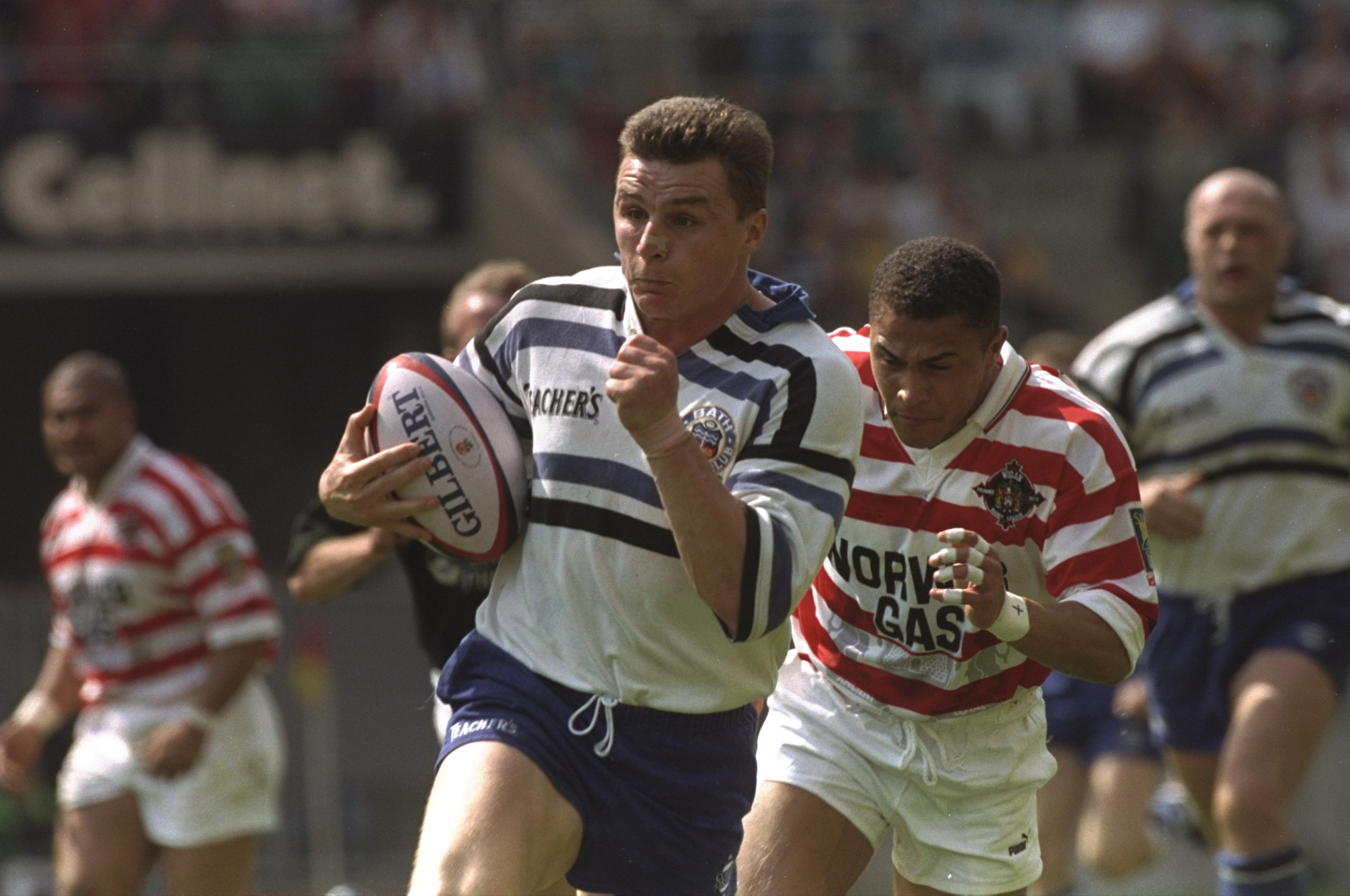
Thirty years ago, the landscape of rugby was undergoing a seismic shift. The barriers that had stood for over a century—walls built on the fundamental disagreement over player compensation—were beginning to crumble. In the spring of 1996, those barriers were tested not just in theory, but in a high-profile, two-legged experimental series that would become etched in sporting folklore: the Clash of the Codes.
It was a moment of profound transition. Rugby union, long the bastion of amateurism, was finally embracing the professional era. Simultaneously, rugby league, which had pioneered professionalism decades earlier, stood as the dominant force of its code. When the reigning giants of both worlds—Bath FC and Wigan RLFC—agreed to meet, it wasn’t just a series of matches; it was a collision of philosophies, rules, and histories.
As we look back three decades later, the Clash of the Codes serves as a fascinating time capsule of a sport in flux. It was a period of immense uncertainty and excitement, where the question wasn’t just who would win on the pitch, but what the future of rugby would look like once the codes finally began to converge.
The Great Schism: A Century of Divided Rugby
To understand the significance of the 1996 series, one must first understand the “Great Schism” that had defined the sport since 1895. For over a hundred years, the rugby world had been bifurcated. The split originated in the North of England, where a group of clubs broke away from the governing Rugby Football Union (RFU) over the contentious issue of “broken time” payments—compensation for players who were unable to play due to work commitments.
This breakaway led to the formation of the Northern Rugby Football Union, which would eventually evolve into the Rugby Football League. This division created two distinct disciplines: rugby union, which remained strictly amateur for another century, and rugby league, which embraced a professional model. The two codes developed different rules, different rhythms, and, most importantly, different social identities.
By the mid-1990s, however, the amateur status of rugby union was becoming unsustainable in the face of a modernizing sporting world. In August 1995, the International Rugby Board (IRB) made the historic announcement that rugby union would become an “open” game. This decision effectively ended the prohibition on player payments and signaled the beginning of the professional era for union, bringing it closer to the reality rugby league had inhabited for generations.
The 1996 Showdown: Two Matches, Two Laws
In January 1996, following the liberalization of union rules, an announcement was made that would capture the imagination of fans globally. Bath FC, then the dominant force in English rugby union, and Wigan RLFC, the powerhouse of rugby league, would engage in a two-game, cross-code challenge series. The premise was as simple as it was complex: each club would play one match under the laws of the other code.

While the series was a massive talking point, it did not receive universal acclaim. The series met with what was described as lukewarm support from the established governing bodies, the Rugby Football Union and the Rugby Football League. There were concerns about the integrity of the codes and the potential for injury or confusion, but the spectacle of the reigning champions meeting head-on was too significant to ignore.
Dominance at Maine Road
The first leg of the series took place on May 8, 1996, at Maine Road in Manchester. This match was contested under rugby league rules, a format that emphasizes speed, collision, and a continuous flow of play without the lineouts and scrums characteristic of union.
The result was a demonstration of the sheer power and clinical efficiency of the rugby league champions. Wigan RLFC delivered a masterclass in their own code, overwhelming Bath with a staggering 82–6 victory. The match, overseen by referee Russell Smith, drew an attendance of 20,148 spectators who witnessed the profound differences in tactical execution between the two disciplines when played under league laws.
The Twickenham Response
The second leg, held on May 25, 1996, offered a complete reversal of fortune. This match was played at the iconic Twickenham Stadium in London, and the rules were those of rugby union. For Bath, this was the opportunity to showcase the tactical intricacies and set-piece dominance that had made them the kings of the union code.
The atmosphere at Twickenham was significantly more electric than at Maine Road, with an attendance of 42,000 fans eager to see if the union giants could reclaim their pride. And they did. Bath FC played a disciplined and highly effective game, utilizing the nuances of union play to neutralize Wigan’s momentum. Bath secured a convincing 44–19 victory, proving that while the codes were different, the elite level of competition was remarkably high in both.
Legacy of a Cross-Code Experiment
The Clash of the Codes did not result in a unified code of rugby, nor did it merge the two sports. Instead, it served as a bridge between two eras. It was a celebration of the talent present in both disciplines and a recognition that the era of strict amateurism was officially over.

The series highlighted the distinct identities that both codes had cultivated during their century of separation. The sheer scoreline at Maine Road and the tactical battle at Twickenham provided a clear, if stark, comparison of how different rulesets shape the way athletes move, think, and compete. It remains a vital chapter in the history of rugby, marking the moment when the sport’s two halves finally acknowledged their shared future in the professional age.
Match Summary: Clash of the Codes 1996
| Feature | Match 1 (League Rules) | Match 2 (Union Rules) |
|---|---|---|
| Date | May 8, 1996 | May 25, 1996 |
| Venue | Maine Road, Manchester | Twickenham Stadium, London |
| Referee | Russell Smith | Brian Campsall |
| Attendance | 20,148 | 42,000 |
| Result | Wigan 82–6 Bath | Bath 44–19 Wigan |
As rugby continues to evolve in the 21st century, the lessons of 1996 remain relevant. The series was a testament to the courage of clubs willing to step outside their comfort zones and a reminder that even the most deeply entrenched traditions can be transformed by the changing tides of professional sport.
What are your memories of the 1996 series? Do you think a cross-code match would hold the same weight in today’s era of highly specialized professional rugby? Let us know in the comments below and share this article with your fellow rugby enthusiasts.