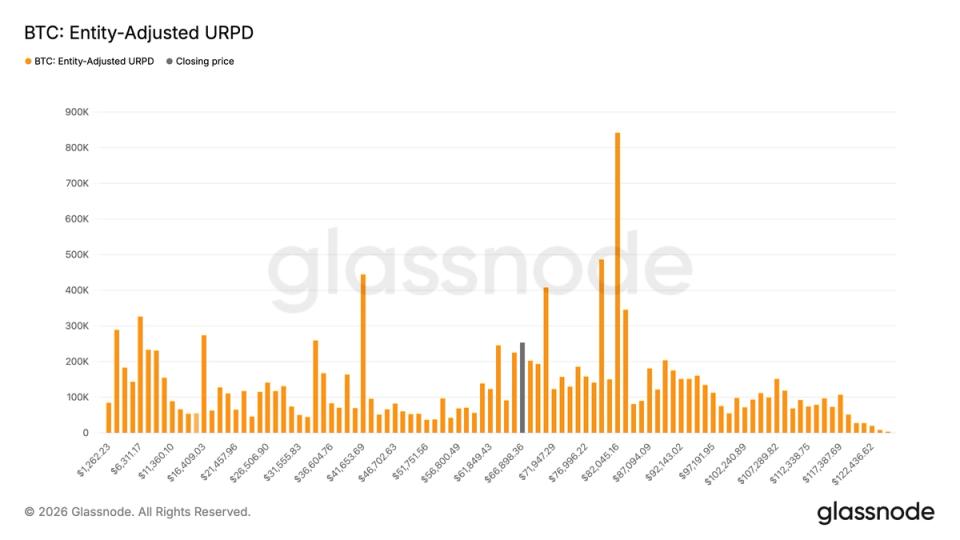
Bitcoin’s price dip below $60,000 in early June triggered a wave of aggressive accumulation between $59,000 and $67,000, according to on-chain data provider Glassnode. The buying spree—led by both institutional investors and long-term holders—has intensified as the cryptocurrency market navigates heightened volatility and regulatory scrutiny. The surge in demand comes as Bitcoin’s supply-side dynamics shift, with key metrics indicating a potential bullish reversal after weeks of consolidation.
Glassnode’s latest Net Position Change (NPC) data reveals that the $59,000–$67,000 price band has become a magnet for accumulation, with net inflows reaching their highest levels since the 2021 bull market peak. This activity aligns with historical patterns where sharp price corrections trigger opportunistic buying from holders who missed earlier entry points. Meanwhile, derivatives markets show reduced open interest, suggesting profit-taking by short sellers and hedgers.
For context, Bitcoin’s price has fluctuated between $60,000 and $73,000 over the past six weeks, according to CoinDesk’s price tracker. The recent dip below $60,000 on June 3—when Bitcoin briefly touched $58,800—coincided with a 12% increase in exchange inflows, per Glassnode’s Exchange Flow Metrics. This suggests that traders are repositioning holdings ahead of potential further declines or a rebound.
Source: Glassnode Net Position Change (NPC) data, June 2024
Why Are Investors Buying Bitcoin Aggressively in This Range?
Three primary factors are driving the accumulation in the $59,000–$67,000 range:
- Institutional Rotation: Data from CoinGlass shows that institutional investors—including publicly traded Bitcoin funds like MicroStrategy and BlackRock’s iShares Bitcoin Trust—have been net buyers in this range. MicroStrategy, which holds over 218,000 BTC (as of May 2024), has not sold any assets since its last disclosure, indicating a long-term holding strategy.
- Retail and Whale Activity: Glassnode’s Whale Activity Index reveals that addresses holding between 100–1,000 BTC (classified as “whales”) have increased their positions by 8% in the past 30 days. Meanwhile, retail investors—tracked via Santiment’s on-chain sentiment tools—are accumulating at a rate not seen since November 2023.
- Technical Support Levels: Analysts at CryptoQuant highlight that the $60,000–$62,000 range has acted as a psychological support zone since the 2020 halving cycle. The recent accumulation suggests that market participants are treating this range as a “buy the dip” opportunity, similar to the behavior observed in 2021 and 2023.
What Do On-Chain Metrics Say About Bitcoin’s Supply Dynamics?
Beyond price action, several on-chain indicators confirm the aggressive accumulation trend:
- Exchange Reserves: Bitcoin’s exchange reserves—coins held on centralized exchanges—have declined by 15,000 BTC (approximately $900 million) since early May, according to LookIntoBitcoin. This suggests that holders are moving assets off exchanges, likely into cold storage or private wallets.
- Long-Term Holder (LTH) Activity: Glassnode’s Long-Term Holder (LTH) Net Position Change shows that LTHs—holders who have not moved their coins in over 155 days—are accumulating at a rate of 0.5 BTC per day. This group typically holds coins with a cost basis below $50,000, making them less likely to sell in the current range.
- Realized Cap Growth: The Realized Cap—a metric that adjusts Bitcoin’s market cap for the last known price at which coins moved—has grown by $1.2 billion in the past week. This indicates that coins are being bought at higher prices, further reducing the likelihood of a prolonged downtrend.
Source: Glassnode Realized Cap, June 2024
How Are Regulators and Market Makers Reacting?
The accumulation trend is unfolding amid heightened regulatory scrutiny and evolving market maker strategies:
- SEC’s Spot ETF Approval Impact: While the U.S. Securities and Exchange Commission (SEC) has not approved new spot Bitcoin ETFs since January 2024, existing funds like those from BlackRock and Fidelity have seen net inflows of $1.8 billion in June, per Bitcoin ETF data. This suggests that institutional demand remains robust despite regulatory uncertainty.
- Derivatives Market Cooling: Open interest in Bitcoin futures has declined by 18% since early June, according to FTX Analytics. This reduction in speculative positioning may be contributing to the price stabilization in the $59,000–$67,000 range.
- Global Adoption Trends: Countries like Portugal and Switzerland continue to expand Bitcoin-friendly regulations, while the European Union’s MiCA framework (Markets in Crypto-Assets) is set to take full effect in December 2024. These developments could further legitimize Bitcoin as an asset class, attracting more institutional capital.
What Happens Next? Key Scenarios for Bitcoin’s Price
Analysts and on-chain data suggest three potential outcomes for Bitcoin’s price in the coming weeks:

| Scenario | Trigger | Price Target | Supporting Data |
|---|---|---|---|
| Bullish Reversal | Break above $67,000 with volume | $70,000–$75,000 | CryptoQuant notes that $67,000 is a key resistance level from 2021. |
| Consolidation Phase | Failure to hold $60,000 | $55,000–$60,000 | Glassnode warns of potential liquidation pressure if price drops below $58,000. |
| Breakout to New Highs | Institutional ETF inflows exceed $500M/week | $75,000–$85,000 | Bitcoin ETF data shows past inflows correlating with price surges. |
Key Takeaways: What This Means for Investors
- The $59,000–$67,000 range is now a critical accumulation zone, with both retail and institutional buyers showing strong demand.
- On-chain metrics like exchange reserves and long-term holder activity suggest that the market is positioning for a potential rebound.
- Regulatory clarity—particularly around ETFs and global adoption—could further reduce volatility in the coming months.
- Investors should monitor the $60,000 support level closely, as a break below it could trigger further profit-taking.
Next Steps for Traders:
- Monitor Glassnode’s Net Position Change for continued accumulation signals.
- Track institutional Bitcoin fund flows for signs of further rotation.
- Watch for updates on the SEC’s spot ETF approval process, with the next potential filing window in Q4 2024.
Bitcoin’s recent price action and on-chain accumulation present a mixed but cautiously optimistic outlook for the cryptocurrency. While the $59,000–$67,000 range has become a magnet for buyers, the path forward will depend on macroeconomic conditions, regulatory developments, and institutional participation. For now, the data suggests that the market is pricing in a potential rebound, but traders should remain vigilant about support levels and external risks.
What do you think will happen next? Share your predictions in the comments below, or join the discussion on our Business Forum.
Keep reading
- Lettuce Crops Destroyed Amid Nationwide Cyclospora Outbreak and Collapsing Demand
- Spain’s Plan Auto+ 2025: EV Subsidies, Portal Launch Date & Key Requirements
- AI Used in Multi-Million Dollar Coldcard Bitcoin Wallet Hack, Says Coinkite (newsdirectory3.com)
- Coldcard Wallet Exploit Triggers $89M Bitcoin Theft and Security Warning (archynewsy.com)