Gravitational Waves Confirm Einstein’s “No-Hair” Theorem and Hawking’s Area theorem with Unprecedented Detail
Recent observations of gravitational waves have provided compelling new evidence supporting two fundamental theorems in black hole physics: the ”no-hair” theorem and hawking’s area theorem. These confirmations, stemming from the analysis of a particularly strong signal designated GW250114, represent a significant leap forward in our understanding of these enigmatic cosmic objects.
Unveiling the Secrets of Black Hole Mergers
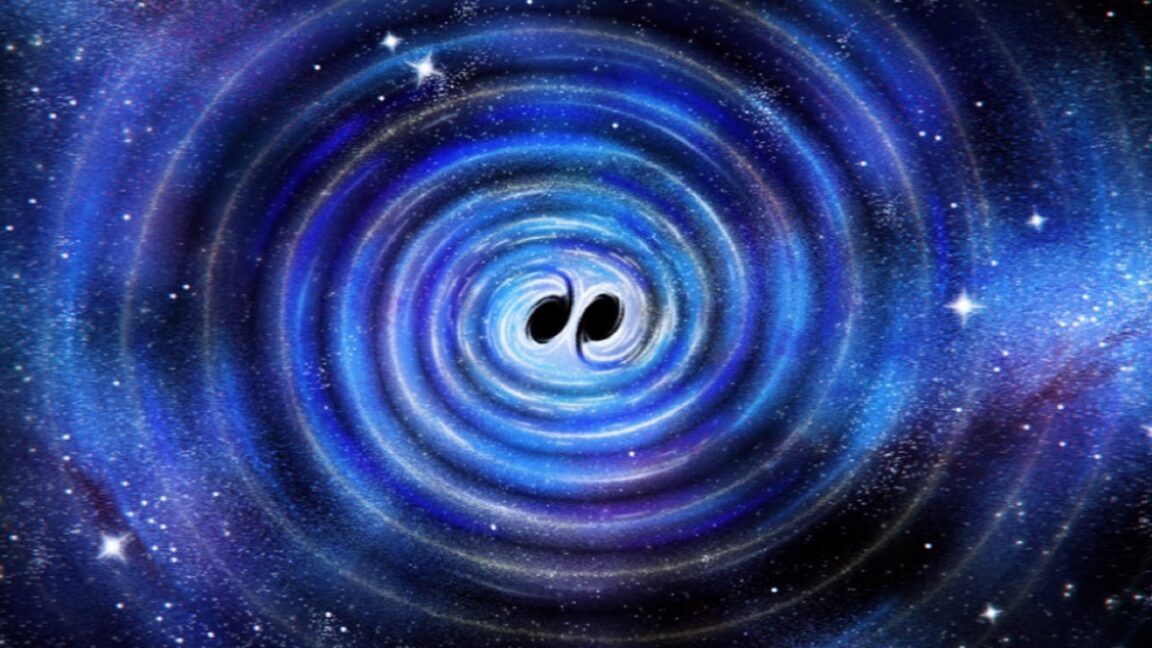
Gravitational waves, ripples in spacetime predicted by Albert Einstein, offer a unique window into the universe’s most extreme events. When black holes collide and merge, they generate these waves, carrying information about the black holes’ mass, spin, and other properties.
The GW250114 event, detected in January 2025, was exceptionally clear.It allowed physicists to observe the gravitational wave signal with unprecedented detail both before and after the merger. This clarity is crucial for testing theoretical predictions about black hole behavior.
The “No-Hair” Theorem Reaffirmed
The “no-hair” theorem posits that black holes are remarkably simple objects, fully described by only three properties: mass, electric charge, and angular momentum (spin). Essentially, all other information about the matter that formed the black hole is “lost” beyond it’s event horizon.
This latest analysis strongly reinforces the 2019 findings that support this theorem. The GW250114 data demonstrates that the resulting black hole after the merger was consistent with predictions based solely on its mass and spin, showing no evidence of additional “hair” or distinguishing characteristics.
Hawking’s Area Theorem Confirmed Again
Alongside the “no-hair” theorem,the observations also bolster earlier confirmations of Hawking’s area theorem. This theorem states that the total surface area of a black hole’s event horizon can never decrease over time.
Physicists calculated that the two initial black holes involved in GW250114 had a combined surface area roughly equivalent to the size of the United kingdom (approximately 240,000 square kilometers). Following the merger, the resulting black hole’s surface area expanded to about 400,000 square kilometers - comparable to the size of Sweden.
This increase in area, even for such massive objects, is a powerful exhibition of the theorem’s validity.
Implications for Quantum Gravity
The confirmation of Hawking’s area theorem carries profound implications beyond black hole physics. Stephen Hawking and Jacob Bekenstein demonstrated a connection between a black hole’s area and its entropy – a measure of disorder.
Since entropy must always increase according to the second law of thermodynamics, this link suggests a deep relationship between gravity, thermodynamics, and quantum mechanics. Understanding this connection is a key goal in the ongoing quest to develop a complete theory of quantum gravity.
As one physicist explained, the behavior of a black hole’s event horizon mirroring entropy is “really profound.” It suggests that black holes can be used as a mathematical tool to explore the fundamental nature of space and time.
A Legacy of Scientific Inquiry
The significance of these findings wasn’t lost on the scientific community. A prominent physicist recalled a conversation with the late Stephen Hawking, who eagerly anticipated the day gravitational wave observatories could test his theorem.He would have been thrilled to see the area of the merged black holes increase,confirming his predictions.
These observations represent not just a validation of existing theories, but a stepping stone toward unraveling the deepest mysteries of the universe. They highlight the power of gravitational wave astronomy to push the boundaries of our knowledge and reveal the hidden workings of the cosmos.
Further Research:
* DOI: 10.1103/kw5g-d732
Related reading