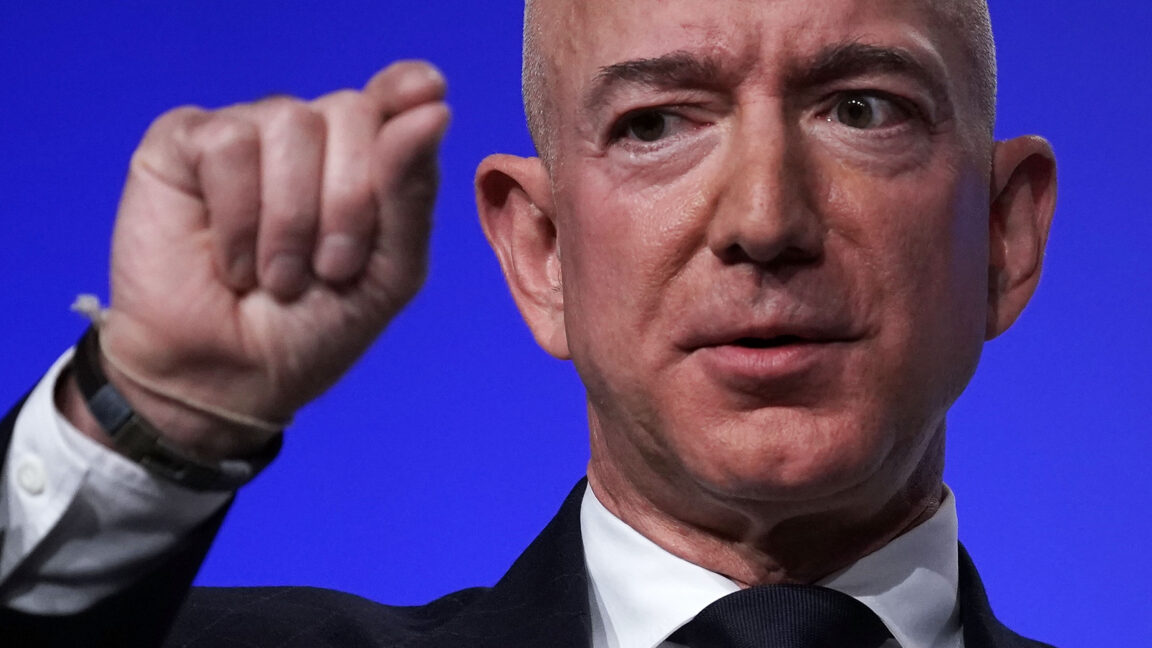
The space race is intensifying, and Blue Origin, Jeff Bezos’s space exploration company, is taking steps to bolster its financial standing in the face of fierce competition from SpaceX. Earlier this week, Blue Origin announced a modern stock option plan for its employees, a move widely interpreted as an attempt to retain talent and incentivize growth as the company navigates a challenging landscape. This comes as SpaceX prepares for a potential initial public offering (IPO) that could value the company at a staggering $1.5 trillion, significantly outpacing Blue Origin in terms of both revenue and market capitalization. The evolving dynamics between these two space industry giants are reshaping the future of space travel and technology development.
The details of Blue Origin’s new stock option plan remain limited. According to an email sent to employees by Dave Limp, Blue Origin’s CEO, the plan is designed to allow employees to benefit from the company’s future success. “As Blue achieves its goals and increase in value your equity will grow alongside it,” Limp wrote, offering little in the way of specifics. However, the timing of the announcement strongly suggests a response to the looming prospect of a SpaceX IPO and the potential for increased financial rewards for employees at Elon Musk’s company. The move underscores the growing pressure on Bezos to ensure Blue Origin remains competitive in attracting and retaining top engineering and scientific talent.
SpaceX’s Impending IPO and Valuation
SpaceX is poised to disrupt the financial markets with its anticipated IPO. While the exact valuation remains fluid, analysts predict the company could seek a valuation around $1.5 trillion, potentially raising between $30 billion and $50 billion in capital. This projection is based on SpaceX’s current estimated revenue of $22 billion to $24 billion in 2026, a figure that dwarfs Blue Origin’s estimated annual revenue, which is believed to be around $1 billion. Fortune reports that this influx of capital would provide SpaceX with substantial resources to accelerate development of key projects, including the Starship rocket, the Starlink satellite constellation, and advancements in artificial intelligence and orbital data centers.
The potential financial windfall for SpaceX is particularly significant given the ambitious scope of its projects. Starship, designed to be a fully reusable transportation system, is central to Musk’s vision of establishing a permanent human presence on Mars. Starlink, a rapidly expanding satellite internet constellation, aims to provide high-speed internet access to underserved areas globally. These ventures require massive investment, and an IPO would provide SpaceX with the financial flexibility to pursue them aggressively. The success of Starlink is particularly noteworthy. its rapid growth is already generating substantial revenue and positioning SpaceX as a major player in the telecommunications industry.
Blue Origin’s Strategic Position and Challenges
Jeff Bezos has also expressed interest in many of the same technologies as Musk, with Blue Origin pursuing its own initiatives in areas such as reusable rockets (New Glenn), lunar landers, satellite constellations (TeraWave), and space-based data centers. Ars Technica detailed Blue Origin’s plans for TeraWave, a proposed constellation intended to compete with Starlink. However, despite these ambitions, Blue Origin currently lacks the financial resources to match SpaceX’s scale and pace of innovation. While Bezos has personally invested heavily in Blue Origin, his contributions are increasingly dwarfed by SpaceX’s growing revenue stream and the potential capital injection from an IPO.
Until recently, Bezos was able to largely match SpaceX’s financial input through personal funding. Both companies boasted workforces exceeding 10,000 employees and pursued broad, long-term goals. However, the rapid advancement of Starlink and the impending IPO have created a significant disparity. SpaceX is now on a trajectory to abandon Blue Origin behind, not only in terms of revenue but also in overall financial strength. This widening gap raises the question of whether Bezos will consider seeking outside investment to maintain Blue Origin’s competitiveness.
The Question of Outside Investment
Historically, Bezos has been reluctant to relinquish control of Blue Origin by bringing in external investors. However, the changing dynamics of the space industry may force a reassessment of this strategy. Chris Davenport, author of Rocket Dreams, suggests that SpaceX’s success and the liquidity events associated with its IPO will put pressure on Bezos to at least consider outside investment. “He’s never really talked about going for outside investment,” Davenport stated. “The fact that Elon has had a number of liquidity events is going to put some pressure on Jeff and Blue Origin to at least think about it.”
The decision to seek outside investment would be a significant departure for Bezos, who has long maintained a tight grip on his companies. However, the stakes are high. If Blue Origin is to remain a major player in the space race, it may need to tap into external capital to fund its ambitious projects and compete with SpaceX’s growing financial muscle. The potential benefits of outside investment include access to additional funding, expertise, and strategic partnerships. However, it would also signify ceding some control over the company’s direction and decision-making processes.
The Broader Implications for the Space Industry
The competition between SpaceX and Blue Origin is not merely a battle between two companies; it represents a broader shift in the space industry. Traditionally dominated by government agencies and large defense contractors, the space sector is now witnessing the emergence of agile, privately funded companies that are driving innovation and lowering the cost of space access. SpaceX and Blue Origin are at the forefront of this transformation, pushing the boundaries of what is possible in space exploration and commercialization.
The success of SpaceX’s IPO could have a ripple effect throughout the industry, attracting further investment and encouraging other private companies to pursue ambitious space ventures. It could also accelerate the development of new technologies and business models, leading to a more vibrant and competitive space ecosystem. The race to colonize Mars, establish a sustainable presence on the Moon, and exploit the resources of space is well underway, and the outcome will likely be shaped by the strategic decisions made by companies like SpaceX and Blue Origin.
The new stock option plan at Blue Origin is a clear indication that the company recognizes the need to adapt to the changing landscape. Whether this will be enough to close the gap with SpaceX remains to be seen. The coming months will be crucial as SpaceX prepares for its IPO and Blue Origin navigates its own strategic challenges. The future of space exploration may well depend on the outcome of this high-stakes competition.
The next key event to watch will be the official filing for SpaceX’s IPO with the Securities and Exchange Commission (SEC). The filing will provide more detailed information about the company’s valuation, financial performance, and future plans. Readers interested in following these developments can find updates on the SEC website: https://www.sec.gov/. Share your thoughts on the future of space exploration in the comments below.
- Brandul de gaming Pulsar a lansat comercial un mouse care îţi răcoreşte palma (sesiunile lungi de jocuri vor fi astfel mai relaxante) – Gadget.ro
- Acho Estol y Josué Geredús: un disco nacido de la improvisación y sin fronteras musicales
- Investment Analysis: US and Iranian Stock Markets (world-today-news.com)