
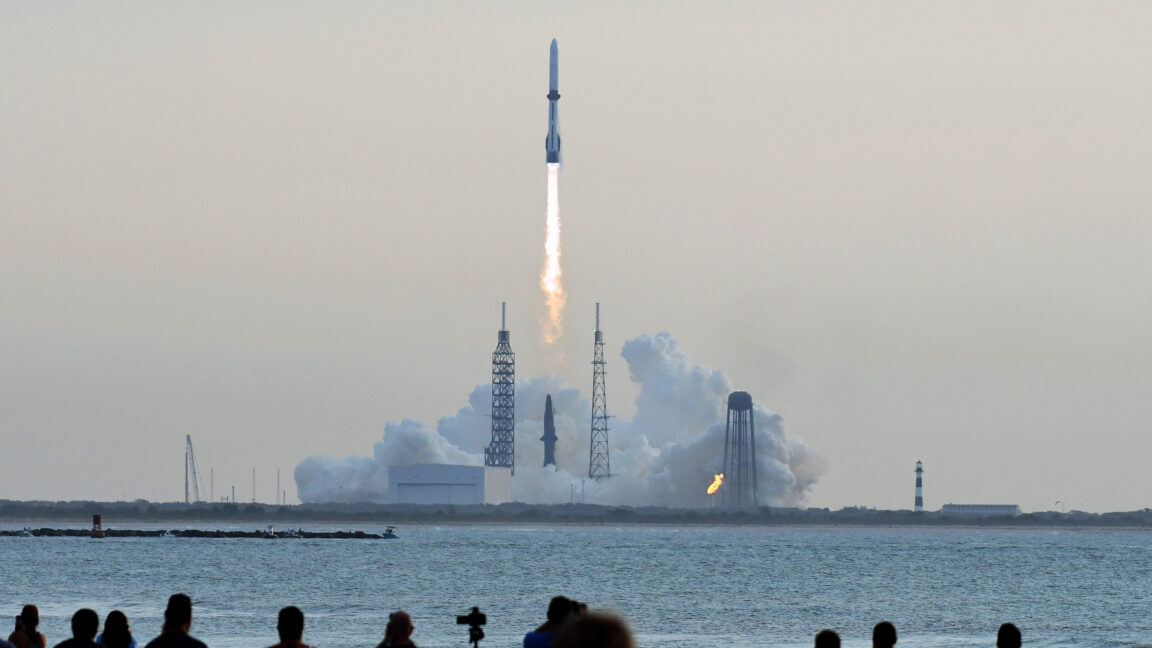
Blue Origin’s New Glenn rocket achieved a significant milestone on Sunday with the successful reflight of its first-stage booster, marking a key step forward in the company’s pursuit of reusable orbital launch systems. The heavy-lift vehicle lifted off from Cape Canaveral Space Force Station in Florida at 7:25 a.m. EDT, powered by seven BE-4 engines burning liquid methane and liquid oxygen. After approximately three minutes of flight, the booster separated as intended and began its descent back to Earth, whereas the upper stage continued onward with its mission.
Yet, the upper stage encountered an anomaly shortly after separation, preventing the vehicle from completing its planned trajectory. This setback tempered what was otherwise a historic achievement for Blue Origin: the first reflight of an orbital-class rocket booster, a capability long demonstrated by SpaceX but still emerging for other launch providers. The outcome underscores both the progress and persistent challenges in developing fully reusable launch systems capable of supporting ambitious national space goals.
The mission represents a critical development in NASA’s broader strategy to foster multiple commercial partners for deep space exploration, including lunar landings under the Artemis program. While New Glenn is not yet certified for crewed flights, its capacity to deliver large payloads to orbit positions it as a potential contributor to future logistics and infrastructure missions beyond low Earth orbit.
Reusability Milestone Amid Technical Hurdles
The successful recovery and reflight of the New Glenn booster validates years of engineering perform focused on withstanding the extreme stresses of launch, re-entry, and landing. Blue Origin has emphasized that reusability is central to reducing the cost per launch and increasing flight frequency — goals shared across the industry as demand for satellite constellations, scientific missions, and lunar logistics grows.
According to telemetry released by the company, the booster executed a controlled descent and landed vertically on its designated drone ship in the Atlantic Ocean, a maneuver requiring precise guidance, thermal protection, and engine reignition capabilities. This marked the second successful landing for a New Glenn booster and the first time one has flown a second mission, completing a full reusability cycle.
“Achieving booster reflight is a testament to the robustness of our design and the dedication of our teams,” said a Blue Origin spokesperson in a statement emailed to media outlets following the launch. “While we are disappointed by the upper stage anomaly, the data gathered will be invaluable as we work to improve reliability across the entire vehicle.”
The upper stage, powered by two BE-3U engines that burn liquid hydrogen and liquid oxygen, experienced an unexpected deviation in trajectory after separation. Independent tracking data from public space monitoring sources indicated the stage began to tumble shortly after engine ignition, preventing it from achieving a stable orbit. Neither Blue Origin nor launch range officials have publicly disclosed the root cause as of this writing, though both have confirmed that an investigation is underway.
Context Within the Commercial Launch Landscape
New Glenn is designed to compete in the heavy-lift launch category, capable of delivering up to 45 metric tons to low Earth orbit and potentially heavier payloads to higher energies with an optional third stage. Its seven-engine first stage uses the BE-4, a methane-fueled engine too selected by United Launch Alliance for its Vulcan Centaur rocket, highlighting growing industry interest in methane as a cleaner-burning, high-performance propellant.
The vehicle’s development has been closely watched due to its potential role in national security launches, scientific missions, and commercial satellite deployments. In 2023, NASA awarded Blue Origin a contract under the Human Landing System program to develop a lunar lander for Artemis missions, though that effort remains separate from New Glenn’s development.
Industry analysts note that successful reusability remains a key differentiator in launch market competitiveness. While SpaceX has flown numerous reused Falcon 9 and Falcon Heavy boosters, Blue Origin’s progress with New Glenn represents the most significant challenge to date from another entrant aiming to match that operational cadence.
“Reusability isn’t just about saving money — it’s about increasing access to space,” said Dr. Michelle Hanlon, co-director of the Center for Air and Space Law at the University of Mississippi, in a recent interview with SpaceNews. “Every successful reflight builds confidence in the system and moves us closer to routine, sustainable space operations.”
Implications for Artemis and Future Missions
Although New Glenn is not currently slated to launch crewed Orion spacecraft or lunar landers under Artemis, its capabilities align with NASA’s interest in acquiring reliable heavy-lift services for cargo delivery to lunar orbit or supporting surface infrastructure. The agency has emphasized a “multiple award” strategy to avoid over-reliance on any single provider, particularly as Artemis missions increase in frequency.
NASA officials have previously indicated that vehicles like New Glenn could support the delivery of habitat modules, power systems, or in-situ resource utilization equipment to the Moon — components essential for sustained presence. The rocket’s large fairing diameter (7 meters) allows it to accommodate bulky payloads that might not fit on smaller launchers.
Following the mission, NASA’s Kennedy Space Center issued a statement acknowledging the booster reflight as “an key step in advancing commercial space capabilities,” while noting that range operations remained unaffected by the upper stage anomaly. The Federal Aviation Administration, which oversees commercial launch licensing, confirmed that the flight proceeded under its existing permit and that no public safety concerns arose.
Looking ahead, Blue Origin has not announced a firm date for the next New Glenn flight but indicated that the investigation into the upper stage issue will inform upcoming modifications. The company continues to work toward achieving full certification for national security launches through the U.S. Space Force’s National Security Space Launch (NSSL) program, a process that requires multiple successful flights with demonstrated reliability.
What This Means for the Space Industry
The mixed outcome of this launch reflects the inherent difficulty of pushing the boundaries of aerospace engineering. While the booster’s success demonstrates progress in mastering re-entry and landing — phases once considered among the most risky — the upper stage issue highlights that reliability must be achieved across all systems for a launch vehicle to be considered truly operational.
For satellite operators and mission planners, the event serves as a reminder that emerging launch vehicles, even those with impressive capabilities, may still carry higher risk profiles than flight-proven systems. However, many in the industry view such setbacks as expected parts of the development cycle, particularly when attempting ambitious engineering feats like rapid reusability.
Supporters of commercial space growth argue that competition and innovation driven by companies like Blue Origin ultimately benefit the entire sector by lowering costs, increasing launch availability, and encouraging technological advancement. Critics, however, caution that premature reliance on unproven systems could jeopardize high-value missions if not paired with rigorous testing and redundancy.
As the investigation continues, stakeholders across government, industry, and academia will be watching closely to spot how Blue Origin responds. The ability to diagnose and correct flight anomalies quickly is often seen as a hallmark of mature aerospace organizations, and the company’s response will likely influence perceptions of its readiness for more demanding missions.
The next major milestone for New Glenn will be a successful flight in which both booster and upper stage perform as intended, culminating in payload delivery to orbit. Until then, each flight — whether fully successful or partially so — provides critical data that brings the vehicle closer to operational status.
For updates on the investigation and future launch schedules, readers can refer to Blue Origin’s official newsroom and the Federal Aviation Administration’s launch licensing portal.
We welcome your thoughts on this development. Share your perspective in the comments below and help foster an informed conversation about the future of space exploration.