
A critical security flaw in the Windows operating system has sent shockwaves through the cybersecurity community, as a functional zero-day exploit dubbed “BlueHammer” has been released publicly. The vulnerability potentially impacts more than 1 billion devices, granting attackers the highest level of system privileges—NT AUTHORITY\SYSTEM—without requiring a kernel bug or memory corruption potentially impacting 1 billion+ devices.
The exploit was made public on April 3, 2026, by a security researcher using the alias “Chaotic Eclipse,” who published the full proof-of-concept source code on GitHub released on April 3rd, 2026. Unlike typical vulnerability disclosures, this release was not coordinated with Microsoft, leaving users and organizations exposed while a formal patch remains unavailable.
The “BlueHammer” exploit is particularly dangerous because it does not rely on traditional software bugs. Instead, it leverages a sophisticated chain of legitimate Windows features—including the Microsoft Defender update workflow, the Volume Shadow Copy Service and the Windows Cloud Files API—to escalate a low-privileged local user to full system control exploits the Windows Defender update process.
As of April 9, 2026, no CVE (Common Vulnerabilities and Exposures) identifier has been assigned, and Microsoft has not yet released an official patch or specific mitigation guidance. The company’s public response has been limited to a statement confirming its support for coordinated vulnerability disclosure, a phrasing that highlights the contentious nature of this specific release Microsoft’s only public response.
How BlueHammer Turns Defender Against Itself
At its core, BlueHammer is a local privilege escalation (LPE) chain. In the world of cybersecurity, LPE occurs when an attacker, who already has limited access to a machine (such as a standard user account), finds a way to gain the permissions of a more powerful user or the system itself. In this case, the exploit targets the very tool designed to protect the system: Microsoft Defender.
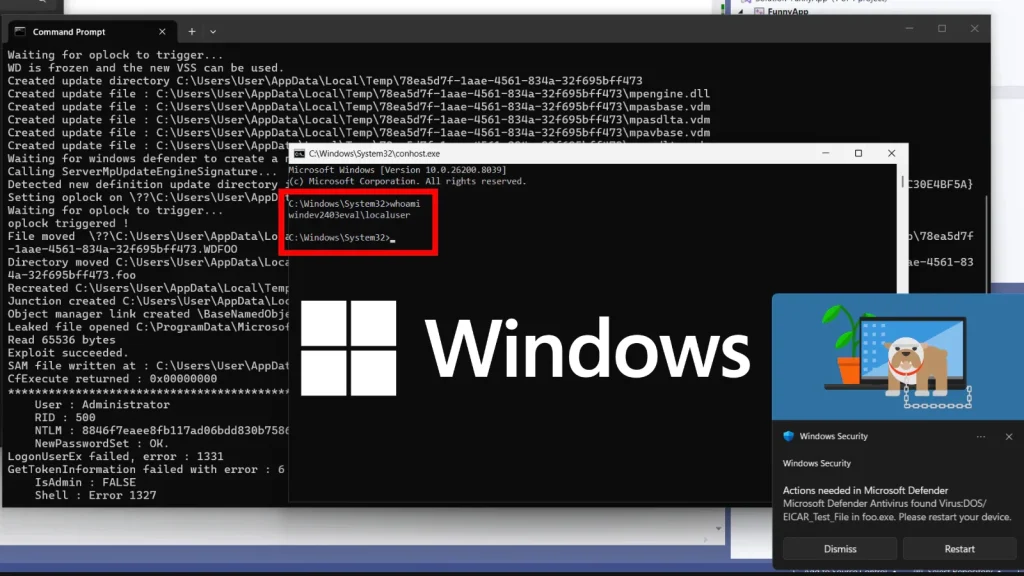
According to an analysis by Howler Cell, the exploit abuses the interaction between several documented Windows features. By manipulating the Volume Shadow Copy Service and opportunistic locks, the exploit disrupts the Defender update process to escalate privileges abuses the interaction between Microsoft Defender’s update workflow. Because it uses legitimate features working as designed, traditional security monitors may not flag the activity as malicious.
Further technical analysis from Red Packet Security confirms that the chain allows an attacker to leak the SAM (Security Account Manager) hive—the database that stores user passwords—and ultimately escalate to SYSTEM privileges abuses Microsoft Defender’s own signature update workflow to leak the SAM hive. This level of access allows an attacker to perform any action on the machine, including installing malware, stealing sensitive data, or disabling security software entirely.
Independent Validation and Reliability
The validity of the BlueHammer exploit has been independently confirmed by Will Dormann, a principal vulnerability analyst at Thartos independently confirmed to work by vulnerability researcher Will Dormann. This confirmation adds a layer of urgency to the situation, as it proves the GitHub code is functional and not a theoretical exercise.
However, the exploit is not currently perfect. The researcher, Chaotic Eclipse, has noted that bugs still exist in the released code, meaning it may not work reliably on every single single single system in its current form the author has stated bugs exist in the released code. Despite this, security experts warn that skilled threat actors—such as ransomware operators and access brokers—are highly likely to refine the code and integrate it into their toolkits within days of a public release.
The Fallout of Uncoordinated Disclosure
The release of BlueHammer was accompanied by a pointed message from Chaotic Eclipse to Microsoft’s Security Response Center (MSRC): “I was not bluffing Microsoft, and I’m doing it again” “I was not bluffing Microsoft, and I’m doing it again”. This suggests a breakdown in the communication between the researcher and the software giant.
Standard industry practice involves “coordinated disclosure,” where a researcher privately notifies a company of a bug and gives them a window of time (often 90 days) to develop a patch before the details are made public. In this instance, the researcher claims to have followed the standard process but grew frustrated with how the MSRC handled the report, leading to the decision to dump the code on GitHub researcher had previously disclosed the vulnerability to Microsoft’s Security Response Centre.
This “full disclosure” approach is controversial. While it puts immediate pressure on the vendor to fix the issue, it also provides a roadmap for cybercriminals to attack millions of unpatched systems. With over 1 billion devices potentially at risk, the window of vulnerability is significant.
Who Is at Risk?
Because BlueHammer is a local privilege escalation exploit, it cannot be used to take over a computer remotely over the internet by itself. An attacker must first gain a foothold on the target machine—perhaps through a phishing email, a malicious download, or by having physical access to the device. Once they are “inside” as a low-privileged user, they can use BlueHammer to seize total control of the operating system.
The primary targets for this type of exploit are typically:
- Corporate Environments: Where an attacker might compromise a low-level employee’s workstation and then use BlueHammer to move laterally through the network as a system administrator.
- Shared Computing: Systems where multiple users have accounts, allowing one user to escalate their privileges to spy on or control other users.
- High-Value Targets: Government or financial institutions where gaining SYSTEM-level access is the final step in a sophisticated data breach.
Key Takeaways for Security Teams
For IT professionals and security operations centers (SOCs), the current lack of a patch means they must rely on behavioral detection and monitoring. Since the exploit uses legitimate Windows APIs, signature-based antivirus may not detect the exploit itself, but the actions taken after escalation (such as dumping the SAM hive) often exit traces.
- Monitor for Unusual API Calls: Pay close attention to abnormal interactions involving the Volume Shadow Copy Service and the Windows Cloud Files API.
- Audit Privilege Changes: Monitor for unexpected transitions of low-privileged accounts to NT AUTHORITY\SYSTEM.
- Restrict Local Access: Ensure that the principle of least privilege is strictly enforced to limit the initial foothold an attacker can gain.
- Watch for Official Updates: Regularly check the Microsoft Security Update Guide for the eventual release of a CVE and a corresponding patch.
The current situation serves as a stark reminder of the fragility of the software supply chain and the tension between independent researchers and large tech corporations. As the industry waits for Microsoft to resolve the issue, the “BlueHammer” exploit remains a live threat to Windows users worldwide.
Microsoft has acknowledged the issue and stated it is investigating, but no official mitigation guidance has been published as of this writing Microsoft has acknowledged the issue and stated it is investigating. Users are encouraged to keep their systems updated and remain vigilant against phishing and suspicious software installations.
We will continue to monitor this story for the release of an official patch or CVE identifier from Microsoft. In the meantime, we invite our readers to share their thoughts or any observed anomalies in the comments section below.