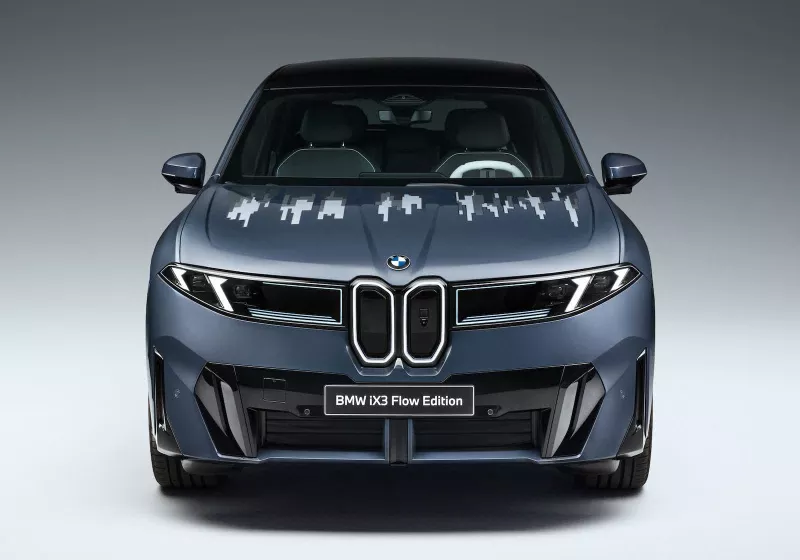
BMW has taken a significant step toward bringing color-changing vehicle technology into mainstream production with the unveiling of the iX3 Flow Edition at the 2026 Beijing Auto Display. This model marks the first series-ready automobile to feature E Ink Prism™ technology integrated directly into a large body panel—the vehicle’s hood—signaling a shift from experimental concepts to engineering-ready implementation.
The innovation builds on years of collaboration between BMW and E Ink, tracing back to the iX Flow concept debuted at CES 2022, which used electrophoretic foil to enable black-and-white color shifts across the vehicle’s surface. Subsequent iterations, including the i Vision Dee in 2023 with 32 true colors and the i5 Flow NOSTOKANA artistic collaboration, refined the technology’s potential for personalization and digital expression. The iX3 Flow Edition now represents the culmination of this progression, embedding E Ink’s electrophoretic system into the car’s structural design rather than applying it as an external layer.
According to the official announcement from E Ink and BMW, the technology embedded in the hood uses millions of microcapsules containing charged particles that respond to low-voltage electrical signals. This allows the surface to shift between visual states—such as displaying outlines of notable Chinese landmarks—with power consumed only during transitions, making it highly energy-efficient. The system has undergone BMW’s rigorous quality and durability testing to meet automotive engineering standards for everyday use, including resistance to environmental factors like temperature fluctuations and UV exposure.
The iX3 Flow Edition offers eight selectable animations accessible via a button interface, enabling drivers to change the hood’s appearance on demand. These animations were specifically designed to showcase cultural landmarks from China, aligning with the vehicle’s debut at the Beijing Auto Show. Unlike earlier prototypes that required hundreds of segmented E Ink panels to cover a vehicle’s surface, this version consolidates the technology into a single, large-area application on the hood, simplifying integration and improving visual continuity.
E Ink Prism™, the specific technology used in the iX3 Flow Edition, is adapted from the company’s widely known ePaper displays found in e-readers. However, its application in automotive contexts required significant engineering adaptation to withstand vibration, moisture, and long-term outdoor exposure. The collaboration highlights how electrophoretic technology—once limited to static signage and consumer devices—can be reimagined for dynamic, interactive surfaces in mobility design.
Industry analysts note that the move from concept to series-ready validation addresses a critical hurdle in bringing such innovations to market: scalability. By demonstrating that E Ink can be embedded within a vehicle’s structure and pass production-level validation, BMW and E Ink are laying groundwork for potential expansion to other body panels or vehicle models in future generations. The technology’s low power draw during static display—energy is only needed when changing images—also aligns with growing industry focus on energy efficiency in electric vehicles.
Even as the iX3 Flow Edition is not yet confirmed for mass production, its status as a “series-ready” model indicates it has cleared key feasibility and validation stages. This designation suggests the vehicle is positioned for potential limited-run or special-edition release, pending market feedback and further development. BMW has not announced pricing, production timelines, or regional availability for the model as of the Beijing Auto Show unveiling.
The broader implications of this technology extend beyond aesthetics. Dynamic surface capabilities could one day enable vehicles to communicate information—such as battery status, driving mode, or pedestrian warnings—through visual cues on the exterior. In adaptive driving scenarios, exterior color shifts might contribute to visibility or thermal regulation, though such applications remain exploratory and would require additional validation.
As automotive design increasingly intersects with digital interfaces and user personalization, technologies like E Ink Prism™ offer a path toward vehicles that can evolve their appearance over time without physical modifications. For consumers, this could imply greater longevity and customization potential. for manufacturers, it opens latest avenues for brand expression and software-defined features.
The BMW iX3 Flow Edition will be featured in post-show evaluations and technical reviews throughout 2026, with insights from the Beijing Auto Show informing future research into durable, scalable electrophoretic applications in transportation design. Official updates from BMW Group or E Ink regarding next steps will be shared through their respective investor relations and press channels.
For readers interested in following developments in automotive innovation, display technology, or sustainable design, staying tuned to official announcements from BMW Group and E Ink provides the most reliable source of verified information.
What are your thoughts on color-changing car technology? Would you choose a vehicle whose appearance you could shift with a button? Share your perspective in the comments below, and feel free to pass this article along to others interested in the future of automotive design.
Worth a look