
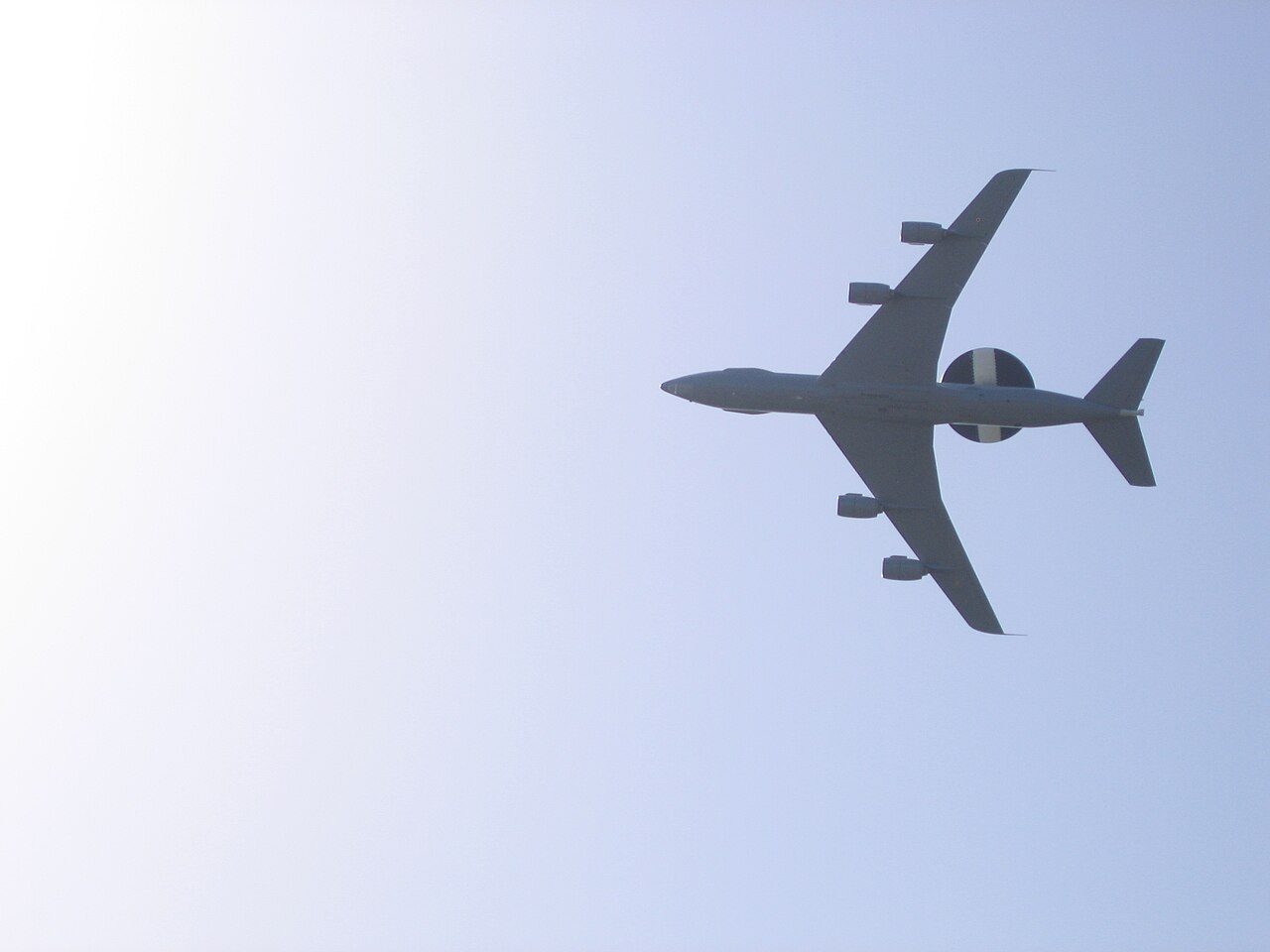
A Boeing E-3F Sentry, an Airborne Warning and Control System (AWACS) aircraft, conducted a sustained seven-hour surveillance mission over the Lyon region in France. Operated by the French Air and Space Force, the flight utilized the aircraft’s specialized radar to monitor civilian and military air traffic throughout the duration of its presence in the airspace.
The presence of the heavy military aircraft, characterized by its large rotating radar dome, drew attention from residents in the Lyon metropolitan area. While long-duration flights by military assets can cause public curiosity, these missions are standard components of regional airspace management and training protocols for the French Air and Space Force.
What is the Boeing E-3F Sentry?
The Boeing E-3F Sentry serves as a critical intelligence, surveillance, and reconnaissance (ISR) platform for the French military. Unlike standard transport or fighter aircraft, the E-3F is designed to function as a flying command center. Its primary tool is the Airborne Warning and Control System, which allows it to detect, track, and manage multiple aerial targets simultaneously.
The aircraft’s most distinctive feature is the rotodome mounted on top of the fuselage. This radar system scans 360 degrees, providing a comprehensive view of the surrounding airspace. According to technical specifications for the E-3 platform, the radar can distinguish between civilian airliners, military jets, and potential aerial threats, transmitting this data in real-time to ground stations and other combat units.
The “F” designation specifically identifies the variant utilized by France, adapted to meet the specific communication and operational requirements of the French Air and Space Force. These aircraft play a vital role in both national defense and NATO-led collective security operations, providing a high-altitude vantage point that ground-based radar cannot achieve due to the curvature of the Earth.
Why did the aircraft circle Lyon for seven hours?
Military aviation experts note that extended loitering patterns, such as the seven-hour flight observed over Lyon, typically serve one of three operational purposes: routine training, air policing, or specific surveillance tasks. While the French Air and Space Force does not always release specific mission details for active sorties, these flights are a regular part of maintaining pilot and crew proficiency.
Long-endurance missions allow crews to practice managing complex airspace environments. In a densely populated region like Lyon, which sits near major European flight corridors, practicing the coordination between military surveillance and civilian air traffic control is a standard training requirement. This ensures that the transition between routine civilian flight monitoring and emergency military response remains seamless.
Additionally, the E-3F Sentry is often deployed for “Air Policing” missions. These missions involve monitoring airspace to ensure compliance with national and international flight regulations. The seven-hour duration suggests a mission focused on endurance training or a wide-area surveillance sweep, rather than a rapid-response intercept, which would involve much shorter, high-speed flight profiles.
The role of surveillance in regional security
The ability to maintain a presence in the sky for several hours provides a continuous “eye in the sky.” This capability is essential for several security functions:

- Air Traffic Management: Assisting in the oversight of complex airspace transitions.
- Threat Detection: Identifying unidentified or non-responsive aircraft entering sovereign airspace.
- Command and Control: Acting as a relay for communication between ground-based command centers and active military assets.
- Training: Preparing crews for the logistical challenges of long-duration airborne operations.
Technical capabilities of the AWACS radar system
The effectiveness of the Boeing E-3F Sentry relies on its ability to process vast amounts of data. The radar system does not simply “see” objects; it categorizes them based on altitude, speed, heading, and transponder signals. This allows operators to maintain a clear distinction between a commercial flight on a standard approach to a nearby airport and a military aircraft conducting a maneuver.
The data processed by the E-3F is transmitted via secure data links. These links ensure that information reaches the appropriate authorities without delay. This real-time data stream is what makes the AWACS an indispensable tool for modern air defense, as it provides a layer of situational awareness that extends far beyond the range of traditional terrestrial radar installations.
The integration of these systems allows the French Air and Space Force to manage large-scale aerial operations with precision. Whether conducting a large-scale exercise or responding to a specific regional requirement, the E-3F provides the necessary data to prevent mid-air conflicts and maintain the integrity of the airspace.
Comparison of Airborne Surveillance Platforms
To understand the specific role of the E-3F Sentry, it is helpful to compare it to other types of surveillance assets used in modern aviation.
| Feature | Boeing E-3F Sentry (AWACS) | Unmanned Aerial Vehicles (UAVs) | Ground-Based Radar |
|---|---|---|---|
| Primary Role | Command, Control, and Surveillance | Long-endurance Reconnaissance | Fixed-point Air Defense |
| Endurance | High (Multi-hour manned flight) | Very High (Can fly for 24+ hours) | Continuous (Stationary) |
| Human Element | On-board crew for real-time decision making | Remote pilot via data link | Ground-based operators |
| Detection Range | Extensive (360-degree coverage) | Variable (Sensor dependent) | Limited by Earth’s curvature |
What happens next for regional airspace monitoring?
The presence of military aircraft in civilian airspace is a controlled and regulated occurrence. Following such missions, the French Air and Space Force typically conducts internal reviews of flight data and crew performance. These reviews are essential for refining the tactics used during long-endurance surveillance and ensuring that all mission objectives were met without disrupting civilian flight schedules.

For the public, these flights are a reminder of the ongoing maintenance required to secure European airspace. As military technology evolves, the French Air and Space Force continues to integrate new systems and training methods to address modern aerial challenges.
Key Takeaways:
- The aircraft seen over Lyon was a Boeing E-3F Sentry, a specialized military surveillance platform.
- A seven-hour flight duration is consistent with training, air policing, or endurance exercises.
- The aircraft uses advanced radar to monitor both civilian and military aircraft simultaneously.
- The French Air and Space Force operates these missions to maintain regional security and crew proficiency.
Official updates regarding military flight schedules or airspace notices are typically issued through the French aviation authorities or the Ministry of Armed Forces. No specific emergency or security incident has been reported in connection with this flight.
Have you observed military aircraft in your area? Share your observations and questions in the comments below.