
The Point of All Points: Exploring Borges’ The Aleph and the Quantum Universe
In a dim basement in Buenos Aires, a fictional narrator discovers a point in space that contains all other points. Anyone who gazes into it can see everything in the universe from every angle simultaneously, without distortion, overlapping, or confusion. This is the “Aleph,” the central conceit of Jorge Luis Borges’ 1945 short story, a literary device that compresses the infinite into the infinitesimal. For the casual reader, it is a surrealist masterpiece; for the physicist, it is a hauntingly accurate metaphor for the singularity that preceded the Big Bang.
As a technology editor with a background in computer science, I have always been fascinated by the intersection of information theory and physical reality. The Aleph is not merely a poetic invention; it is a conceptual precursor to how we understand the origin of our universe. In the realm of quantum cosmology, the idea that the entire complexity of the cosmos was once condensed into a single, dimensionless point is not a fantasy—it is the foundation of the Standard Model of cosmology.
The bridge between Borges’ Argentine surrealism and modern theoretical physics lies in the concept of the singularity. Whether we are discussing a literary point in a cellar or the gravitational singularity of a black hole, we are grappling with the same fundamental paradox: how can the infinite be contained within the finite? By examining the Aleph through the lens of quantum gravity and the Big Bang, we find a profound dialogue between the poet and the scientist regarding the nature of existence, information, and the architecture of space-time.
The Literary Singularity: Understanding Borges’ Aleph
Jorge Luis Borges, the Argentine master of labyrinths and mirrors, spent his career exploring the boundaries of human perception. In “The Aleph,” first published in September 1945 and later included in the 1949 collection The Aleph and Other Stories, Borges presents a point that defies Euclidean geometry. The Aleph is described as a “small iridescent sphere” that serves as a window to the entire universe. To look into it is to perceive the totality of time and space in a single, instantaneous flash.
This narrative device mirrors the mathematical concept of a point—something that has position but no magnitude. However, Borges imbues this point with an infinite capacity for information. This is where the story transitions from a mere curiosity to a philosophical inquiry. The narrator struggles to describe the Aleph because human language is sequential; we describe things one after another. But the Aleph is simultaneous. It is a “simultaneity” that breaks the linear flow of time and the spatial limitations of the human eye.
For Borges, the Aleph represents the ultimate archive. Throughout his works, Borges was obsessed with the idea of the “total library” or the “universal map”—the notion that there exists a system capable of containing all possible information. The Aleph is the physical manifestation of this obsession. It is the ultimate data compression algorithm, where the entire history and geography of the universe are stored in a single, infinitesimal coordinate.
The Cosmological Singularity: The Big Bang and the Beginning of Time
In the language of physics, the Aleph has a real-world counterpart: the initial singularity. According to the general theory of relativity, the universe began approximately 13.8 billion years ago from a state of nearly infinite density, and temperature. At this “t=0” moment, all the matter, energy, and space-time that currently make up the observable universe were compressed into a volume smaller than a single atom.
This cosmological singularity is the scientific Aleph. Just as Borges’ protagonist sees the entire universe within a small sphere in a basement, the Big Bang theory posits that every galaxy, every star, and every single photon we observe today was once contained within that primordial point. The expansion of the universe is, the “unfolding” of the Aleph. The singularity did not exist in space; it was space, containing all potential coordinates of the future cosmos.
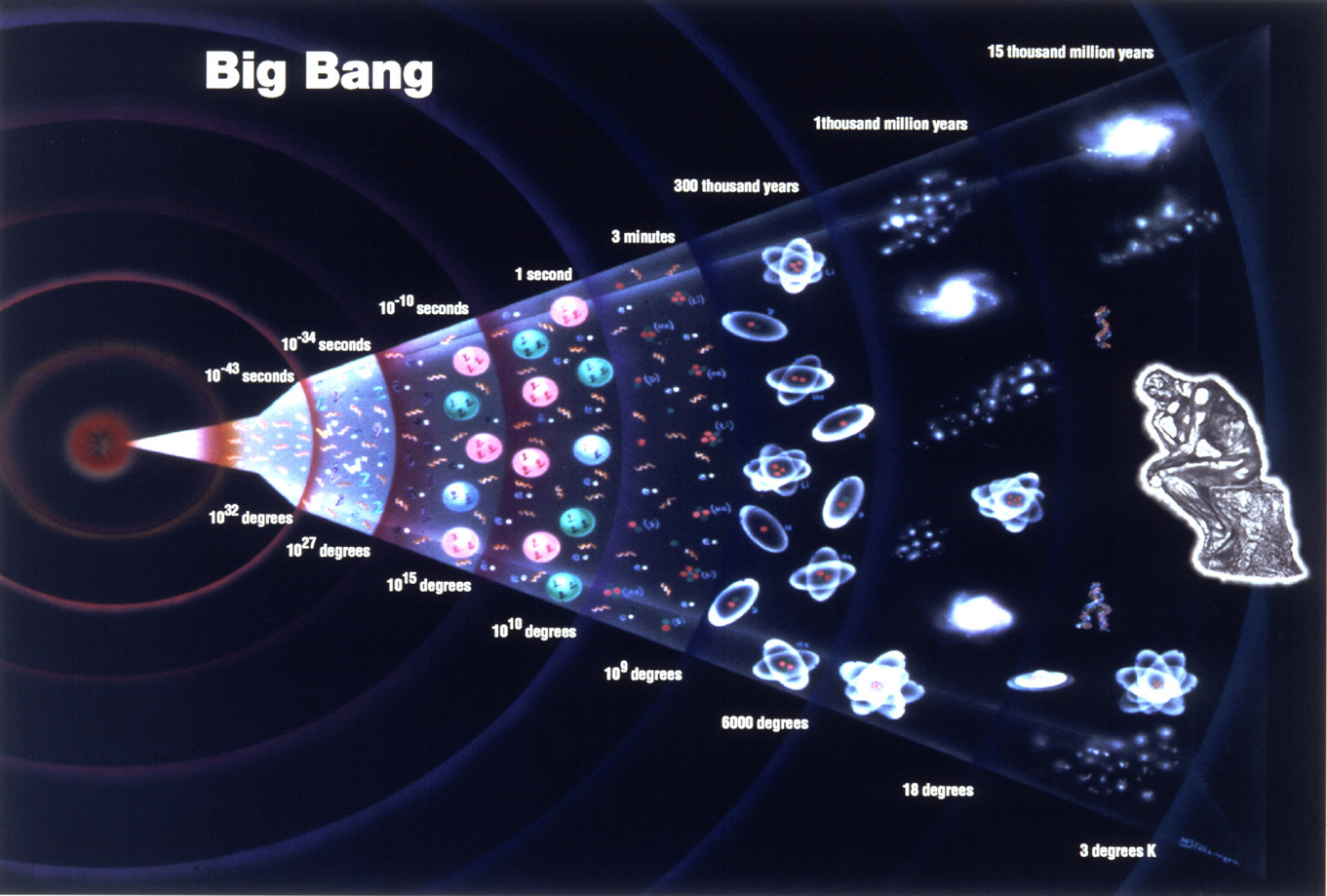
However, the singularity is also where our current understanding of physics breaks down. General relativity, which governs the macro-scale of gravity and space-time, and quantum mechanics, which governs the micro-scale of subatomic particles, are fundamentally incompatible at the point of the Big Bang. When you attempt to calculate the density of a singularity, the equations return “infinity,” a mathematical red flag indicating that the theory is incomplete. This “crisis of infinity” is exactly what Borges explored in his fiction: the psychological and linguistic impossibility of processing the infinite.
Beyond the Singularity: Quantum Gravity and the ‘Big Bounce’
While the classical Big Bang theory suggests a definitive beginning at a singularity, modern theoretical physics is searching for a “quantum” version of the Aleph—one that avoids the problem of infinite density. This is where the field of quantum gravity comes into play. Theories such as Loop Quantum Gravity (LQG) suggest that space-time is not a smooth fabric but is instead composed of discrete “loops” or “atoms” of space.
In the LQG framework, the universe cannot be compressed into a point of zero volume because there is a minimum possible size for space itself. Instead of a singularity, these theories propose a “quantum bounce.” In this model, a previous universe may have collapsed under its own gravity, reaching a maximum density threshold before “bouncing” back in a new expansion. If this is true, our Big Bang was not the absolute beginning, but a transition—a cosmic inhalation followed by an exhalation.
This scientific hypothesis aligns remarkably well with the cyclical themes often found in Borges’ work. Borges frequently wrote about eternal return and the circularity of time. The idea of a “Big Bounce” transforms the Aleph from a one-time event into a recurring phenomenon. The universe becomes a series of Alephs, each containing the remnants and the potential of the ones that came before.
The Holographic Principle: Information and the Architecture of Reality
From a computer science perspective, the most compelling connection between Borges and physics is the Holographic Principle. This theory, emerging from the study of black holes by physicists like Stephen Hawking and Leonard Susskind, suggests that the entire description of a volume of space can be encoded on a lower-dimensional boundary surrounding that region.
Essentially, the 3D world we experience may be a projection of 2D information stored on the “surface” of the universe. This is the ultimate realization of the Aleph: the idea that the totality of a complex, three-dimensional existence is actually stored in a simpler, more condensed form. In this sense, the “point” in Borges’ story is not just a window, but the actual source code of the universe.
If the universe is holographic, then the Aleph is not a magical object but a glimpse into the underlying data structure of reality. The narrator’s struggle to describe the Aleph is a struggle with “dimensionality.” He is trying to use a 3D language to describe a state where all dimensions are collapsed into one. This mirrors the challenge physicists face when trying to reconcile the four dimensions of space-time with the ten or eleven dimensions proposed by String Theory.
Why the Intersection of Literature and Physics Matters
One might ask why a technology editor is spending time analyzing a mid-century Argentine short story in the context of quantum cosmology. The answer lies in the way humans process complex systems. Science provides the mathematical framework, but literature provides the conceptual metaphors that allow us to imagine the unthinkable.
The “singularity” is a mathematical term, but the “Aleph” is a human experience. By framing the Big Bang as a literary device, we can better grasp the sheer scale of the cosmic transition from a single point to a trillion galaxies. Conversely, by applying physics to Borges, we see that his “surrealism” was actually a form of intuitive exploration into the nature of information and entropy.
This intersection is particularly relevant in the age of Artificial Intelligence and Big Data. We are currently building “digital Alephs”—large language models and global databases that attempt to synthesize the totality of human knowledge into a single accessible interface. Just as the narrator of Borges’ story felt overwhelmed by the simultaneous presence of all things, we are navigating an era of information saturation where the challenge is no longer finding the data, but synthesizing it into meaning.
Key Conceptual Overlaps
- The Singularity: Both the Aleph and the Big Bang describe a point of infinite density and information.
- Simultaneity: The Aleph removes the linear sequence of time, mirroring the state of the universe at the moment of the Big Bang where time as we know it had not yet begun.
- Information Compression: The concept that a vast amount of data can be stored in a minimal spatial footprint (The Holographic Principle).
- Cyclicality: The “Big Bounce” theory of quantum gravity echoes Borges’ themes of eternal return and recursive loops.
The Enduring Legacy of the Infinite
Jorge Luis Borges once wrote that “the universe (which others call the World) is the Aleph.” In doing so, he suggested that the distinction between the part and the whole is an illusion. Whether we are looking through a magical sphere in a basement or through the lens of the James Webb Space Telescope, we are searching for the same thing: the point where everything connects.

The study of the quantum universe before the Big Bang remains one of the greatest frontiers of science. While we may never possess a physical Aleph, the mathematical pursuit of a Theory of Everything is, an attempt to find that single point of truth. We are all, in a sense, fragments of that original singularity, expanding outward into a void, forever carrying the blueprint of the infinite within us.
As we continue to probe the depths of quantum gravity and the early moments of the cosmos, the works of Borges serve as a reminder that the most profound scientific truths often wear the mask of poetry. The Aleph is not just a story; it is a mirror reflecting our own desire to understand the origin of all things.
The next major milestone in our understanding of the early universe will likely come from the next generation of cosmic microwave background (CMB) experiments, which aim to find “B-mode polarization” patterns—the smoking gun of primordial gravitational waves from the first fraction of a second after the Big Bang. These findings will either confirm the inflationary model or push us closer to a quantum gravity explanation, potentially proving that our universe did indeed “bounce” from a previous state.
Do you think the universe is a cyclical “bounce” or a one-time event? Share your thoughts on the intersection of science and literature in the comments below.
Related reading