
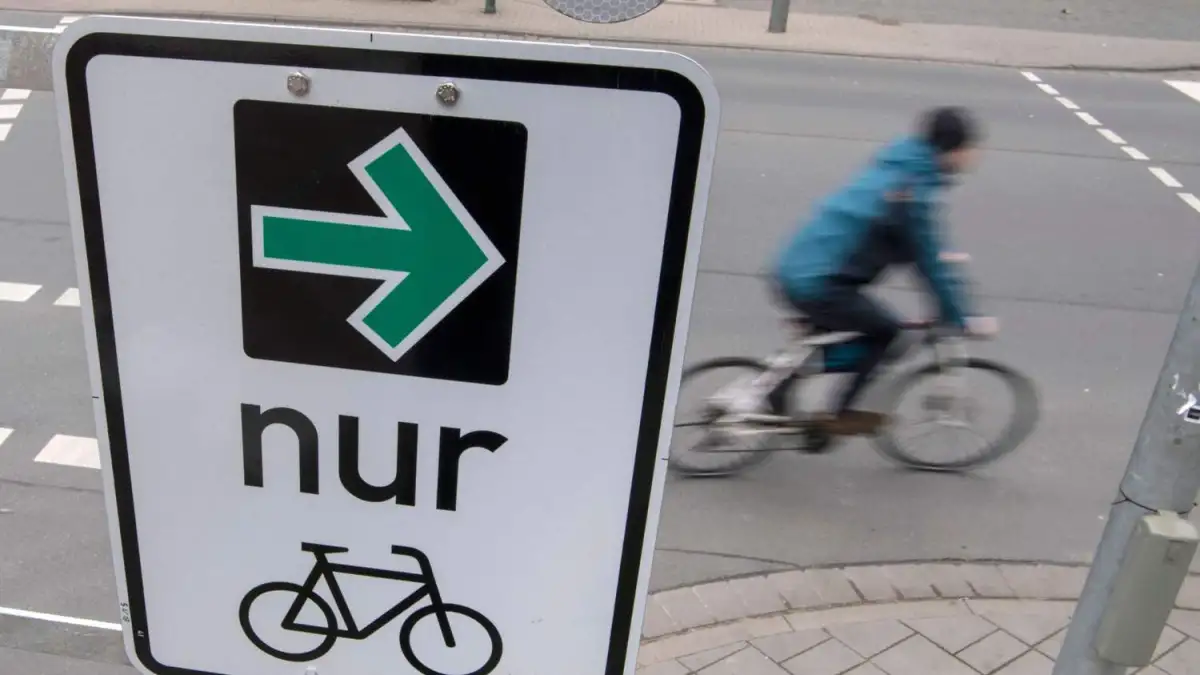
- In Bremen there are only two green arrows for cycling; numerous citizens’ applications were rejected due to high hurdles.
- Christian Schmidt from the Office for Roads and Transport names a total of 18 exclusion criteria: The main problems are a lack of visibility and track crossings.
- According to research, only six percent of cyclists stop properly at red lights; The Foot Association is critical of the Green Arrow.
It is a cross with the green arrow for cyclists, which is actually intended to ensure more safety on the roads. Once imported from the new federal states, he was always a rather unloved child who had difficulty asserting himself. Nevertheless, the local office and the Office for Roads and Transport (ASV) Citizens have repeatedly submitted requests to have such green metal arrows with right-turn signs erected at certain traffic hotspots.
Where are there green arrows in Bremen?
Christian Schmidt from ASV explained the difficulties in the Mobility Committee of the Eastern Suburb Advisory Board. The expert for Cyclings projects knows what he’s talking about. After all, he wrote a 100-page master’s thesis at the Kassel University of Applied Sciences on the subject of “Green Arrow with restriction to bicycle traffic,” as he said. In it he broke down every single one of the 18 exclusion criteria. As part of his master’s thesis, he also sent inquiries to 20 major German cities. Result: Oldenburg has no green turn arrow, Bremen only has two, namely in Ramparts on Holsteiner Straße, corner of Osterfeuerberger Ring.
What speaks against the Green Arrows?
Christian Schmidt also explained why it is not possible at the traffic junctions Am Herdentor and Am Dobbenfor example coming from Humboldtstrasse, to install green arrows for bicycle traffic. This is not possible, among other things, because Humboldtstrasse flows into the track bed of line 10. Another requirement that is difficult to meet: the intersection must be visible from a distance of 30 meters. Four corresponding Green Arrow applications are already in Hemelingen rejected, he added.
What about cycling?
Schmidt also admitted that experience shows that cyclists find it difficult to stop when the traffic light is red. In order to be able to turn, if a traffic sign with a green arrow makes this theoretically possible, the cyclist must come to a complete stop. At the same time, it is almost impossible to monitor this, says Schmidt. That’s why he sees Club foot the Green Arrow is rather critical. Schmidt gave an example: School children on the Hasteder Osterdeich were insulted by cyclists when crossing the premium route just because they had to stop at red light.
What about punishing violations?
If every violation of the regulation were to be punished with fines, as is the case with car traffic, it could be worthwhile for the state coffers, noted district parliamentarian Georg-Christoph von Heussinger (FDP). According to Schmidt, studies have shown that only six percent of all cyclists stop as required. Under real conditions, six-figure fines would have been due.
In exceptional cases, however, the regulation works, said Schmidt. In the Netherlands For the most part, the green arrow was not introduced because driving there was generally more compliant with the rules, emphasized Schmidt.
What is the point of a public checklist?
Henrike Neuenfeldt from the local office made a suggestion about quality: whether it would be possible to publish a short version of the exclusion criteria, i.e. a kind of checklist for the green arrow. So that citizens who planned to submit an application could check in advance whether it was worth submitting such an application. This could relieve both the local office and the ASV.
Consistent punishment for violations of the Green Arrow rules would increase the safety of cyclists, since, according to several statements and studies, a large proportion of drivers often ignore the prescribed stop and thereby endanger cyclists when crossing (Articles 1 and 2). Dangerous situations and “near misses” between right-turning cars and cyclists, particularly at intersections near schools, could be reduced through stricter control and sanctions for such violations (Articles 1 and 2). As a result, consistent punishment would help reduce conflicts between motorized traffic and cyclists and noticeably reduce the risk of accidents for cyclists on affected routes.
Sources
These questions and answers were created with AI based on our articles.
→ More information


