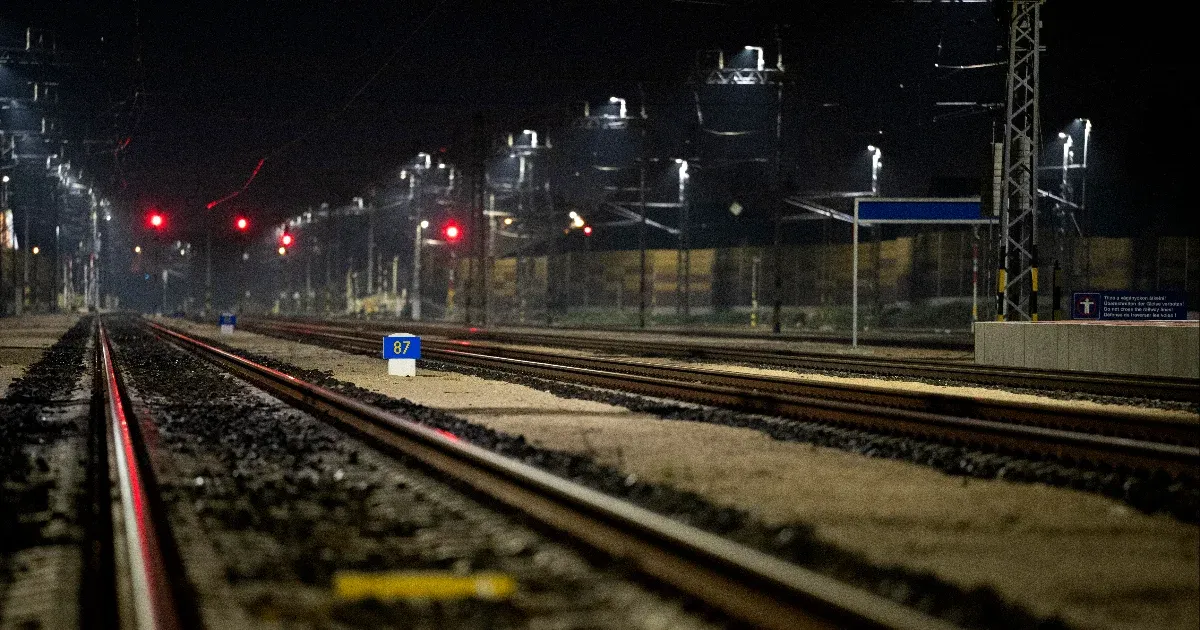
Budapest-Belgrade Railway: Passenger Service Launch Date Remains Uncertain
The anticipated launch of passenger service on the newly constructed Budapest-Belgrade railway remains without a firm date, hinging on the full operational capacity of the European Train Control System (ETCS). While officials express optimism for a spring commencement, potentially before Easter, concerns persist regarding the system’s readiness, as highlighted by recent reports. The delay underscores the complexities of integrating modern safety technology into a major international rail project, and the careful approach being taken to ensure passenger safety. The railway, a significant infrastructure investment for both Hungary and Serbia, has been subject to scrutiny regarding its cost and operational readiness.
The Építési és Közlekedési Minisztérium (ÉKM), Hungary’s Ministry of Construction and Transport, issued a statement on Monday evening addressing what it described as “misleading information” circulating in the media regarding the railway’s functionality. State Secretary Csepreghy Nándor asserted that there are no restrictions on operating the switches or transporting large container units – known as “big cube” containers – along the line. This response came after reports questioned the railway’s ability to operate efficiently and safely, particularly concerning the ETCS implementation. The ministry’s statement aims to clarify the situation and dispel what it considers inaccurate claims.
ETCS: The Key to Operational Launch
The ETCS, or European Train Control System, is a critical component of the Budapest-Belgrade railway, representing a significant upgrade in rail safety standards. According to the European Union Agency for Railways, ETCS is a system designed to automatically enforce speed restrictions and prevent collisions by continuously monitoring train movements and intervening if necessary. The European Union Agency for Railways details the ETCS system, explaining its function in managing train operations, monitoring, signaling, and speed enforcement. The system’s functionality is paramount to the launch of passenger services, with the ÉKM stating that the start date is “tied to the flawless operation of the ETCS system.” Csepreghy Nándor indicated a tentative timeframe of spring, with the possibility of service beginning before the Easter holidays.
However, reports from G7 on Monday morning raised doubts about the ETCS’s current status. The publication stated that the most complex part of the railway, the train protection system, was not only non-operational but also lacked the necessary approvals. This raised serious questions about the feasibility of launching passenger trains on March 14th, as previously suggested. The ÉKM refuted these claims, labeling them as based on “outdated, long-expired information.”
Addressing Concerns Over Switch Operation and Costs
The ministry also addressed concerns regarding the operation of switches at stations. Csepreghy Nándor clarified that there is no prohibition on accessing stations from connecting lines, such as Kiskunhalas, without ETCS onboard equipment. He further stated that shunting movements and serving sidings can also be performed without the train protection system. This clarification aims to counter claims that operational limitations would hinder the railway’s functionality.
A point of contention has been the disparity in construction costs between the Hungarian and Serbian sections of the railway. The ÉKM explained that a direct comparison is not possible due to differences in the scope of perform included in each country’s budget. On the Hungarian side, the total cost encompasses not only track construction but also all associated infrastructure elements, including 13 railway station buildings (five newly built and eight significantly renovated), 381 Park and Ride (P+R) and 410 Bike and Ride (B+R) parking spaces, 13 pedestrian underpasses, 26 elevators for accessibility, and 177,000 square meters of noise barriers. Csepreghy Nándor noted that the Serbian side’s reported costs do not fully account for the construction of grade-separated crossings.
Minister Lázár János has commissioned a comprehensive TÜV inspection of the entire Hungarian section of the railway. This rigorous audit will cover all infrastructure elements, from railway buildings and bridges to safety equipment, ensuring a thorough assessment of the line’s safety and reliability. This audit represents an additional investment in ensuring the highest safety standards, and is included within the Hungarian budget.
Previous Issues and Ongoing Assessments
Earlier reports, as noted by Telex in February 2026, highlighted challenges related to level crossings along the Budapest-Belgrade railway, specifically near Dunaharaszti. Telex’s reporting detailed test operations aimed at resolving these issues. These challenges underscore the complexities of integrating a new railway line into existing infrastructure and the importance of thorough testing and safety assessments.
The Budapest-Belgrade railway project represents a significant investment in regional connectivity, aiming to improve transport links between Hungary and Serbia, and facilitate trade and passenger travel. The railway is part of a broader effort to modernize rail infrastructure in Central and Eastern Europe, aligning with European Union standards for safety and efficiency. The project has faced delays and challenges, but remains a priority for both governments.
Key Takeaways
- The launch of passenger service on the Budapest-Belgrade railway is contingent upon the full operational readiness of the ETCS.
- The ÉKM has refuted claims of operational restrictions, stating that switch operation and container transport are not prohibited.
- Construction costs differ between Hungary and Serbia due to variations in the scope of included infrastructure elements.
- A comprehensive TÜV inspection is underway to ensure the safety and reliability of the Hungarian section of the railway.
As of March 4, 2026, a definitive launch date for passenger service remains elusive. The focus remains on completing the ETCS implementation and ensuring the railway meets the highest safety standards. Further updates are expected following the completion of the TÜV inspection and ongoing testing of the ETCS system. The ÉKM has not provided a revised timeline, but continues to emphasize its commitment to launching the service as soon as it is safe and operationally feasible.
We encourage readers to share their thoughts and perspectives on this developing story in the comments below. Stay tuned to World Today Journal for further updates as they grow available.