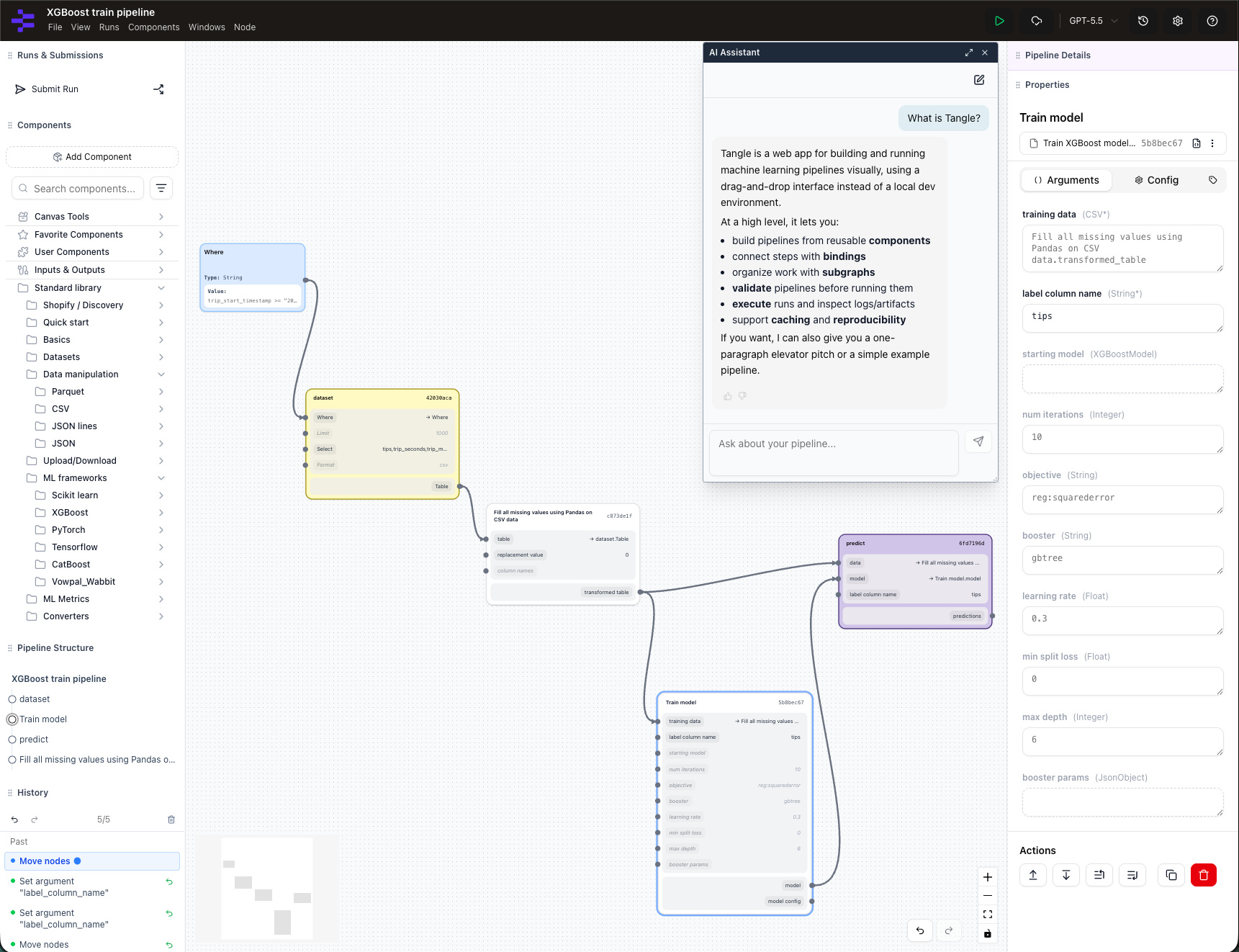
Autonomous machine learning experimentation is moving toward a self-orchestrating model, as engineers increasingly look for ways to automate the repetitive cycles of hypothesis generation, pipeline execution, and metric analysis. The integration of the Tangle platform with the Tangent agentic framework provides a system for managing these workflows, allowing developers to automate complex ML tasks while maintaining visibility into every stage of the process. According to documentation from the project maintainers, this approach enables teams to treat ML pipelines as reproducible, shareable assets that can be managed through version-controlled files rather than isolated, proprietary notebooks.
The Tangle platform serves as the foundation for this experimentation, offering an open-source, platform-agnostic environment that utilizes a drag-and-drop visual editor to construct pipeline graphs. By decoupling components from specific execution environments, Tangle allows any containerized command-line interface (CLI) program to function as a pipeline step. A core feature of this architecture is its caching layer, which reuses previously executed steps to lower costs and accelerate iteration cycles. Because these runs and their associated caches are shared, multiple developers can inspect, modify, or replicate a pipeline in seconds, addressing common challenges associated with environment drift in collaborative data science environments, as outlined in the project’s technical specifications at TangleML.com.
Autonomous Workflows with Tangent
Tangent functions as an autonomous engineering agent designed to operate on top of Tangle, effectively automating the experimentation loop. Drawing inspiration from the “autoresearch” concept popularized in recent machine learning discourse, Tangent manages a fleet of specialized subagents to handle tasks ranging from model training to metric analysis. Users can interact with the system by delegating specific tasks—such as debugging a failed run or building a new component—or by initiating a fully autonomous loop with a single command, such as tangent auto. This flexibility allows for varying levels of human oversight depending on the complexity of the experiment.
Under the hood, Tangent operates via an eight-step loop that includes gated checkpoints to ensure the agent does not deviate from its objectives during long-running tasks. At each gate, the agent validates its progress against a checklist before proceeding, reloading its instructions and context to maintain alignment with the project goals. This system relies on persistent, plain-text memory; specifically, a MEMORY.md file stores the best-known configurations and lessons learned, while daily session logs and archived object storage provide a comprehensive history of the agent’s actions.
Markdown-Based Agent Skills
A distinctive feature of Tangent is its reliance on Markdown for defining agent “skills.” Rather than using proprietary configuration languages, the system uses a SKILL.md entry point backed by various subagent files, such as those for researchers, builders, or debuggers. This design choice makes agent capabilities portable and reviewable within standard pull requests, allowing developers to manage agent behavior using the same version control workflows they use for code. Because these skills are harness-agnostic, they can be deployed across different coding agent environments without requiring custom binaries or complex schemas.
The subagent structure is modular, with specific files dedicated to distinct roles:
- Builder: Handles the construction of components and pipeline modifications.
- Debugger: Analyzes failed runs and suggests fixes.
- Researcher: Explores datasets and evaluates hypotheses.
- Reviewer: Provides oversight on pipeline changes.
- Reporter: Synthesizes results and documents findings.
By utilizing Markdown, both humans and the coding agents can read the documentation and the instructions natively, ensuring that the skill file serves as its own technical reference.
Secure Agent Hosting and Infrastructure
To facilitate the deployment of these autonomous agents, the project provides a Linux-based Agent Hosting Platform. This platform allows users to run persistent Tangent instances that communicate with cloud providers and Tangle without exposing sensitive credentials. Security is maintained through a system-wide proxy residing in a separate container, which intercepts and modifies HTTP requests to automatically insert authentication headers. By creating new SSL certificates on the fly, the proxy allows the agent to interact with various services while ensuring that credentials remain isolated within the secure host environment.

For Kubernetes environments, each instance is deployed as a StatefulSet, featuring a container pod that houses the agents, applications, and the proxy, supported by per-instance persistent storage. The Tangent Shell environment further enhances this by allowing agents to operate remotely, maintaining their memory and sessions across restarts. This allows experiments to continue running even after a user closes their local machine. According to the project maintainers, the Shell is designed to split complex requests into smaller, parallelizable slices, which are then coordinated by a “Prime” agent that owns the session, enabling efficient utilization of compute resources for deep experimentation plans.
Practical Application in Model Optimization
The efficacy of this autonomous approach was tested during the reconstruction of a large reranking model. By utilizing Tangent, engineers were able to iterate through various feature sets and training data configurations while maintaining a clear audit trail of performance improvements. The results demonstrated a clear trend of performance gains as the agent systematically applied changes to the pipeline:
| Step | Change Implemented | R@90% Prec. | R@95% Prec. | R@97% Prec. |
|---|---|---|---|---|
| Previous | Prior distillation/standard features | 67.3% | 54.4% | 33.6% |
| Standardized | Reproducible trainer | 69.5% | 51.9% | 35.2% |
| Features | Added structured metadata/taxonomy | 71.3% | 58.7% | 48.5% |
| Data | Added hard-negative pairs | 75.6% | 60.2% | 43.9% |
The data indicates that the most significant performance lift resulted from the inclusion of richer product features, such as structured metadata and predicted attributes. This real-world implementation highlights how the autonomous loop can handle the repetitive task of ablation studies and hyperparameter optimization, allowing human engineers to focus on architectural direction rather than manual configuration management.
Tangle, the Tangent skills, and the associated hosting platforms are released under the Apache 2.0 license. Development is currently public on GitHub, with the project accepting contributions for new subagent skills and infrastructure improvements. Users interested in testing these tools can find the source repositories and installation instructions through the official Tangle GitHub organization.