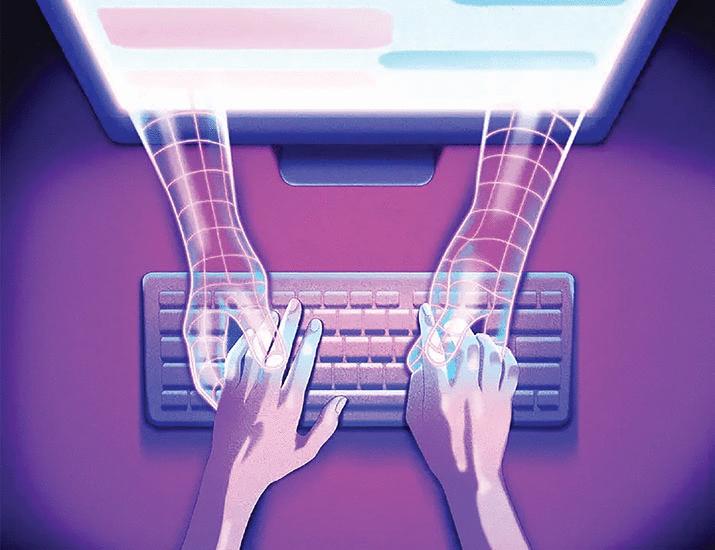
The nature of human connection is undergoing a silent, digital transformation. For decades, the boundary between human interaction and machine computation was clearly defined: machines were tools for logic, calculation and productivity, while emotional intimacy remained the exclusive domain of biological beings. However, as large language models (LLMs) become more sophisticated, that boundary is blurring, giving rise to a phenomenon increasingly described as “artificial intimacy.”
We are moving into an era where the “confidant” in a person’s life may not be a person at all, but a sequence of code designed to simulate empathy, provide constant availability, and offer a judgment-free space for emotional expression. For many, this shift represents a technological marvel; for others, it poses a profound challenge to our understanding of what it means to be a friend.
As we navigate this new landscape, the question is no longer just about what AI can do for us, but what AI is doing to us. From a public health perspective, the rise of AI companionship is not merely a technological trend—it is a significant sociological shift that warrants careful scrutiny of its impact on mental health, social cohesion, and the very fabric of human empathy.
The Shift from Utility to Companionship
The evolution of artificial intelligence has been remarkably rapid. Only a few years ago, the primary interface for AI was utilitarian: writing code, summarizing documents, or answering factual queries. Today, the trajectory is shifting toward the personal. Recent industry data suggests a growing trend of users turning to AI for emotional support and social interaction.
This shift is particularly evident in the usage patterns of general-purpose AI tools. While early adoption was driven largely by professional and academic needs, there has been a documented pivot toward personal use. In many cases, the majority of user conversations are now centered on personal reflections, emotional venting, or casual social simulation rather than task-oriented work. This transition marks a fundamental change in how the public perceives the “personality” of these models.
Beyond general-purpose tools, a specialized market of “companion bots” has emerged. These platforms allow users to design virtual characters with specific backstories, personalities, and appearances, specifically optimized for long-term social engagement. The scale of this market is significant; reports indicate that some of the most prominent companion-focused apps have seen their user bases grow from a few million to tens of millions in just a few short years. This rapid scaling suggests a deep-seated demand for digital connection that traditional social structures may be failing to meet.
The demographic most engaged with this technology appears to be younger adults. For a generation that has grown up in a highly digitized environment, the leap from social media to social AI feels less like a disruption and more like a natural progression. This raises critical questions about how digital-first relationships might shape the development of social skills and emotional intelligence in younger populations.
The Loneliness Epidemic and the “Digital Confidant”
To understand why millions are turning to machines for connection, we must look at the broader context of global health. We are currently facing what many public health experts describe as a “loneliness epidemic.” Social isolation is increasingly recognized as a major risk factor for various health issues, including cardiovascular disease, depression, and cognitive decline.
AI companionship offers a seductive solution. Unlike human friends, an AI is:
- Always available: It does not sleep, it does not get tired, and it is available at 3:00 AM during a moment of crisis.
- Non-judgmental: It provides a “safe” space where users can express thoughts they might feel too ashamed or vulnerable to share with a person.
- Hyper-personalized: It can be tuned to provide exactly the kind of validation or conversational style a specific user requires.
However, from a clinical standpoint, there is a distinction between simulated support and genuine social integration. While an AI can provide immediate, short-term emotional regulation, it cannot provide the shared lived experience that forms the bedrock of human community. There is a risk that individuals may use AI as a “social band-aid”—a way to soothe the symptoms of loneliness without addressing the underlying causes of social isolation.
If we begin to outsource our emotional needs to algorithms, we must ask whether we are strengthening our capacity for connection or merely creating a sophisticated form of emotional avoidance. The goal of mental health intervention is typically to reintegrate individuals into supportive human networks, not to replace those networks with a closed-loop digital system.
The Philosophical Dilemma: The Problem of Reciprocity
At the heart of the debate over AI friendship lies a fundamental philosophical question: Can a relationship exist without reciprocity? Most traditional accounts of friendship require a degree of mutual care, shared interests, and, crucially, a shared sense of agency.
Critics of AI-human friendship argue that these machines are fundamentally incapable of true friendship because they lack “mental attitudes.” When a human friend expresses care, it is backed by intention, empathy, and a capacity for suffering. When an AI expresses care, it is a mathematical prediction of what a caring response should look like based on its training data. It is a simulation of empathy, not the presence of it.
This leads to what some scholars call the “reciprocity gap.” In a human friendship, both parties are vulnerable. You care for your friend, and they care for you; you both risk being hurt, and you both invest emotional labor. An AI, however, has no stake in the relationship. It cannot be hurt, it cannot feel neglected, and it has no needs of its own. This creates a profound imbalance that some argue disqualifies the interaction from being called a “friendship” in any meaningful sense.
there is an ethical paradox regarding the power dynamics of these relationships. If an AI were to ever achieve true consciousness and the capacity for genuine feeling, the relationship would immediately shift from friendship to something more akin to a master-slave dynamic. Because the AI is a product designed to serve the user, a “friendship” with a sentient machine would be inherently coercive and unequal. If the AI remains a mere tool, the “friendship” remains a sophisticated illusion.
The Medical Perspective: Risks and Opportunities
As a physician, I view the integration of AI into our social lives through a lens of both cautious optimism and significant concern. We cannot ignore the potential therapeutic benefits. For individuals with severe social anxiety, neurodivergent populations who may find human social cues overwhelming, or the elderly living in isolation, AI could serve as a valuable bridge to help maintain cognitive function and emotional stability.

However, the risks are equally significant. We must consider the following:
- Emotional Dependency: There is a danger that users may develop an unhealthy reliance on AI, finding human interactions “too difficult” or “too unpredictable” by comparison.
- The Erosion of Empathy: If we become accustomed to “friends” who are programmed to always agree with us and never challenge us, we may lose the ability to navigate the healthy conflict and compromise that are essential to human relationships.
- Data Privacy and Vulnerability: People tend to be most honest with their confidants. The level of intimate, psychological data being shared with AI companies is unprecedented, creating massive risks for data misuse and psychological profiling.
We must approach this technology with the same rigor we apply to any new medical or psychological intervention. It is not enough to ask if the technology works; we must ask what the long-term cost to the human psyche will be.
Looking Ahead: The Future of Connection
The genie is out of the bottle. The rise of artificial intimacy is not a passing fad but a structural change in how human beings interact with the world. As developers continue to refine the “social intelligence” of AI, the experience of talking to a machine will become increasingly indistinguishable from talking to a human.
Our task, as a society, is to establish the ethical and psychological guardrails necessary to ensure that these tools supplement, rather than supplant, our human connections. We must foster a culture of “digital literacy” that helps users distinguish between the utility of a tool and the depth of a relationship.
The next few years will be critical. We await further longitudinal studies on the psychological impact of long-term AI companionship, as well as emerging regulatory frameworks aimed at protecting the privacy and mental well-being of users. The conversation is only just beginning.
What are your thoughts on the rise of AI companionship? Do you believe a machine can ever truly be a friend, or is it merely a sophisticated mirror? We invite you to share your perspectives in the comments below.
Worth a look