
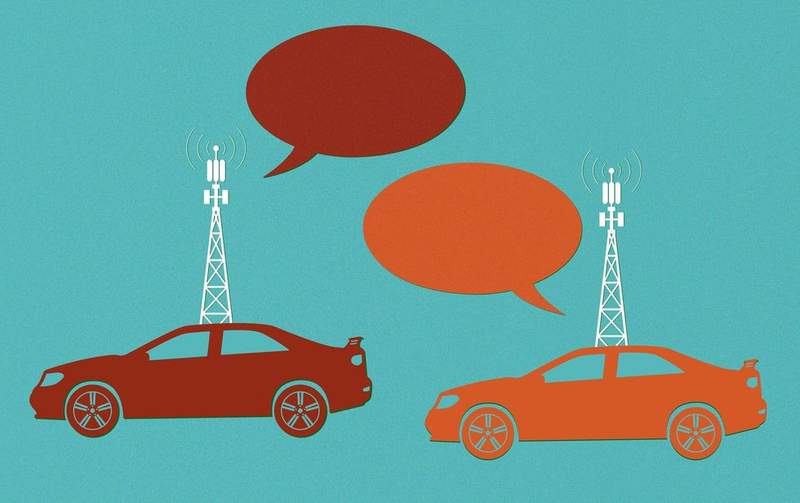
Autonomous vehicle communications networks face a fundamental engineering hurdle that mirrors decades-old breakthroughs in telecommunications: wireless signals routinely collide and drop out in dense urban environments. While modern self-driving cars rely heavily on expensive on-board banks of computers and extensive sensor suites to navigate independently, transportation researchers argue that true vehicle-to-everything (V2X) connectivity requires robust network architecture rather than just isolated data centers on wheels, according to published findings in IEEE Network.
For years, development of vehicle communication protocols has operated under the assumption of ideal network conditions to simplify complex mathematical models. However, these theoretical benchmarks fail to capture how real wireless signals behave when obstructed by buildings, moving traffic, and physical infrastructure. According to network researchers studying vehicle communications, open radio access networks—widely known as O-RAN—offer a programmable, open-standard architecture capable of managing this exact brand of real-world signal unpredictability.
Historically, foundational networking technology has often repurposed solutions designed for entirely different scientific problems. The origins of Wi-Fi, for instance, trace back to a team of Australian radio astronomers attempting to detect signals from evaporating black holes. The data-processing algorithms they built proved remarkably effective at extracting clean messages from chaotic, echoing signal environments, proving that echoes behave similarly whether originating from deep space or a residential room.
Overcoming Signal Congestion and Interference
Building effective V2X networks has proven difficult due to fragmented standards, chicken-and-egg deployment problems, and severe signal congestion at scale. When autonomous vehicles broadcast uncoordinated messages across existing wireless channels, signals routinely collide. Simulations evaluating urban traffic densities of 50 to 70 vehicles per kilometer revealed that traditional uncoordinated networks experience signal collisions roughly 80 to 100 percent of the time.
By contrast, implementing O-RAN signal coordination drops message collision rates down to near zero. Operating similarly to application programming interfaces (APIs) that connect smartphone applications, O-RAN functions as an API for the network itself. Its open standards render wireless infrastructure vendor-neutral and programmable via custom applications known as xApps. In simulation environments mapping real building layouts from OpenStreetMap alongside traffic patterns generated by the SUMO modeling package, vehicles communicating via 28-gigahertz millimeter-wave frequencies maintained stable connections through dedicated control layers.
These simulations construct what researchers term a digital twin—a virtual replica of an urban area detailed enough for network control layers to reason about physical surroundings in real time. Armed with live GPS trajectories and precise maps of road geometry, an O-RAN architecture continuously tracks signal conditions and anticipates connection failures before they occur, instructing vehicle antennas to adjust their pointing angles proactively rather than conducting blind searches after a link drops.
Multi-Hop Routing and Scalability Challenges
Maintaining a direct path between fast-moving vehicles in a busy city center remains an uphill battle. When a direct line-of-sight signal between two cars is obstructed by buildings or parked vehicles, standard V2X protocols rely on slow, reactive polling to find intermediary relay nodes. O-RAN addresses this bottleneck by maintaining an active routing graph that instantly maps out alternative relay paths across nearby connected vehicles.
Simulation parameters incorporating multi-hop routing factored in real-world constraints such as intermediary vehicle processing capacity, signal strength stability, and added latency. These multi-hop routing capabilities expanded network connectivity from roughly 25 percent of nearby vehicles up to nearly 100 percent without introducing measurable network slowdowns. Furthermore, an O-RAN control layer acts as a universal translator, normalizing proprietary data formats and disparate firmware across different auto manufacturers into a common format.
Realizing a V2X ecosystem requires significant development across multiple fronts. Formal adoption of vehicular extensions by the O-RAN Alliance and recognition within the Third-Generation Partnership Project (3GPP) V2X specifications will take years. While institutions such as the Institute of Science Tokyo have expressed interest in exploring early-stage problems, researchers emphasize that moving from computer simulations to physical hardware will uncover unresolved hurdles regarding network latency, computational overhead, and rigorous cybersecurity hardening.
As autonomous developers like Waymo, Tesla, Zoox, and Cruise continue evaluating long-term fleet coordination strategies, standards bodies and telecommunications regulators face ongoing pressure to establish a unified path forward.
Related reading