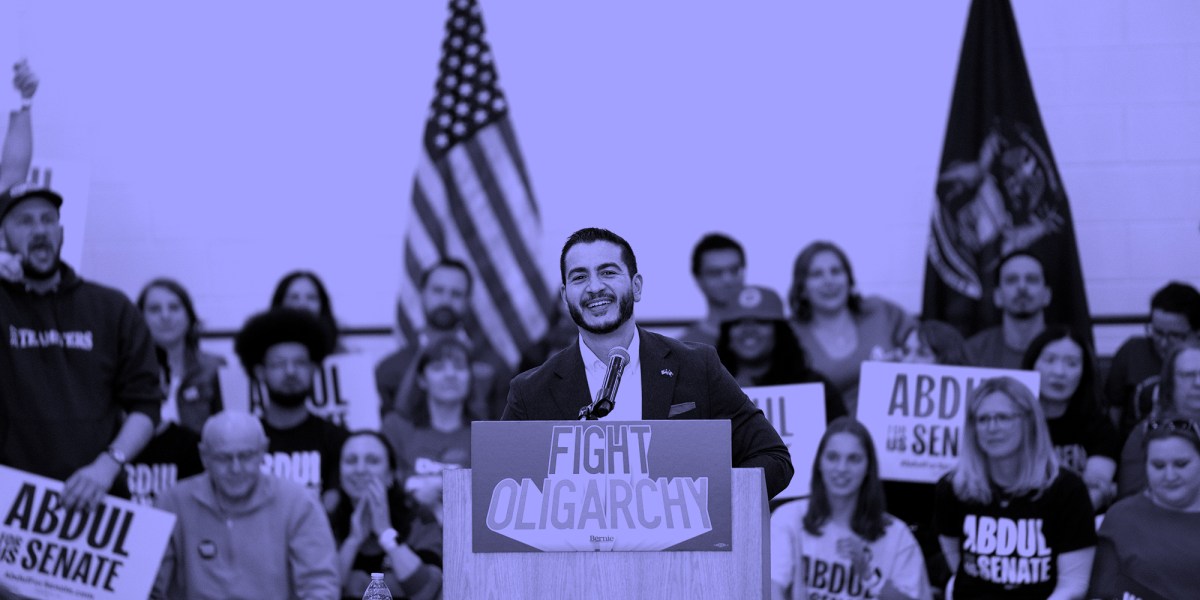
The Michigan Democratic Senate primary has emerged as one of the most expensive primaries of the cycle. Dr. Abdul El-Sayed, a former public health official and progressive candidate, faces Rep. Haley Stevens in a primary contest that has drawn upwards of $50 million in outside spending.
The high-stakes race serves as a major test of whether progressive candidates can secure victories in statewide purple territory. The campaign has drawn financial investment from federal super PACs, thrusting Michigan to the center of a national debate over the future direction of the Democratic Party, corporate campaign funding, and the political viability of the progressive platform in the American Midwest.
Financial Inflows and the Super PAC Battleground
According to The AP, the American Israel Public Affairs Committee and its affiliated groups have poured close to $30 million into the race, marking the organization’s largest investment ever in a single race.
During an appearance on The Intercept Briefing podcast hosted by senior politics reporter Akela Lacy, El-Sayed addressed the massive influx of outside capital. “It’s just anti-democratic on its own terms,” El-Sayed stated during the interview. He questioned the framing of the race as a tight contest independent of financial influence, asking, “Would it even be a close race at all?”
While El-Sayed has criticized the reliance on corporate and super PAC money, Stevens’ campaign has emphasized her legislative record and electability.
Midwestern Perspectives on Progressive Messaging
The question of whether leftist or progressive candidates can triumph in battleground states has divided political commentators and organizers. Alongside the Michigan primary, political analysts note similar intra-party friction across the Midwest, including primary battles in Minnesota and Wisconsin.
Appearing alongside El-Sayed on the podcast, Wisconsin state Representative Ryan Clancy, a founding member of the state legislature’s current Socialist Caucus, argued that voters in purple districts want bold advocacy rather than ideological moderation. “The idea that in order to win in a purple district that is roughly split between Democrats and Republicans, that you need when you’re a Democrat, to look as much like a Republican as possible is just not helpful,” Clancy said.
Thom Hartmann, a progressive political commentator and author, also joined the discussion to contextualize the economic anxieties driving modern political alignments. Hartmann pointed to long-term wage stagnation and the decline of organized labor over the past four decades as foundational drivers behind voter disaffection with the political establishment.
Policy Debates: Healthcare, Housing, and Emerging Technologies
El-Sayed has centered his platform on wanting people to have healthcare, wanting kids to have a good school, and addressing corporate influence.
In discussions regarding technological transformation, El-Sayed highlighted the potential disruption to labor markets if a data center gets planted in a backyard to automate jobs away.
Meanwhile, the general election outlook remains a key point of contention between the campaigns. While primary polling has indicated a commanding lead for El-Sayed among Democratic primary voters, general election surveys suggest a competitive matchup in November against Republican candidate Mike Rogers, who is backed by Donald Trump. Stevens’ campaign has frequently highlighted these general election metrics to argue for electability in a statewide contest.
Next Steps and Election Timeline
The Democratic primary election takes place on Tuesday, following weeks of debates, ad campaigns, and heavy grassroots organizing across Michigan. Voters will decide which candidate moves forward to face the Republican nominee in the November general election, setting the stage for the final outcome in one of the most closely watched Senate races.
Worth a look