
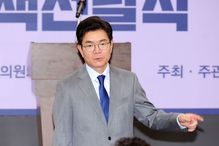
The race for the Seoul mayoral seat has intensified into a sharp exchange of personal accusations, as Democratic Party of Korea candidate Jeong Won-oh launched a scathing rebuttal against People Power Party representative Jang Dong-hyuk on Sunday, May 17, 2026. The confrontation, which played out across social media and public forums, highlights the deepening polarization and the shift toward character-based attacks as the ninth local elections approach.
The conflict erupted after Jang Dong-hyuk publicly referenced past assault allegations involving Jeong, suggesting that such a record would be intolerable within a conservative political framework. In a swift and aggressive response, Jeong dismissed the claims as irrelevant and countered by questioning Jang’s own stability and standing within the People Power Party (PPP), signaling a strategy of aggressive counter-offense rather than defensive clarification.
This clash is not merely a dispute between two individuals but a reflection of the broader systemic friction between South Korea’s two dominant political forces. As the battle for the capital city—the most influential local office in the country—heats up, the discourse has moved beyond urban planning and economic policy toward a volatile mix of historical grievances and internal party loyalty tests.
The Spark: Allegations of Past Misconduct
The current tension began when Jang Dong-hyuk, a prominent figure in the People Power Party, brought up historical incidents of alleged physical altercations involving Jeong Won-oh. Jang asserted that if Jeong had been a member of a conservative party, he would have been “expelled” or “forced out” due to the nature of those past events. This line of attack is designed to frame Jeong as unfit for the moral leadership required of the Seoul mayor, attempting to alienate moderate voters who prioritize stability and law and order.
By framing the issue through the lens of “conservative standards,” Jang attempted to position the PPP as the party of strict ethical discipline. However, this tactic has historically been a double-edged sword in South Korean politics, often triggering a “whataboutism” response that pivots the conversation toward the opposing party’s own internal scandals.
Jeong Won-oh’s Rebuttal: “Nonsense” and Military Dictators
Jeong Won-oh did not shy away from the attack, utilizing his Facebook platform to deliver a direct and visceral response. He characterized Jang’s comments as “nonsense” (literally translating to “the sound of someone knocking on a window while asleep”), arguing that the standards of conservative parties are not a benchmark he cares to meet.
In a move to delegitimize the PPP’s moral authority, Jeong pointed to the party’s roots, stating that he has had no interest in political organizations “created by military dictators” since his youth. This rhetoric taps into the long-standing narrative of the Democratic Party as the champion of democratization against the authoritarian regimes of the past, effectively shifting the conversation from his personal history to the ideological history of the conservative movement.
Jeong’s strategy was to frame Jang’s criticism not as a matter of ethics, but as a projection. He argued that the person actually facing a crisis of legitimacy is Jang himself, suggesting that the PPP representative is currently “on the verge of expulsion” from his own party.
Internal Fractures: Pro-Yoon vs. Anti-Yoon Dynamics
A critical element of Jeong’s counter-attack was the mention of internal strife within the People Power Party. He specifically questioned whether Jang Dong-hyuk identifies as “Pro-Yoon” (loyal to the current administration’s core) or “Jeol-Yoon” (a term referring to those distancing themselves from or cutting ties with the administration’s influence). This distinction is a central fault line in current conservative politics, where loyalty to the presidency often clashes with the need for broader electoral appeal.
Jeong claimed that even fellow candidates within the People Power Party are reluctant to have Jang join their campaign trails for support. By highlighting this perceived isolation, Jeong aimed to portray Jang as a weakened leader whose “prestige is in tatters,” thereby undermining the weight of Jang’s criticisms. This tactic transforms a personal attack on Jeong’s character into a strategic attack on the PPP’s internal unity.
Comparative Political Positioning
| Feature | Jang Dong-hyuk (PPP) | Jeong Won-oh (DPK) |
|---|---|---|
| Primary Attack | Past assault allegations; lack of ethical fitness. | Internal party instability; legacy of military dictatorship. |
| Key Argument | “Would have been expelled from a conservative party.” | “Worry about your own party’s candidate first.” |
| Strategic Goal | Frame opponent as morally unfit for the mayoralty. | Frame opponent as an isolated figure in a fractured party. |
| Communication Channel | Public statements/Political discourse. | Facebook / Social Media. |
Why This Matters for the Seoul Mayoral Race
The Seoul mayoral election is often viewed as a bellwether for national sentiment. The transition from policy-driven debate to personal warfare suggests a high-stakes environment where neither side believes they can win on a purely administrative platform. For the global observer, this clash illustrates the “zero-sum” nature of South Korean political competition, where the goal is often to disqualify the opponent morally rather than outdo them programmatically.
Voters in Seoul, a demographic known for being highly educated and politically active, may react to these attacks in two ways. Some may be repelled by the “mud-slinging” and gravitate toward a third-party candidate or abstain, while others may see Jeong’s aggressive defense as a sign of strength and leadership. The mention of “military dictators” is a calculated move to energize the progressive base, while the focus on “expulsion” is intended to galvanize the conservative core.
Key Takeaways for Voters
- Shift in Rhetoric: The campaign has moved from urban vision to personal history and party loyalty.
- Internal PPP Tension: The mention of “Pro-Yoon” vs. “Jeol-Yoon” suggests that internal fractures within the conservative camp remain a viable target for the opposition.
- Legacy Issues: The invocation of military dictatorship shows that historical identity still plays a massive role in modern electoral strategy.
- Social Media as a Battlefield: Facebook continues to be a primary tool for rapid-response political warfare in Korea.
Looking Ahead: The Path to the Polls
As the candidates move closer to the election date, the focus is expected to shift back toward tangible issues—such as housing costs, transportation infrastructure and the “Global City” vision—but the damage from these personal exchanges often lingers. The People Power Party will likely attempt to verify and amplify the assault allegations to create a “character crisis” for Jeong, while the Democratic Party will continue to probe the cracks in the PPP’s internal coalition.

The next critical checkpoint will be the official party debates, where these accusations will likely be addressed in a moderated setting. Whether Jeong can pivot from this defensive posture back to his “G2 Seoul Vision” will be a deciding factor in his ability to capture the center-right swing voters.
World Today Journal will continue to monitor the developments of the 9th local elections. We invite our readers to share their perspectives on the impact of character-based campaigning in the comments section below.