
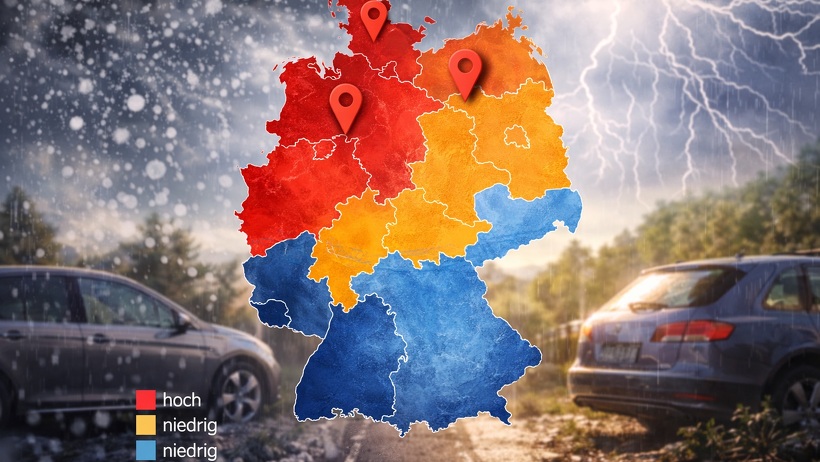
Weather-related damage to vehicles in Germany has shown a significant decline in recent years, according to verified data from the country’s insurance industry. The trend reflects shifting patterns in severe weather events and their impact on insured automobiles, with particular attention to regional variations in claims frequency and severity.
In 2025, German insurers paid out approximately 650 million euros in claims for weather-related vehicle damage, marking nearly a 50% reduction from the 1.2 billion euros recorded in the previous year. This figure comes from the German Insurance Association (GDV), which collects data exclusively from vehicles covered by partial or comprehensive motor insurance policies (Kaskoversicherung). Since such coverage is not legally mandatory, the actual total of weather-related vehicle damage across all registered cars in Germany is likely higher than the reported insured losses.
The decline in claims was not uniform across all federal states. While some regions experienced substantial reductions, others saw increases that highlight the localized nature of extreme weather events. In Baden-Württemberg, weather-related claims dropped sharply from 530 million euros in 2024 to 148 million euros in 2025. Conversely, North Rhine-Westphalia reported a rise from 142 million to 200 million euros over the same period, making it the state with the highest total claims in 2025. Lower Saxony also saw an increase, with claims growing from 44 million to 64 million euros, while Bremen remained relatively stable at around 3 million euros.
These variations underscore a key insight from industry analysts: single major weather events can significantly influence annual statistics. As noted by GDV Chief Executive Jörg Asmussen, “A single severe weather event in one region can quickly shift the overall damage balance.” This volatility means that year-to-year comparisons must be interpreted with caution, particularly when assessing long-term trends in climate-related risk exposure for vehicles.
How Insurance Covers Weather Damage to Vehicles
When vehicles sustain damage from storms, hail, flooding, or falling objects like trees or debris, the type of motor insurance policy held determines whether the loss is covered. Third-party liability insurance (Haftpflichtversicherung), which is legally required for all vehicles in Germany, does not cover weather-related damage to the policyholder’s own vehicle. Protection against such events requires either partial comprehensive (Teilkasko) or full comprehensive (Vollkasko) coverage.
Partial comprehensive insurance typically covers direct weather-related damage under specific conditions. This includes harm caused by hail, windstorm (generally defined as wind force 8 or higher on the Beaufort scale), lightning strikes, flooding, and impacts from falling objects such as branches, roof tiles, or traffic signs — provided there is a clear causal link between the weather event and the damage. For example, if a tree falls on a parked car during a storm, or hail dents the bodywork, partial comprehensive policies will usually cover the repair costs.

Still, coverage may be denied if the damage results from indirect actions taken during severe weather. If a driver swerves to avoid a falling branch and collides with a stationary object, or if debris only becomes a hazard after being displaced by the storm (such as lying visibly on the road), insurers may determine that the storm was not the direct cause. In such cases, partial comprehensive insurance may not apply, though full comprehensive coverage could still provide compensation depending on the policy terms.
Full comprehensive insurance offers broader protection and may cover weather-related damage even when partial comprehensive policies exclude it, including certain collision scenarios arising from evasive maneuvers during storms. Policyholders are advised to review their specific contract details, as conditions for payout — such as minimum wind speed thresholds for storm claims — can vary between insurers.
Regional Risk and Preventive Measures
The uneven distribution of weather-related claims across German states reflects both climatic differences and local infrastructure vulnerabilities. North Rhine-Westphalia’s position as the state with the highest claims in 2025 may be linked to its dense population, extensive urban road networks, and exposure to specific weather systems. Meanwhile, the sharp decline in Baden-Württemberg suggests either fewer severe weather incidents in 2025 or improved mitigation efforts following the unusually high losses experienced in 2024.
Industry experts emphasize that while insurance provides financial protection, preventive actions remain critical. Drivers are encouraged to monitor weather warnings, avoid parking under trees or near unstable structures during forecasts of high winds or hail, and seek sheltered parking when severe weather is expected. Prompt reporting of damage to insurers — ideally with photographic documentation — helps streamline the claims process.

As climate patterns continue to evolve, insurers and policymakers alike are monitoring weather-related vehicle damage trends to assess emerging risks. The GDV and other regulatory bodies regularly update guidelines on natural hazard coverage, though no immediate changes to motor insurance regulations have been announced for 2026.
For the most current information on coverage options, claims procedures, or regional risk assessments, vehicle owners should consult their insurance provider directly or refer to official resources from the German Insurance Association (GDV) and automobile clubs such as the ADAC, which offer detailed guidance on weather-related vehicle protection.
Stay informed about developments in motor insurance and weather risk management by following updates from trusted financial and automotive sources. Share your experiences or questions in the comments below, and help others navigate the complexities of vehicle protection in changing climatic conditions.