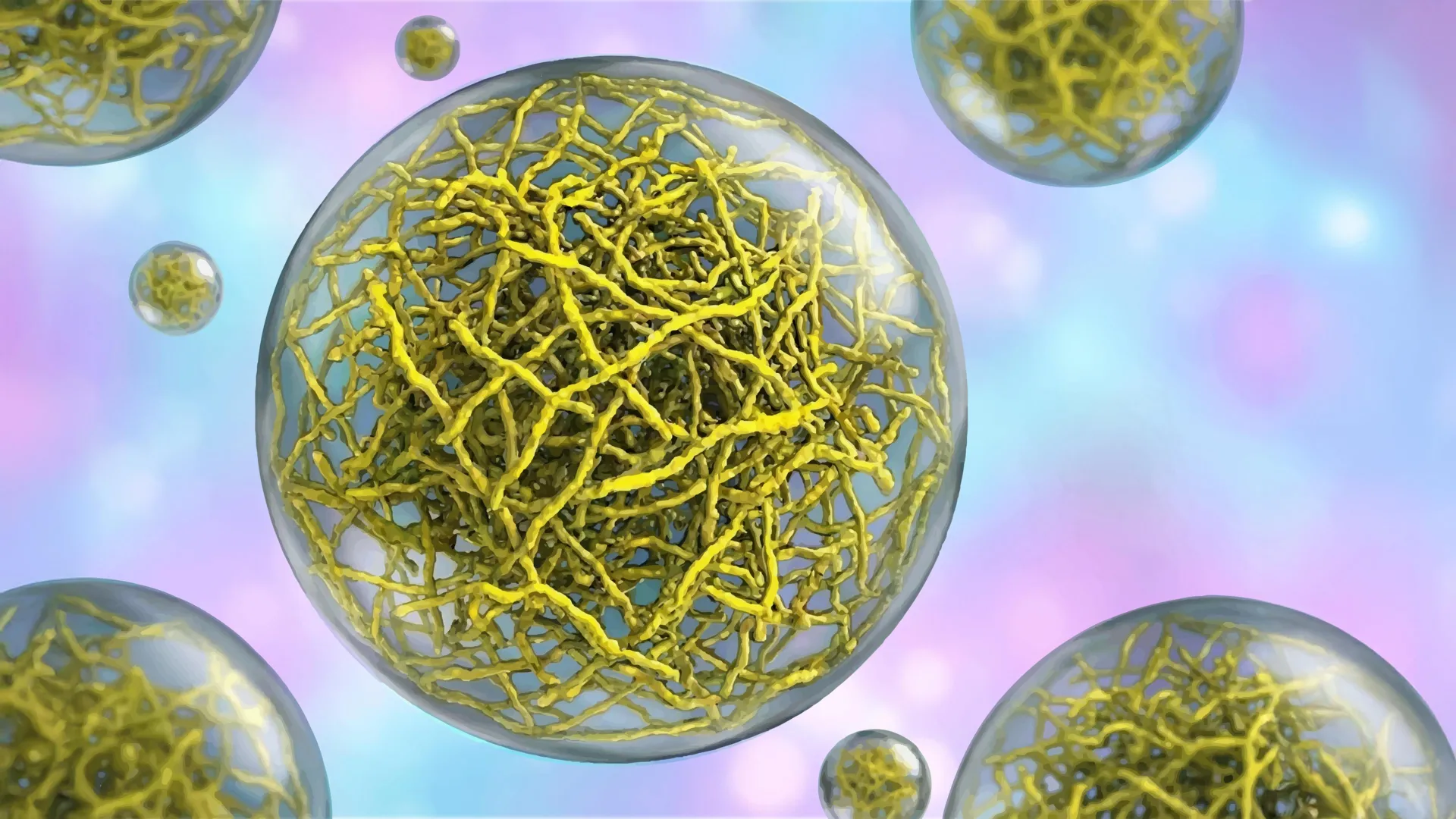
For decades, scientists have understood that cells rely on intricate structures to organize their internal processes. These aren’t the membrane-bound organelles traditionally taught in biology textbooks, but rather droplet-like assemblies known as biomolecular condensates. These condensates, formed through the interactions of proteins and nucleic acids, play a critical role in everything from gene expression to waste removal. Now, groundbreaking research is challenging the long-held belief that these condensates are simply unstructured blobs, revealing a hidden architecture that could unlock new therapeutic targets for devastating diseases like cancer and amyotrophic lateral sclerosis (ALS).
A study published in Nature Structural and Molecular Biology on February 2, 2026, details how researchers at Scripps Research discovered that certain biomolecular condensates aren’t random collections of molecules, but are instead built upon complex networks of protein filaments. This internal scaffolding provides a defined structure crucial for the condensate’s function, opening up possibilities for targeted drug development. The discovery represents a significant shift in our understanding of cellular organization and disease mechanisms, potentially paving the way for more effective treatments.
“Ever since we realized that disruptions in condensate formation are at the heart of many diseases, it has been challenging to target them therapeutically because they appeared to lack structure – there were no specific features for a drug to latch onto,” explains Keren Lasker, associate professor at Scripps Research and senior author of the study. “This perform changes that. We can now see that some condensates have an internal architecture, and that, importantly, this structure is required for function, opening the door to targeting these membrane-less assemblies much like we target individual proteins.” This newfound structural understanding is a critical step towards developing therapies that can restore proper condensate function and combat disease.
Unveiling the Architecture: The PopZ Protein as a Model
To investigate the architecture of biomolecular condensates, Lasker’s team focused on a bacterial protein called PopZ. In rod-shaped bacteria, PopZ proteins congregate at the cell poles, forming condensates that are essential for organizing other proteins involved in cell division. This made PopZ an ideal model system for studying condensate formation and structure. The team collaborated with Scripps Research professors Ashok Deniz and Raphael Park, who co-led the study, to employ advanced imaging techniques.
The researchers utilized cryo-electron tomography (cryo-ET), a powerful imaging method that functions similarly to a CT scan but at the molecular level. Cryo-ET allowed them to visualize the PopZ proteins in remarkable detail, revealing that they assemble into filaments through a carefully ordered, step-by-step process. These filaments then intertwine to create a scaffold that dictates the condensate’s physical characteristics, such as its fluidity and surface tension. This intricate arrangement demonstrates that condensate formation isn’t a haphazard process, but a highly regulated one.
Protein Conformity and the Importance of Filament Structure
The research didn’t stop at visualizing the filament structure. The team also investigated how individual PopZ molecules behave within and outside the condensate. Using single-molecule Förster resonance energy transfer (FRET), a technique that detects subtle shifts in distance within proteins by measuring energy transfer between fluorescent tags, they discovered that PopZ undergoes a conformational change depending on its location. The protein adopts one shape when it’s outside the condensate and a different shape when it’s inside.
“Realizing that protein conformation depends on location gives us multiple ways to engineer cellular function,” says Daniel Scholl, first author and former postdoctoral researcher in the Lasker and Deniz labs. This finding suggests that manipulating protein shape within condensates could be a powerful tool for controlling cellular processes. The ability to influence protein conformation opens up exciting possibilities for therapeutic intervention.
To confirm that the filaments weren’t merely structural details but were essential for condensate function, the researchers engineered a mutant version of PopZ that couldn’t form filaments. The resulting condensates were significantly more fluid and exhibited lower surface tension. When introduced into living bacteria, these altered condensates disrupted cell growth and prevented proper DNA separation. This demonstrated that the physical properties of the condensate, dictated by its filament structure, are vital for normal cellular function. Without the proper architecture, the condensate loses its ability to effectively organize and carry out its essential tasks.
Implications for Human Health: Cancer and Neurodegenerative Diseases
While the initial experiments were conducted using bacteria, the findings have profound implications for human health. In human cells, filament-based condensates perform two crucial functions: clearing away damaged or toxic proteins and regulating cell growth. Disruptions in these processes are implicated in a wide range of diseases, including neurodegenerative disorders like ALS and various types of cancer.
In neurodegenerative diseases such as ALS, the breakdown of “cleanup” condensates leads to the accumulation of harmful proteins, a hallmark of these conditions. Research indicates that these protein aggregates contribute to neuronal dysfunction and cell death. Conversely, when growth-regulating condensates fail, the protective mechanisms that prevent tumor formation can collapse, contributing to the development of cancers like prostate, breast, and endometrial cancer. Understanding how condensate structure impacts these processes is crucial for developing effective therapies.
“By demonstrating that condensate architecture is both definable and functionally critical, the work raises the possibility of designing therapies that act directly on condensate structure and correct the underlying disorganization that allows disease to take hold,” Lasker emphasizes. This could involve developing drugs that stabilize condensate filaments, promote proper protein conformation, or restore the physical properties of dysfunctional condensates. The potential for targeted therapies is a significant advancement in the fight against these debilitating diseases.
The Future of Condensate Research
The Scripps Research team’s findings represent a major step forward in our understanding of biomolecular condensates. Yet, much work remains to be done. Future research will focus on identifying the specific proteins and interactions that govern condensate formation and structure in human cells. Researchers will also explore the potential of using compact molecules and other therapeutic approaches to manipulate condensate architecture and restore proper cellular function. The field of biomolecular condensates is rapidly evolving, and this latest discovery promises to accelerate the development of new and effective treatments for a wide range of diseases.
The authors of the study, “The filamentous ultrastructure of the PopZ condensate is required for its cellular function,” include Tumara Boyd, Andrew P. Latham, Alexandra Salazar, Asma Khan, Steven Boeynaems, Alex S. Holehouse, Gabriel C. Lander, and Andrej Sali, in addition to Lasker, Scholl, Deniz, and Park. The research was supported by the National Institutes of Health (NINDS DP2 NS142714, NIGMS F32 GM150243, NIGMS R01 GM083960, NINDS R01 NS095892, NIGMS RO1 GM14305, NIGMS R35 GM130375, and ORIPS10 OD032467), the National Science Foundation (2235200 and DBI 2213983), the Water and Life Interface Institute, the Gordon & Betty Moore Foundation (Moore Inventor Fellowship 579361), and the Cancer Prevention and Research Institute of Texas (RR220094).
As research into biomolecular condensates continues, we can anticipate a deeper understanding of the fundamental processes that govern cellular life and the development of innovative therapies to combat some of the most challenging diseases facing humanity. The next steps will involve translating these findings into clinical applications, a process that will require continued collaboration between researchers, clinicians, and pharmaceutical companies.
Key Takeaways:
- Biomolecular condensates are droplet-like structures within cells crucial for organizing cellular processes.
- Recent research reveals that some condensates possess an internal architecture built from protein filaments.
- This structural organization is essential for condensate function and is disrupted in diseases like ALS and cancer.
- The discovery opens new avenues for developing targeted therapies that restore proper condensate function.
Do you have thoughts on this groundbreaking research? Share your comments below, and please share this article with your network to help spread awareness of these important findings.
Keep reading