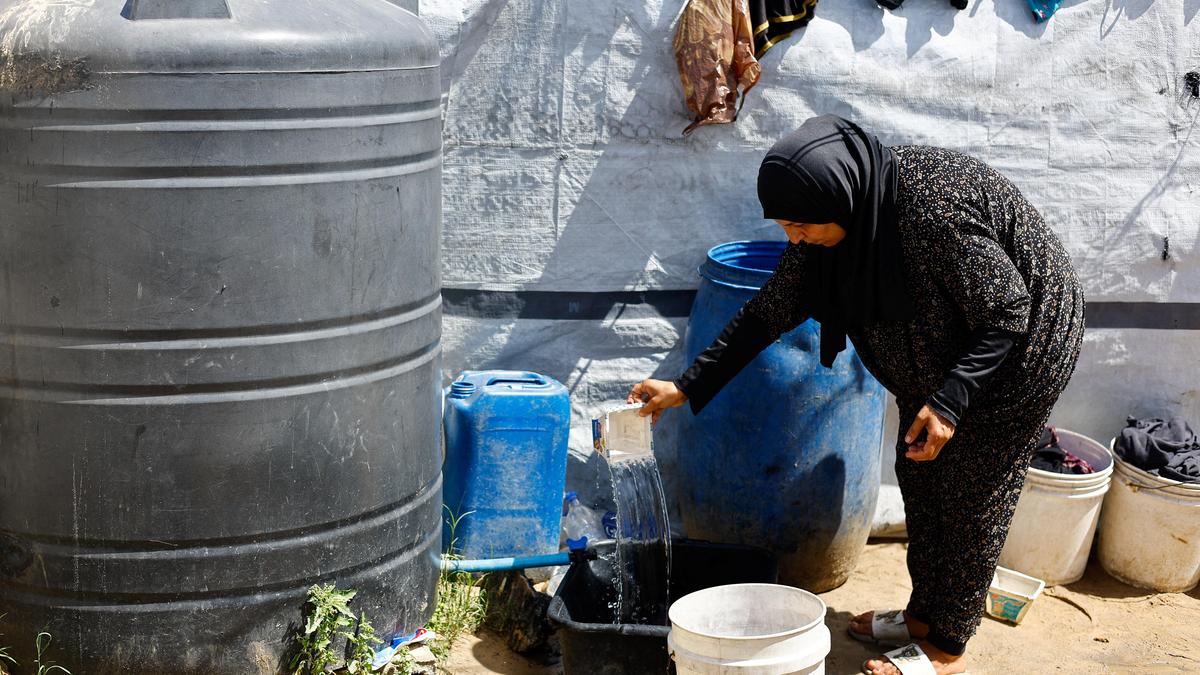
Israel Accused of Weaponizing Water Access in Gaza as Humanitarian Crisis Deepens
GAZA — In a stark condemnation of Israel’s military operations in the Gaza Strip, the international medical charity Médecins Sans Frontières (MSF), also known as Doctors Without Borders, has accused Israeli forces of systematically depriving Palestinians in Gaza of access to clean water, describing the tactic as a form of “collective punishment.” The allegations, detailed in a report released on Monday, paint a dire picture of a population on the brink of a public health catastrophe, with nearly 90% of Gaza’s water and sanitation infrastructure either damaged or destroyed since the escalation of hostilities in October 2023.
MSF’s findings, which cite data from the United Nations, the European Union, and the World Bank, highlight the deliberate targeting of critical water facilities, including desalination plants, boreholes, pipelines, and sewage systems. The charity documented multiple incidents where its clearly marked water trucks and boreholes were either shot at or rendered inoperable, further exacerbating an already critical situation. “The weaponization of water is not just a violation of international humanitarian law; We see a direct assault on the survival of an entire population,” an MSF spokesperson told World Today Journal in a statement verified by independent sources.
The humanitarian crisis in Gaza has reached unprecedented levels, with the United Nations Office for the Coordination of Humanitarian Affairs (OCHA) reporting that over 2.2 million people—nearly the entire population of the Gaza Strip—are facing acute water shortages. The World Health Organization (WHO) has warned that the lack of clean water is fueling outbreaks of waterborne diseases, including cholera and dysentery, which are particularly deadly for children and the elderly. “The situation is catastrophic,” said Dr. Richard Brennan, WHO’s Regional Emergency Director for the Eastern Mediterranean. “Without immediate access to clean water, we are looking at a potential public health disaster that could claim thousands of lives.”
The Collapse of Gaza’s Water Infrastructure
Gaza’s water infrastructure was already fragile before the current conflict, relying heavily on a network of desalination plants and groundwater wells to meet the needs of its densely populated urban centers. According to a 2023 report by the United Nations Relief and Works Agency for Palestine Refugees (UNRWA), Gaza’s water supply was barely sufficient to meet 50% of the population’s daily needs, even under normal conditions. The recent destruction of key facilities has pushed the system to the brink of total collapse.
MSF’s report details the extent of the damage, noting that nearly 90% of Gaza’s water and sanitation infrastructure has been either destroyed or severely damaged since October 2023. Among the hardest-hit facilities are the Gaza Strip’s three main desalination plants, which collectively provided nearly 40% of the region’s potable water before the conflict. The largest of these, the Southern Gaza Desalination Plant, was rendered inoperable after sustaining direct hits during airstrikes in November 2023, according to OCHA’s December 2023 situation report. The remaining two plants, located in Khan Younis and Deir al-Balah, have been operating at less than 20% capacity due to fuel shortages and structural damage.
Groundwater wells, which supply the majority of Gaza’s remaining water, have also been targeted. The Palestinian Water Authority (PWA) estimates that over 150 of Gaza’s 250 operational wells have been damaged or destroyed, with many others inaccessible due to ongoing military operations. “The wells that are still functioning are barely able to meet the needs of the population,” said Monther Shoblak, director of the PWA, in a statement released on April 25, 2026. “We are pumping water at a fraction of our capacity, and even then, the water is often contaminated due to the destruction of sewage systems.”
Targeting of Humanitarian Aid and Water Trucks
One of the most alarming aspects of MSF’s report is the documentation of attacks on clearly marked humanitarian aid convoys and water distribution points. The charity provided detailed accounts of several incidents where its water trucks, bearing the organization’s logo and operating under coordination with local authorities, were fired upon or destroyed. In one instance, an MSF water truck was struck by a projectile near the Al-Shifa Hospital in Gaza City in March 2026, killing the driver and injuring two aid workers. The Israeli Defense Forces (IDF) have not commented on the specific incident but have previously stated that they do not target humanitarian workers or facilities.
“These attacks are not isolated incidents,” said MSF’s head of mission in Palestine, Jacob Granger, in a press briefing on April 27, 2026. “They are part of a broader pattern of obstruction that is making it nearly impossible for humanitarian organizations to deliver life-saving assistance. Water is not a luxury; it is a basic human right. Denying people access to it is a violation of international law.”
The targeting of water infrastructure has drawn sharp criticism from the international community. The European Union’s High Representative for Foreign Affairs, Josep Borrell, described the situation as “unacceptable” in a statement released on April 26, 2026, calling on all parties to the conflict to “respect international humanitarian law and ensure the protection of civilians and civilian infrastructure.” The United Nations Security Council has also expressed concern, with Secretary-General António Guterres urging an immediate ceasefire to allow for the delivery of humanitarian aid.
The Human Cost: Disease and Desperation
The collapse of Gaza’s water infrastructure has had devastating consequences for the civilian population. With clean water scarce, many Gazans have been forced to rely on untreated groundwater or contaminated sources, leading to a surge in waterborne diseases. The WHO has reported a sharp increase in cases of acute watery diarrhea, cholera, and hepatitis A, particularly among children under the age of five. In March 2026 alone, the United Nations Children’s Fund (UNICEF) recorded over 10,000 cases of diarrhea in children, a figure that has likely risen in the weeks since.
“The lack of clean water is not just a health issue; it is a matter of survival,” said Lucia Elmi, UNICEF’s Special Representative in the State of Palestine. “Children are dying from preventable diseases because they do not have access to the most basic of necessities. This is a man-made crisis, and it demands an immediate humanitarian response.”
The desperation for water has also led to dangerous practices, such as the consumption of seawater or water from agricultural wells, which are often contaminated with pesticides and fertilizers. In some areas, families have resorted to digging makeshift wells in their backyards, risking contamination from sewage and other pollutants. “People are doing whatever they can to survive,” said an MSF nurse working in a clinic in Rafah. “But without clean water, their chances are slim.”
International Law and the Weaponization of Water
The allegations that Israel is weaponizing water access in Gaza raise serious questions about compliance with international humanitarian law. Under the Geneva Conventions, parties to a conflict are prohibited from targeting civilian infrastructure essential to the survival of the population, including water and sanitation facilities. The deliberate destruction of such infrastructure can constitute a war crime, according to the International Committee of the Red Cross (ICRC).
“The destruction of water infrastructure in Gaza is not just a violation of international law; it is a direct attack on the civilian population,” said Marco Sassòli, a professor of international law at the University of Geneva and a former ICRC legal adviser. “When you deprive people of water, you are not just endangering their health; you are threatening their very existence. This is collective punishment, and it is prohibited under the Geneva Conventions.”
The Israeli government has consistently denied that it is targeting civilian infrastructure, arguing that its military operations are aimed at dismantling Hamas and other militant groups operating in Gaza. In a statement released on April 25, 2026, the IDF claimed that Hamas uses civilian infrastructure, including water facilities, to conceal weapons and command centers. “We take every precaution to minimize civilian harm, but Hamas bears full responsibility for the suffering of the Palestinian people,” the statement read.
Although, human rights organizations have rejected this narrative, pointing to the systematic nature of the attacks on water infrastructure. Amnesty International, in a report published on April 20, 2026, documented multiple instances where water facilities were targeted despite being clearly marked and located far from any known military installations. “The pattern of destruction is too consistent to be accidental,” said Agnès Callamard, Amnesty International’s Secretary General. “This is a deliberate strategy to deprive the civilian population of the most basic necessities of life.”
What Happens Next?
The international community is facing mounting pressure to intervene in the Gaza water crisis. The United Nations has called for an immediate ceasefire to allow for the repair of damaged infrastructure and the delivery of humanitarian aid. The WHO has also urged the establishment of “humanitarian corridors” to ensure the safe passage of water trucks and medical supplies into Gaza.

On April 28, 2026, the UN Security Council is scheduled to hold an emergency session to discuss the situation in Gaza, with water access expected to be a key topic of debate. Meanwhile, humanitarian organizations are scrambling to scale up their operations, despite the risks. MSF has announced plans to deploy additional mobile water treatment units to Gaza in the coming weeks, while UNICEF is working to distribute hygiene kits and oral rehydration salts to families in need.
“The world cannot stand by while an entire population is deprived of water,” said MSF’s Granger. “We need immediate action to restore access to clean water and prevent a public health catastrophe. The lives of millions of people depend on it.”
Key Takeaways
- Nearly 90% of Gaza’s water and sanitation infrastructure has been damaged or destroyed since October 2023, according to data from the UN, EU, and World Bank cited by MSF.
- Over 2.2 million people in Gaza are facing acute water shortages, with the WHO warning of a potential public health disaster due to outbreaks of waterborne diseases.
- MSF has documented multiple attacks on its clearly marked water trucks and boreholes, raising concerns about the targeting of humanitarian aid workers.
- The destruction of water infrastructure is a violation of international humanitarian law, with experts warning that it could constitute a war crime under the Geneva Conventions.
- The UN Security Council is set to hold an emergency session on April 28, 2026, to discuss the crisis, with water access expected to be a key topic.
FAQ
Why is water access so critical in Gaza?
Gaza is one of the most densely populated areas in the world, with over 2.2 million people living in a small coastal enclave. Before the current conflict, Gaza’s water infrastructure was already struggling to meet the needs of the population, with over 95% of the available water deemed unfit for human consumption due to contamination. The recent destruction of key facilities has pushed the system to the brink of collapse, leaving millions without access to clean water.
What is the legal status of targeting water infrastructure in war?
Under international humanitarian law, parties to a conflict are prohibited from targeting civilian infrastructure essential to the survival of the population, including water and sanitation facilities. The deliberate destruction of such infrastructure can constitute a war crime, according to the International Committee of the Red Cross (ICRC). The Geneva Conventions explicitly prohibit collective punishment, which includes the deprivation of essential resources like water.
What can be done to address the crisis?
Humanitarian organizations are calling for an immediate ceasefire to allow for the repair of damaged infrastructure and the delivery of aid. The establishment of “humanitarian corridors” has also been proposed to ensure the safe passage of water trucks and medical supplies into Gaza. The international community is being urged to pressure all parties to the conflict to respect international humanitarian law and protect civilian infrastructure.
As the situation in Gaza continues to deteriorate, the world is watching to spot whether the international community will take decisive action to address what MSF has described as a “man-made catastrophe.” For now, the people of Gaza are left to grapple with the devastating consequences of a conflict that has left them without one of the most basic necessities of life: clean water.
We will continue to monitor developments and provide updates as new information becomes available. If you have questions or insights on this story, please share them in the comments below or on our social media channels. Your voice matters in shaping the global conversation on this critical issue.