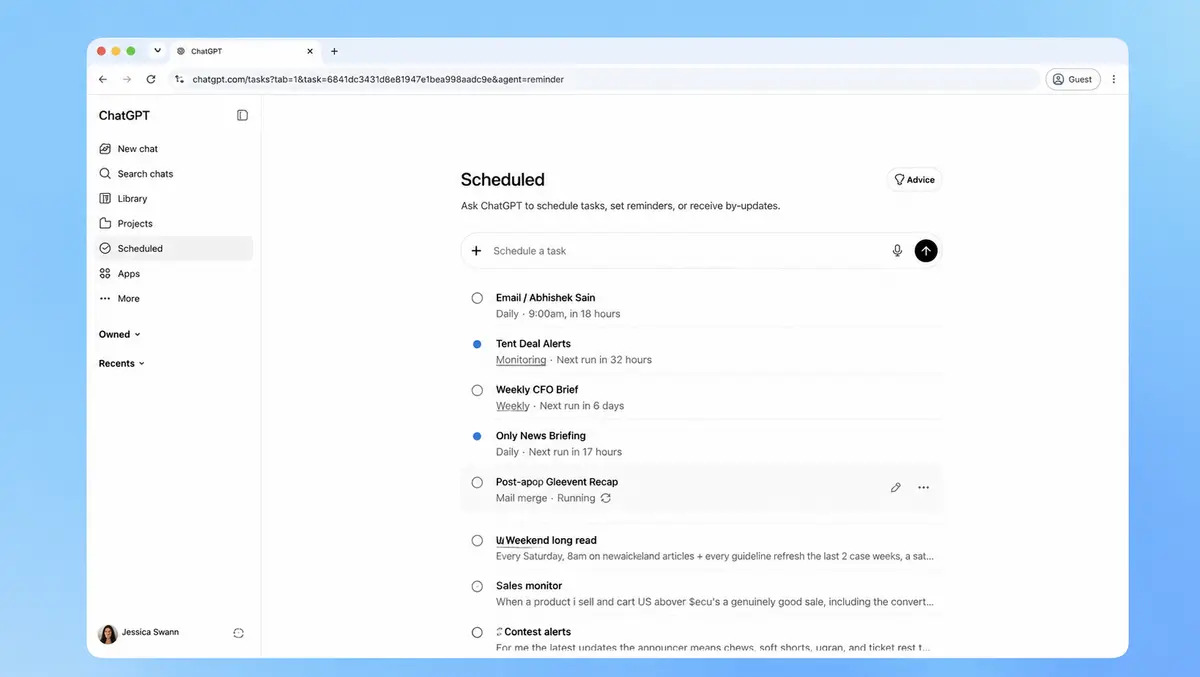
OpenAI has introduced a centralized management interface for ChatGPT scheduled tasks, allowing users to track recurring prompts and reminders from a single sidebar location. This update integrates functionality previously associated with the company’s internal “Pulse” project directly into the main ChatGPT interface, according to recent platform updates from OpenAI.
The new hub allows users to view, edit, and delete scheduled interactions without navigating through individual chat histories. By consolidating these automated workflows, the company aims to improve the utility of ChatGPT for professional and personal productivity, as confirmed by official support documentation regarding the platform’s evolving feature set.
Consolidating Automated Workflows
The primary change involves moving task management to a dedicated sidebar page. Previously, users often had to rely on manual inputs or scattered chat threads to manage recurring outputs. By folding the logic behind the Pulse initiative into the standard sidebar, OpenAI has created a more cohesive environment for users who rely on the platform for daily briefings or routine data analysis, as noted by industry reporting on recent interface adjustments.
This transition reflects a broader trend in generative AI development: moving from simple, single-turn query responses to persistent, agentic workflows. As users increasingly integrate large language models into their daily routines, the ability to manage the “when” and “how often” of AI interactions becomes as important as the quality of the model’s output itself. This shift is consistent with the company’s documented focus on increasing the practical utility of their subscription-based services.
Why Interface Centralization Matters
Centralization solves a significant friction point for power users. When tasks are buried within specific conversation threads, they become difficult to audit or modify. A dedicated hub provides a bird’s-eye view of all active scheduled triggers, which is essential for preventing redundant prompts or managing API-related usage costs. According to tech analysts monitoring AI product cycles, this type of interface refinement is a standard maturity step for platforms transitioning from experimental tools to enterprise-grade productivity suites.

The move also suggests that OpenAI is prioritizing the “agentic” capabilities of ChatGPT. By allowing the system to handle recurring checks—such as monitoring news summaries, tracking project updates, or performing routine data formatting—the platform shifts from a passive chatbot to an active assistant. This development aligns with the technical roadmap outlined in recent research publications, which emphasize autonomous task execution as a key pillar for future model iterations.
Who Is Affected by the Update
The update is currently rolling out to ChatGPT users with access to advanced task scheduling features. The impact is most significant for professionals who use the platform for repetitive tasks, such as generating daily reports or summarizing recurring logs. For these users, the sidebar hub provides a much-needed layer of administrative control, effectively reducing the time spent on manual prompt management.
Casual users may see fewer changes, but the update lays the groundwork for more complex automation in the future. As OpenAI continues to refine its service terms and platform capabilities, the ability to schedule tasks will likely become a standard feature for both free and paid tiers. Organizations that rely on ChatGPT for internal workflows should monitor their sidebar for the new management icon, which indicates that the feature is active for their specific account.
Future Developments
The next checkpoint for these scheduling features will likely involve deeper integration with external APIs and third-party software ecosystems. While the current sidebar hub focuses on internal task management, users can expect further refinements in how the model handles cross-platform triggers. For the latest status on feature availability, users are encouraged to monitor the official OpenAI status page for announcements regarding platform updates.

What has been your experience with managing recurring tasks within ChatGPT? Are you finding the new sidebar hub a helpful addition to your daily workflow? Share your thoughts in the comments below, or join the discussion on our social media channels to see how other users are leveraging these new automation tools.
Keep reading