
Scientists using China’s Large High Altitude Air Shower Observatory have identified the binary system Cygnus X-3 as the most powerful cosmic particle accelerator discovered to date.
Researchers operating China’s Large High Altitude Air Shower Observatory have redefined what scientists thought possible in high-energy astrophysics. Located on a mountain in southwest China’s Sichuan Province at an elevation of about 4,410 meters above sea level, the installation spans 1.36 square kilometers and serves as a premier hub for cosmic ray and gamma-ray observation.
Decoding the Power of Cygnus X-3
The system consists of a compact object—either a black hole or a neutron star—paired with a massive companion star, specifically identified by researchers as a Wolf-Rayet star. As the compact object accretes material from the intense stellar wind of its companion, it creates extreme conditions that accelerate particles to staggering velocities.
For years, mainstream astrophysical theories held that charged particles originating within the Milky Way could only reach energy thresholds of about 1 PeV (peta-electron volt). Through detailed analysis of time variability and spectral characteristics captured by the facility, researchers confirmed that Cygnus X-3 can accelerate cosmic-ray particles to energies of at least 30 PeV.
Through detailed analysis of the time variability and spectral characteristics of ultra-high-energy gamma rays, LHAASO has confirmed that Cygnus X-3 can accelerate cosmic-ray particles to energies of at least 30 PeV.
Cao Zhen, principal investigator of LHAASO and an academician of CAS
Periodic Signals and Compact Region Constraints
Beyond measuring record-breaking energy levels, the observatory detected a distinct 4.8-hour periodicity in the ultra-high-energy gamma-ray signal. By analyzing this rhythm, scientists successfully constrained the particle acceleration region to roughly three times the solar radius.
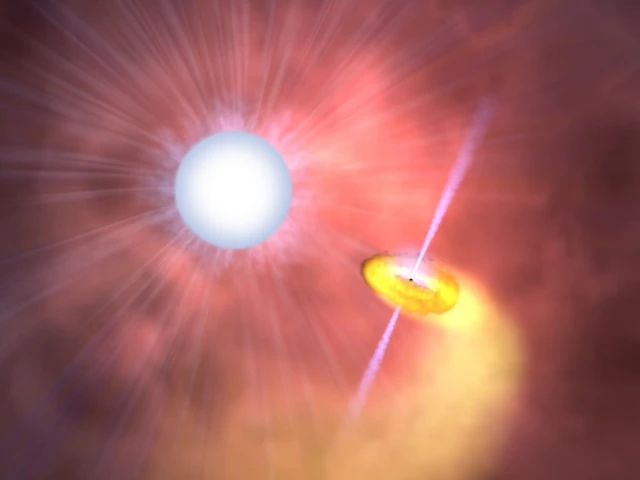
According to findings released by the Institute of High Energy Physics of the Chinese Academy of Sciences, these insights open new avenues for investigating extreme physical processes near dense celestial objects. The complete research findings have been published in the journal National Science Review, marking a significant milestone for cosmic-ray research at the high-altitude facility in Sichuan Province.
Worth a look