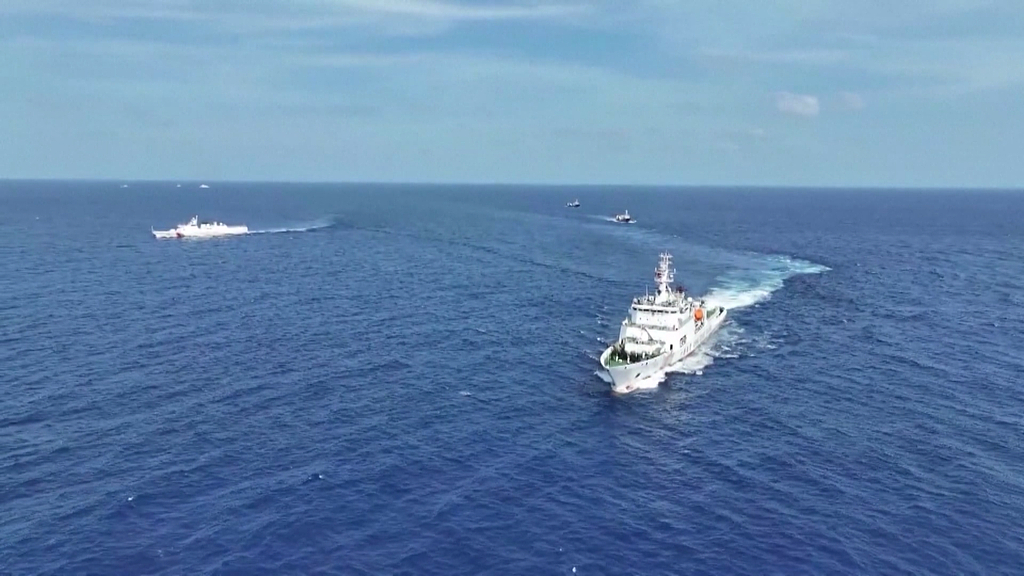
Manila, Philippines – The Philippines has expressed serious concerns to China following a recent escalation in rhetoric between officials from both countries regarding the ongoing territorial dispute in the South China Sea. The diplomatic friction centers on China’s increasingly assertive actions in the disputed waters, a situation that has prompted the Philippine government to publicly condemn Beijing’s behavior and seek international support.
The Philippine Department of Foreign Affairs stated Monday it had conveyed its “serious concerns with the escalation of public exchanges” to the Chinese Ambassador and Embassy. This move comes after a period of heightened tension, sparked by comments from Philippine Coast Guard spokesperson Commodore Jay Tarriela, a vocal critic of China’s activities in the region. The department warned that these exchanges could “unnecessarily derail the diplomatic space needed to manage the tensions in the maritime domain,” while simultaneously reaffirming its support for Philippine officials defending the nation’s territorial interests.
South China Sea Dispute: A Long-Standing Conflict
The dispute over the South China Sea is a complex geopolitical issue involving multiple claimant states, including China, the Philippines, Vietnam, Malaysia, Brunei, and Taiwan. China asserts sovereignty over nearly the entire South China Sea, a claim that overlaps with the exclusive economic zones of other nations in the region. This expansive claim is based on historical grounds, but is contested by other countries and invalidated by a 2016 international arbitration ruling. The Council on Foreign Relations’ Global Conflict Tracker details the history and complexities of these disputes.
The Philippines, in particular, refers to the contested areas as the West Philippine Sea. In 1999, the Philippines intentionally grounded a ship, the BRP Sierra Madre, at the Second Thomas Shoal, a submerged reef in the Spratly Islands, to reinforce its territorial claims. This vessel remains occupied by a small contingent of Philippine marines, and China’s attempts to interfere with resupply missions to the ship have been a major source of tension.
Recent Escalation and Chinese Response
The current escalation began after Commodore Tarriela criticized China’s actions, prompting a strong response from the Chinese Ministry of Foreign Affairs. Beijing summoned Philippine Ambassador Jaime FlorCruz to protest Tarriela’s remarks. The Philippines has consistently and openly condemned China’s growing assertiveness in the South China Sea, a stance that differentiates it from other claimant states. According to the Associated Press, this open condemnation has been a key characteristic of the Philippine government’s approach to the dispute.
The tensions were further highlighted by an incident on February 18, 2025, where a Chinese military helicopter flew close to a Philippine Bureau of Fisheries and Aquatic Resources (BFAR) aircraft above Scarborough Shoal. This incident, captured in a photograph released by the BFAR, underscored the potential for direct confrontation in the disputed waters.
U.S. Concerns and Support for the Philippines
The United States has consistently expressed its concerns over China’s actions in the South China Sea and reaffirmed its commitment to supporting the Philippines. On October 13, 2025, the U.S. State Department condemned China’s ramming and water cannoning of a Philippine Bureau of Fisheries and Aquatic Resources vessel near Second Thomas Shoal. The U.S. Reiterated its treaty obligations to the Philippines, stating that an armed attack on Philippine vessels, aircraft, or armed forces in the South China Sea would trigger its mutual defense commitments.
This incident, and the broader pattern of Chinese behavior, has raised concerns about freedom of navigation and the potential for miscalculation in the region. The U.S. Navy regularly conducts freedom of navigation operations in the South China Sea to challenge China’s excessive maritime claims, a practice that has drawn criticism from Beijing.
The 2016 Arbitration Ruling
A key element of the dispute is the 2016 ruling by the Permanent Court of Arbitration in The Hague. The tribunal found that China’s “nine-dash line,” which it uses to claim vast swathes of the South China Sea, had no legal basis under the United Nations Convention on the Law of the Sea (UNCLOS). Beijing, however, rejected the ruling and continues to assert its claims, refusing to participate in the arbitration process initiated by the Philippines in 2013 following a territorial confrontation.
Impact on Regional Stability and International Law
The ongoing dispute in the South China Sea has significant implications for regional stability and the international rules-based order. China’s disregard for the 2016 arbitration ruling undermines the authority of international law and sets a dangerous precedent for other territorial disputes around the world. The increasing militarization of the South China Sea, with China building artificial islands and deploying military assets, further exacerbates tensions and raises the risk of conflict.
The dispute also affects the livelihoods of fishermen and other communities in the region, as access to fishing grounds and marine resources is restricted by China’s actions. The Philippines, in particular, has voiced concerns about the impact on its fishing industry and the food security of its citizens.
What Happens Next?
The Philippines has indicated it will continue to pursue diplomatic solutions to the dispute, while also strengthening its defense capabilities and seeking support from its allies, including the United States. Further dialogue between the two countries is expected, but the prospects for a breakthrough remain uncertain given China’s unwavering stance on its claims. The next key development will likely be the outcome of ongoing diplomatic efforts to establish a code of conduct for the South China Sea, a set of rules aimed at managing disputes and preventing conflict. Negotiations on the code of conduct have been ongoing for years, but progress has been unhurried.
The situation remains fluid and requires careful monitoring. The international community has a vital role to play in upholding international law and promoting peaceful resolution of the dispute.
What are your thoughts on the escalating tensions in the South China Sea? Share your comments below and join the conversation.
Keep reading