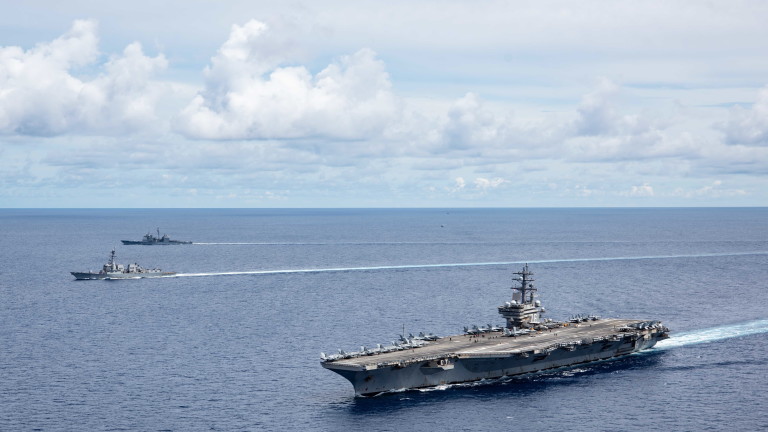
China has issued a stern warning to the United States, the Philippines and Japan, urging them not to “play with fire” amid escalating military exercises in the South China Sea. The statement, delivered by China’s Ministry of National Defense, comes as the three nations prepare for their largest-ever joint drills, dubbed Exercise Balikatan 2024, which began in early April and involve live-fire maneuvers near disputed territories. Beijing views these activities as a direct provocation aimed at challenging its sovereignty claims in the region.
The warning reflects growing tensions in one of the world’s most strategically vital maritime corridors, where competing territorial assertions have long fueled diplomatic friction. China maintains that nearly the entire South China Sea falls within its historic “nine-dash line,” a claim rejected by an international tribunal in 2016 but still asserted by Beijing. The Philippines, Vietnam, Malaysia, Brunei, and Taiwan also have overlapping claims, making the area a flashpoint for potential conflict.
According to verified reports from the Philippine Armed Forces, Exercise Balikatan 2024 includes over 17,600 personnel — 11,000 from the U.S. And 6,600 from the Philippines — marking the largest iteration of the annual drill since its inception in 1991. The exercises, which run through April 26, feature amphibious landings, urban combat training, and maritime interdiction operations near Palawan and Luzon, islands situated close to the Spratly Islands, where China has built artificial islands equipped with military infrastructure.
China’s Defense Ministry spokesperson, Wu Qian, stated during a regular briefing on April 10 that such maneuvers “undermine regional peace and stability” and could trigger unintended confrontations. He emphasized that China remains committed to resolving disputes through dialogue but will not hesitate to defend its territorial integrity if provoked. “We urge the relevant parties to stop playing with fire and instead contribute to regional cooperation,” Wu said, as reported by China’s official Xinhua News Agency.
The United States has consistently maintained that its military presence in the Indo-Pacific is aimed at upholding freedom of navigation and supporting allies under mutual defense treaties. The U.S.-Philippines Mutual Defense Treaty, signed in 1951, obligates both nations to assist each other if either is attacked by an external force. Washington has repeatedly rejected China’s expansive claims, conducting its own freedom of navigation operations (FONOPs) in the South China Sea to challenge what it views as unlawful maritime restrictions.
Japan, while not a claimant in the South China Sea, has increased its security cooperation with the Philippines and the U.S. In recent years, citing shared concerns over China’s growing assertiveness. In March 2024, Japan announced a modern defense equipment transfer agreement with the Philippines, including patrol vessels and radar systems, to enhance Manila’s maritime domain awareness. Tokyo has also participated in trilateral exercises with Washington and Manila, signaling a deeper alignment in response to regional security challenges.
Analysts at the International Institute for Strategic Studies (IISS) note that the scale and timing of Exercise Balikatan 2024 reflect a broader shift in U.S. Indo-Pacific strategy, which prioritizes strengthening alliances and enhancing interoperability with regional partners. “The drills are less about immediate combat readiness and more about signaling resolve,” said Richard Bitzinger, a senior fellow at IISS. “China interprets this as containment, while the U.S. And its allies frame it as deterrence.”
Despite the heated rhetoric, diplomatic channels remain open. Senior officials from China and the U.S. Held virtual talks in March to manage crisis risks, and both sides have agreed to resume high-level military dialogue later in 2024. The Philippines, meanwhile, continues to balance its defense ties with Washington against economic engagement with Beijing, its largest trading partner.
As the exercises conclude later this week, attention will turn to whether China responds with its own military demonstrations — such as air patrols or naval deployments near the drills — or opts for diplomatic messaging to de-escalate tensions. For now, the South China Sea remains a tense arena where military posturing and diplomatic maneuvering coexist, each step carefully weighed against the risk of miscalculation.
Understanding the Stakes in the South China Sea Dispute
The South China Sea is more than a territorial dispute; it is a critical global thoroughfare through which an estimated $3.4 trillion in annual trade passes, according to the Center for Strategic and International Studies (CSIS). Over 60% of global maritime trade transits these waters, making freedom of navigation a core interest for nations far beyond the region, including those in Europe and the Americas.
China’s construction of artificial islands equipped with airstrips, missile shelters, and radar systems has transformed formerly submerged reefs into permanent military outposts. Satellite imagery analyzed by the Asia Maritime Transparency Initiative (AMTI) shows that Beijing has deployed fighter jets, missile systems, and electronic warfare equipment to at least three of its outposts in the Spratlys since 2020.
Claimant nations argue that these installations violate the United Nations Convention on the Law of the Sea (UNCLOS), which grants exclusive economic zones (EEZs) extending 200 nautical miles from coastlines. The 2016 arbitral ruling, brought by the Philippines under UNCLOS Annex VII, concluded that China’s nine-dash line has no legal basis and that its activities caused severe environmental harm and violated Philippine sovereign rights. China refused to participate in the proceedings and rejects the ruling as “null and void.”
The U.S., while not a signatory to UNCLOS, advocates for its principles as customary international law. Washington conducts regular FONOPs to assert navigational rights and challenge excessive maritime claims, regardless of origin. In 2023 alone, the U.S. Navy conducted seven such operations in the South China Sea, targeting restrictions imposed by China, Vietnam, and Taiwan.
For the Philippines, the stakes are existential. Manila relies on the sea for fisheries, energy exploration, and national security. The country has faced repeated incidents of Chinese maritime militia vessels blocking resupply missions to its troops stationed on Second Thomas Shoal, a feature it administers despite being within China’s claimed nine-dash line. These gray-zone tactics — using civilian vessels to assert control without triggering open conflict — have become a hallmark of Beijing’s strategy in the region.
Japan’s involvement stems from its own security concerns in the East China Sea, where it disputes sovereignty over the Senkaku Islands (claimed by China as Diaoyu) with Beijing. Tokyo views any weakening of the rules-based maritime order in the South China Sea as a potential precedent for similar challenges in its northern waters.
What Exercise Balikatan 2024 Entails
Exercise Balikatan, which means “shoulder-to-shoulder” in Tagalog, is an annual bilateral military exercise between the United States and the Philippines, now in its 39th year. The 2024 iteration marks the first time Japan has participated as a full observer with plans to increase involvement in future years, reflecting deepening trilateral coordination.
The two-week drill includes live-fire exercises, cyber defense simulations, humanitarian assistance drills, and special operations training. A key component this year is the testing of the U.S. Army’s Multi-Domain Task Force (MDTF) concept, designed to operate across land, sea, air, space, and cyber domains in contested environments. The MDTF deployed its Long-Range Precision Fires (LRPF) capability during the exercise, simulating strikes on maritime targets beyond visual range.
Amphibious landings were conducted at Palauig in Zambales province and Lal-lo in Cagayan, locations chosen for their proximity to potential flashpoints. U.S. Marines and Filipino forces practiced securing beachheads under simulated enemy fire, followed by inland advances to secure objectives. These maneuvers are intended to improve interoperability and readiness for scenarios ranging from natural disasters to armed conflict.
Humanitarian civic action projects were also conducted in remote communities, including medical missions, engineering support, and school repairs — a traditional aspect of Balikatan aimed at building goodwill and demonstrating the non-combat value of military partnerships.
Environmental safeguards were implemented throughout the exercise to minimize ecological impact, particularly in marine protected areas. The Armed Forces of the Philippines coordinated with local environmental agencies to monitor for pollution or habitat disruption, adhering to both national regulations and international best practices.
Regional Reactions and the Path Forward
Reactions to the exercises have been mixed across Southeast Asia. Vietnam and Malaysia, while not participating, have expressed concern over the potential for escalation but stopped short of criticizing the drills directly, mindful of maintaining balanced relations with all major powers. Indonesia, as the current chair of ASEAN, reiterated the importance of maintaining the South China Sea as a zone of peace, freedom, and stability in line with the 2002 Declaration on the Conduct of Parties in the South China Sea (DOC).
ASEAN has long sought to negotiate a binding Code of Conduct (COC) with China to manage disputes and prevent incidents. Although framework agreements were adopted in 2022, substantive talks have stalled over disagreements regarding the COC’s legal status, scope, and enforcement mechanisms. China prefers a non-binding agreement focused on confidence-building measures, while many ASEAN members push for a legally enforceable framework that includes third-party dispute resolution.
The United States has welcomed ASEAN’s centrality in regional architecture but has also encouraged claimants to strengthen their capabilities to resist coercion. Through the Indo-Pacific Strategy, Washington has pledged billions in security assistance to partners like the Philippines and Vietnam, including coastal radar systems, patrol boats, and training programs.
China, for its part, has accused the U.S. Of turning the Indo-Pacific into a “geopolitical chessboard” and warned that external interference will only prolong instability. Beijing continues to promote its own vision of regional order through initiatives like the Global Security Initiative, which emphasizes mutual respect and win-win cooperation — principles it says are undermined by alliance-based deterrence.
As of mid-April 2024, no incidents have been reported during Exercise Balikatan 2024, and all participating forces have maintained standard safety protocols. The next major development to watch is China’s scheduled announcement of its biannual defense white paper, expected later in 2024, which may offer further insight into its strategic posture toward the South China Sea and Indo-Pacific security dynamics.
For readers seeking ongoing updates, official sources include the Philippine Department of National Defense website, the U.S. Indo-Pacific Command news portal, and China’s Ministry of National Defense releases. These platforms provide verified information on exercises, statements, and policy developments.
If you found this analysis informative, consider sharing it with others interested in global security affairs. We welcome thoughtful comments and perspectives on how nations can navigate complex territorial disputes without resorting to confrontation.
Worth a look