
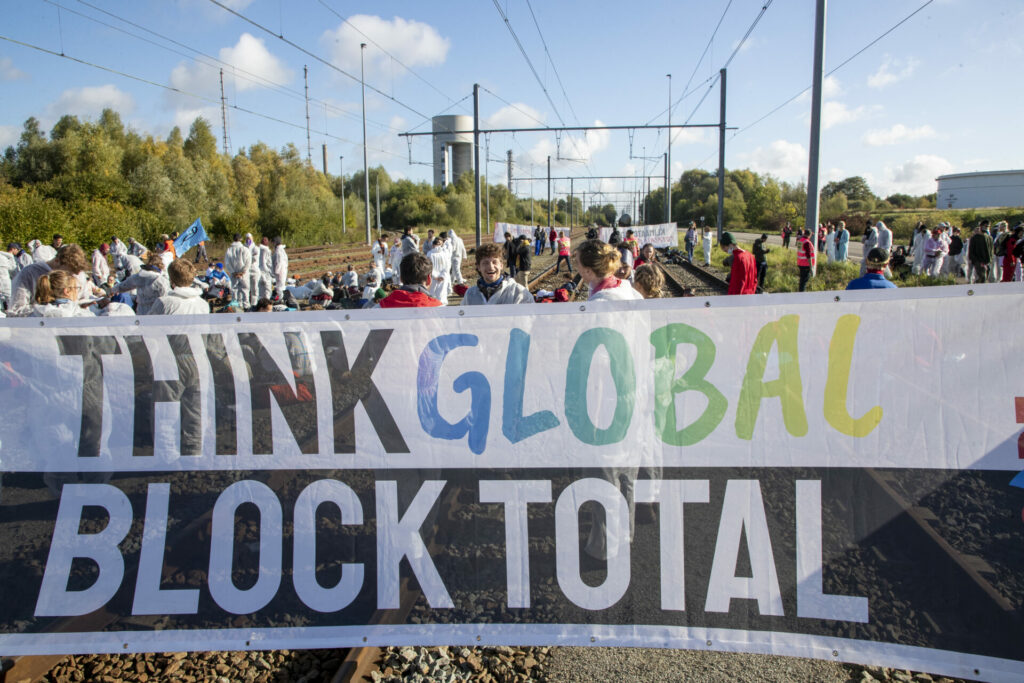
Climate activists targeting the economic arteries of Europe’s largest maritime hub have triggered a significant disruption in the Netherlands, bringing freight operations to a standstill in a calculated effort to pressure the fossil fuel industry. Members of the activist group Geef Tegengas occupied key sections of the Havenspoorlijn, the critical railway line serving the Port of Rotterdam, specifically blocking transit near the Vondelingenweg area.
The operation was not designed as a mere symbolic gesture. According to the organizers, the primary objective of the Rotterdam port rail blockade was to inflict direct financial damage on the logistics chains that support the transport of oil and gas. By halting the flow of goods, the group aimed to demonstrate that the continued prioritization of corporate profit over environmental stability is no longer a sustainable model for the region or the planet.
The blockade forced a sudden halt to freight traffic, creating a ripple effect across the port’s logistics network. Dutch law enforcement intervened shortly after the occupation began, eventually removing the protesters from the tracks to restore the flow of commerce. While the physical blockade was temporary, the incident highlights a growing trend in climate activism: moving away from general public protests toward the strategic disruption of high-value infrastructure.
This escalation reflects a deepening frustration among Dutch environmentalists regarding the pace of the energy transition. The Port of Rotterdam, as a central gateway for energy products entering Europe, remains a primary target for those seeking to accelerate the phase-out of fossil fuels.
The Strategy of Economic Disruption
The choice of the Havenspoorlijn was highly strategic. As the main rail artery connecting the port’s terminals to the hinterland, any disruption on this line immediately impacts the efficiency of the entire supply chain. Geef Tegengas explicitly stated that the intent was to cause financial losses, arguing that economic pressure is the most effective lever for forcing systemic change within the energy sector.
This “economic sabotage” approach differs from traditional climate marches. Instead of appealing to public sentiment, the group targeted the “money machine” of the petroleum industry. By blocking the transport of refined products and raw materials, the activists sought to make the cost of maintaining fossil fuel infrastructure higher than the cost of transitioning to green alternatives.
The Port of Rotterdam is not only the largest port in Europe but also one of the most significant clusters of petrochemical industry in the world. According to the Port of Rotterdam Authority, the port is currently undergoing a massive transition toward becoming a carbon-neutral hub, yet activists argue that the transition is too slow and still too reliant on “bridge fuels” like natural gas.
Who is Geef Tegengas?
Geef Tegengas (which translates roughly to “Give Counter-gas” or “Push Back”) is a Dutch climate action collective known for its more confrontational tactics. Unlike larger, more institutionalized NGOs, this group focuses on direct action and the disruption of fossil fuel infrastructure. Their philosophy centers on the belief that the climate crisis is an emergency that justifies the temporary suspension of “business as usual” to prevent long-term ecological collapse.
The group’s focus on the Port of Rotterdam is part of a broader campaign to highlight the contradiction between the Netherlands’ international climate commitments and the continued expansion or maintenance of fossil fuel terminals. By targeting the logistics of the port, they aim to visualize the invisible flow of carbon that fuels the European economy.
The blockade at Vondelingenweg is one of several actions the group has undertaken to draw attention to the environmental impact of the Botlek and Maasvlakte industrial areas. These regions are critical for the Dutch economy but are also significant sources of localized pollution and global greenhouse gas emissions.
Impact on Freight and Logistics
The disruption of the Havenspoorlijn caused immediate delays for rail freight operators. In a highly synchronized logistics environment where trains are scheduled with precision to move containers and tankers, a blockade of even a few hours can result in significant scheduling conflicts across the national rail network managed by ProRail.
Freight logistics in the port are essential for the distribution of energy products throughout the Benelux region and Germany. When rail lines are blocked, companies are often forced to divert cargo to road transport, which not only increases costs but also contradicts the port’s stated goal of reducing the carbon footprint of its inland shipping and transport.
The removal of the protesters by police was handled as a matter of public safety and economic security. While the protesters remained non-violent, the risk of rail accidents and the high economic cost of the standstill prompted a swift response from the Rotterdam police department.
Key Logistics Impact Points
- Supply Chain Delays: Immediate halting of freight trains moving between the terminals and the mainland.
- Diversion Costs: Potential shift to road transport, increasing congestion on local highways.
- Financial Loss: Direct costs to logistics firms and energy companies due to idling assets and missed delivery windows.
- Operational Friction: Increased security presence and monitoring of rail infrastructure to prevent repeat occurrences.
The Broader Context of Dutch Climate Activism
The actions of Geef Tegengas fit into a wider European pattern of “critical infrastructure” protests. From the blocking of highways in Germany to the targeting of oil pipelines in the UK, climate activists are increasingly focusing on the physical points of failure in the fossil fuel economy.
In the Netherlands, this movement has evolved from the broad-based protests of Extinction Rebellion toward more specialized, tactically focused groups. The shift reflects a belief that awareness is no longer the primary goal—since most of the public is already aware of climate change—and that the new goal must be the actual cessation of fossil fuel activity.
The legal landscape in the Netherlands has also played a role in shaping these protests. Following landmark court cases where the Dutch government was ordered to reduce emissions more aggressively, activists feel they have a legal and moral mandate to push the state and private corporations to meet those targets.
Comparison of Activism Strategies
| Strategy | Primary Goal | Typical Tactic | Target |
|---|---|---|---|
| Awareness-Based | Public Education | Marches, Petitions | General Public/Government |
| Political Pressure | Policy Change | Lobbying, Legal Suits | Legislators/Courts |
| Economic Disruption | Financial Cost | Infrastructure Blockades | Corporations/Supply Chains |
Legal and Security Implications
Following the removal of the activists, the individuals involved face potential charges related to trespassing and the disruption of critical infrastructure. Under Dutch law, blocking a railway is treated with significant severity due to the inherent safety risks associated with high-speed freight and passenger rail.

The Port of Rotterdam and local authorities have indicated that security measures around the Havenspoorlijn and other sensitive logistics nodes will be reviewed. The tension between the right to protest and the need to maintain the flow of essential goods remains a point of contention in the Dutch legal system.
However, for Geef Tegengas, the legal repercussions are viewed as a secondary concern. The group maintains that the “crime” of continuing to destroy the planet’s climate far outweighs the legal infraction of standing on a railway track. This ideological divide suggests that as the climate crisis intensifies, the frequency of such disruptions is likely to increase.
What Which means for the Energy Transition
The Rotterdam port rail blockade serves as a stark reminder of the friction inherent in the energy transition. While the Port of Rotterdam aims to be a leader in hydrogen and carbon capture, it still functions as a primary hub for the very fuels the activists are protesting. This duality creates a volatile environment where the port is simultaneously a symbol of the “old” carbon economy and the “new” green economy.
Industry analysts suggest that while these protests cause short-term financial pain, they also accelerate the conversation around “stranded assets”—the idea that fossil fuel infrastructure will become economically unviable long before its physical lifespan ends. By forcing a financial cost on these assets today, activists are attempting to accelerate the divestment process.
For the global audience, the events in Rotterdam reflect a microcosm of the struggle occurring in industrial hubs worldwide. Whether it is the Port of Rotterdam, the refineries of the Gulf Coast, or the coal terminals of Australia, the conflict between immediate economic utility and long-term ecological survival is playing out in the physical space of logistics and transport.
The next confirmed checkpoint for these developments will be the legal proceedings regarding the arrests made during the blockade, which will likely further test the boundaries of climate-related civil disobedience in the Netherlands.
World Today Journal encourages readers to share their perspectives on the balance between economic stability and climate urgency in the comments below.