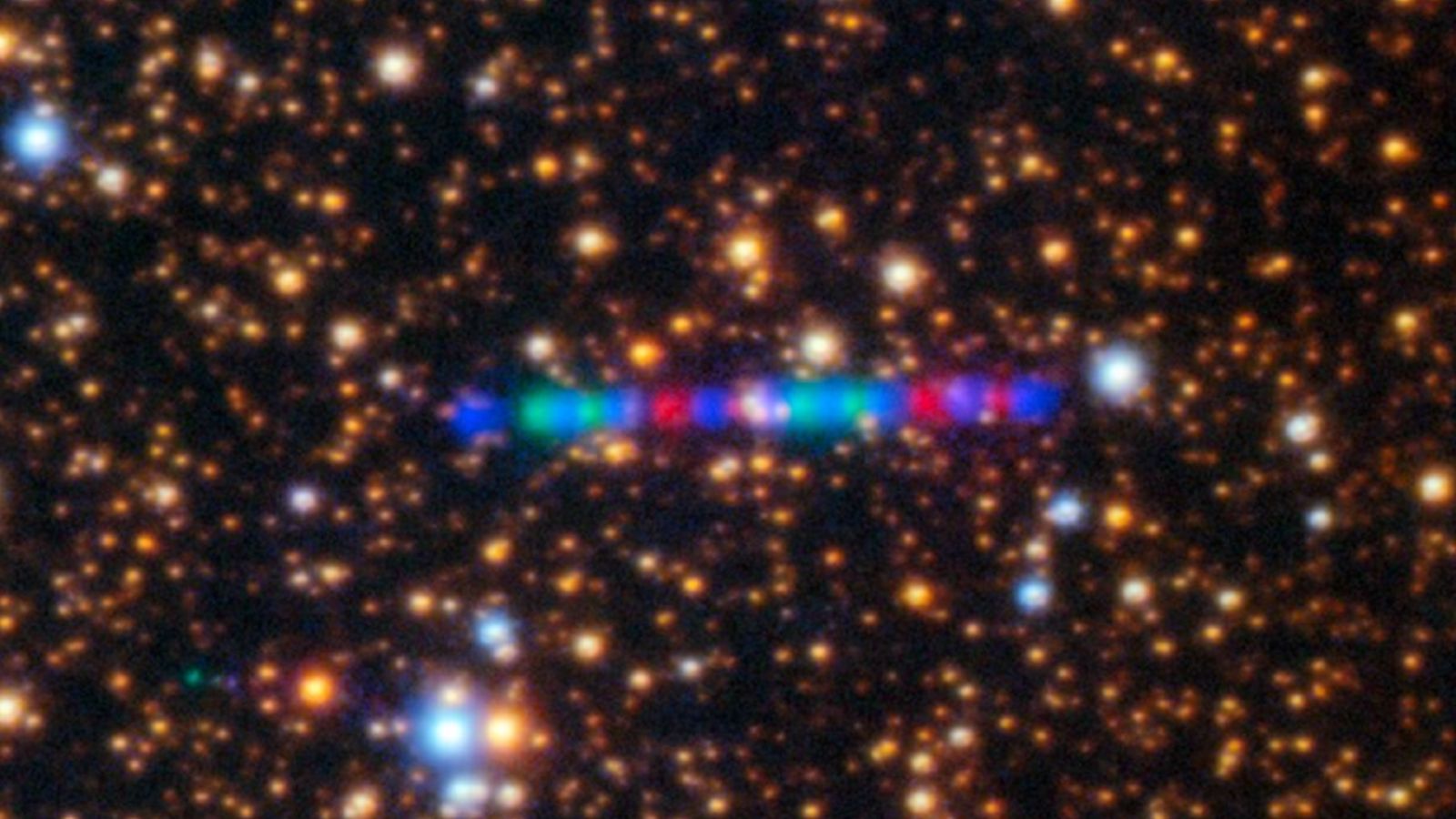
A Once-in-a-Lifetime Opportunity: Spacecraft May Intersect an Interstellar Comet’s Tail
An extraordinary cosmic coincidence is unfolding, potentially offering a unique opportunity to study an interstellar comet up close. Two spacecraft – the European Space Agency’s Hera and NASA’s Europa Clipper – are on trajectories that could take them through the tail of comet 3I/ATLAS, a visitor from beyond our solar system. This unexpected alignment presents a chance to gather invaluable data about the comet’s composition and its interaction with the solar wind, but time is of the essence.
Understanding the Interstellar Visitor
Comet 3I/ATLAS is not your typical comet. Originating from interstellar space, it offers a rare glimpse into the building blocks of planetary systems around other stars. As this comet journeys closer to the Sun, its icy nucleus releases gas and dust, forming a coma (the cloud surrounding the comet) and a tail.
The tail isn’t a static structure. It’s sculpted by the solar wind – a constant stream of charged particles emanating from the Sun. The speed of this wind is critical.It dictates how the comet’s ions (electrically charged particles) are carried away, and thus, precisely where a spacecraft needs to be to collect data directly from the tail.
Predicting the Path: The Tailcatcher Model
Scientists are using a elegant model called ”tailcatcher” to predict the comet’s tail’s path.This model estimates where the cometary ions will travel based on varying solar wind speeds. It then calculates the closest possible approach for each spacecraft to the tail’s central axis.
However,there’s a significant challenge. Accurate solar wind data is frequently enough only available after the fact, making real-time adjustments to spacecraft trajectories arduous. Despite this limitation,current estimates suggest both Hera and europa Clipper could pass within 8 to 8.2 million kilometers of the tail’s central axis. This distance, while vast, is well within range for data collection, especially considering the expansive nature of tails from active comets like 3I/ATLAS.
A Serendipitous Alignment – But With Caveats
This potential fly-through isn’t without its complexities. Here’s a breakdown of the situation:
* Hera’s Limitations: Unluckily, Hera lacks the necessary instruments to directly detect the ions within the tail or the magnetic disturbances it creates in the solar wind.
* Europa Clipper’s Advantage: Europa Clipper,however,is equipped with the right tools. Its plasma instrument and magnetometer are perfectly suited to detect these ions and magnetic field changes.
* Time Sensitivity: Mission controllers need to act quickly. Whether they’ll receive and implement the necessary adjustments in time remains uncertain.
What Could We Learn?
If accomplished, this unplanned encounter could yield groundbreaking insights:
* Interstellar composition: Direct sampling of the comet’s tail would reveal the chemical makeup of a planetary system beyond our own.
* Solar wind Interaction: Studying how the comet’s tail interacts with the solar wind will enhance our understanding of space weather and its effects on our solar system.
* Magnetic Field Dynamics: Observing the “draping structure” – how the comet’s atmosphere alters the solar wind’s magnetic field – will provide valuable data on plasma physics.
A Historic Opportunity
This is more than just a scientific endeavor; it’s a chance to make history. If mission control teams act on this data,Hera and Europa Clipper could become the first spacecraft to directly sample the tail of an interstellar comet. It’s a remarkable possibility, one that wasn’t part of either mission’s original plan, but could deliver extraordinary returns.
Learn More:
* Hera and Europa Clipper Will Pass through 3I/ATLAS Tail – Universe Today
* Earth’s Magnetic Field - Live Science
Related reading