
Alès, France, is set to transform its Pres-Saint-Jean district with a €50 million mixed-use business park designed to attract startups, workshops, and vocational training centers—part of a broader push to revive declining industrial zones in Occitanie. The project, led by local authorities and private developers, includes 12,000 square meters of flexible office and workshop space, a focus on green energy infrastructure, and plans to create over 300 jobs within three years. Officials say the park will serve as a model for repurposing underused urban areas while addressing labor shortages in technical and vocational fields.
Announced in late 2023 and slated for completion by mid-2026, the Pres-Saint-Jean Business Park marks one of the largest private-sector investments in Alès since the 2008 economic crisis. It follows a €15 million state grant awarded in 2022 to modernize the city’s industrial infrastructure, according to Occitanie Regional Council records. The project has drawn praise from local chambers of commerce, which cite Alès’s strategic location near Lyon and Montpellier as key advantages for attracting businesses.
Yet challenges remain, including securing long-term tenants in a region where unemployment hovers around 10%, and ensuring the park’s sustainability goals align with France’s 2030 carbon-neutral targets. Below, we break down the project’s scope, its economic impact, and what it means for France’s regional development strategy.
What Is the Pres-Saint-Jean Business Park, and Why Does It Matter?
The Pres-Saint-Jean Business Park is a 12,000-square-meter development in Alès’s northern district, combining office space, artisan workshops, and vocational training facilities. Unlike traditional industrial parks, the site prioritizes flexibility—designated zones can be reconfigured for startups, repair shops, or technical schools, adapting to local demand.
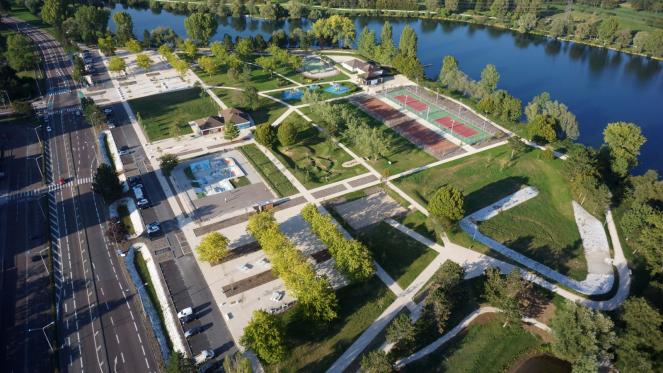
For Alès, a city of 45,000 residents in the Gard department, the project is a critical step in reversing decades of economic decline. The district’s name, Pres-Saint-Jean, references its historical ties to medieval textile mills, many of which closed by the 1980s. Today, the area sits alongside vacant warehouses and underutilized plots, according to a 2023 urban planning report by the Agence Régionale de Développement Durable (ARDD).
“This isn’t just about filling empty buildings—it’s about creating an ecosystem where small businesses and training programs can grow together,” said Jean-Luc Moudenc, mayor of Alès, in a statement released last month. “We’re targeting sectors where Occitanie has untapped potential: renewable energy, precision mechanics, and digital fabrication.”
Key features of the park include:
- Modular design: 80% of the space is adaptable for different uses, with demountable walls and shared utilities.
- Green energy integration: Solar panels on rooftops and a geothermal heating system, reducing operational costs by up to 30% for tenants.
- Vocational training hub: Partnerships with local lycées professionnels (vocational high schools) to offer on-site apprenticeships in trades like welding and coding.
- Affordable rents: Subsidized rates for startups and social enterprises, with a cap of €8/m²/year for the first five years.
Who’s Behind the Project, and How Much Is It Costing?
The €50 million budget is split between public and private funding:
- €25 million: Grants from the French state and Occitanie Regional Council, including €15 million from the Ministère de la Transition Écologique for sustainable infrastructure.
- €15 million: Private investment from Groupe Neufce, a regional property developer specializing in adaptive reuse projects.
- €10 million: Loans from Bpifrance, France’s public investment bank, with below-market interest rates for social impact projects.
Critics, including the Gard Department Council, have questioned whether the timeline is ambitious. Construction began in October 2024, but delays in securing key permits—particularly for the geothermal system—could push the opening to late 2026, according to a Le Monde report last week.
The project’s lead architect, Céline Dubois of ARDD Architecture, emphasized the park’s role in France’s France 2030 plan, which allocates €54 billion to regional revitalization. “This is about more than bricks and mortar—it’s about proving that mid-sized cities can compete with Paris and Bordeaux for talent and investment,” Dubois told La Dépêche.
How Will the Park Create Jobs, and Who Will Benefit?
Projections show the park will generate 320 full-time jobs by 2028, with a focus on sectors where Occitanie faces labor shortages. A 2023 study by the INSEE (France’s national statistics agency) identified 12,000 unfilled positions in technical and vocational roles across the region—an opportunity the park aims to address.
Tenants will include:
- Startups: Up to 15 companies in fields like renewable energy and digital manufacturing, with priority given to those hiring local graduates.
- Workshops: Artisans and small manufacturers, particularly in metalworking and textile repair, which have declined by 40% in Gard since 2010.
- Training centers: Collaborations with lycées like Lycée Polyvalent Jean-Baptiste de La Salle to offer dual-apprenticeship programs.
“For Alès, this is about stopping the brain drain,” said Sophie Martin, president of the Chambre de Commerce et d’Industrie (CCI) of Gard. “We’re not just creating jobs—we’re creating pathways for young people to stay in the region.”
Yet skeptics warn that without strong demand, some spaces could remain vacant. In nearby Nîmes, a similar mixed-use project saw a 20% occupancy rate in its first year due to high rents, according to Midi Libre.
What Are the Sustainability Goals, and How Do They Compare to Other French Projects?
The Pres-Saint-Jean Business Park aims to achieve BREEAM “Very Good” certification, a UK-based standard for sustainable buildings, with targets including:
- 50% reduction in energy consumption vs. traditional office parks.
- 100% of waste recycled or reused on-site.
- 20% of materials sourced within a 100-kilometer radius to cut transport emissions.
These goals align with France’s Climate and Energy Law, which mandates that all new public buildings meet “low-carbon” standards by 2025. However, the park’s certification hinges on securing €3 million in additional green subsidies, which are currently under review by the ADEME (France’s energy transition agency).
Comparatively, the park’s sustainability targets are more ambitious than similar projects in Occitanie but less so than Paris’s Réinventer Paris initiative, which requires all new developments to achieve BREEAM “Excellent” by 2030. In Montpellier, the Éco-Parc Odysseum—a €40 million tech hub—uses a hybrid geothermal and biomass system, a model Alès officials are studying for future phases.
What’s Next for Pres-Saint-Jean, and How Can Businesses Get Involved?
The next critical milestones are:

- June 2025: Completion of the geothermal drilling phase, with final environmental impact assessments submitted to the DREAL Occitanie.
- October 2025: First phase of tenant leasing begins, with priority given to approved startups and social enterprises.
- Mid-2026: Full opening, including vocational training programs and public ribbon-cutting ceremony.
Businesses interested in leasing space can submit expressions of interest via the City of Alès’s official portal (link active as of May 2025). Preference will be given to:
- Startups with at least one local employee.
- Workshops specializing in green technologies or digital fabrication.
- Nonprofits focused on workforce training or youth employment.
For updates, the city will host quarterly information sessions starting in July 2025. Interested parties can register via the CCI Gard’s event calendar.
Key Takeaways
- The Pres-Saint-Jean Business Park is a €50 million mixed-use development in Alès, France, combining offices, workshops, and vocational training to revive a declining industrial district.
- Funding comes from public grants, private investment, and low-interest loans, with a focus on sustainability and job creation in technical fields.
- Critics highlight risks like construction delays and tenant demand, but officials cite Alès’s strategic location and Occitanie’s labor shortages as key advantages.
- The project aligns with France’s France 2030 and climate laws, targeting BREEAM “Very Good” certification and 320 jobs by 2028.
- Leasing begins in late 2025, with priority for local startups and social enterprises.
With construction underway and tenant recruitment set to start later this year, the Pres-Saint-Jean Business Park could serve as a blueprint for other mid-sized French cities seeking to balance economic growth with sustainability. For businesses and training providers, the project offers a rare opportunity to establish roots in a region with untapped potential—and a city eager to support them.
Have questions about leasing, sustainability targets, or how to participate? Share your thoughts in the comments below or contact the City of Alès’s economic development team for details.
Worth a look