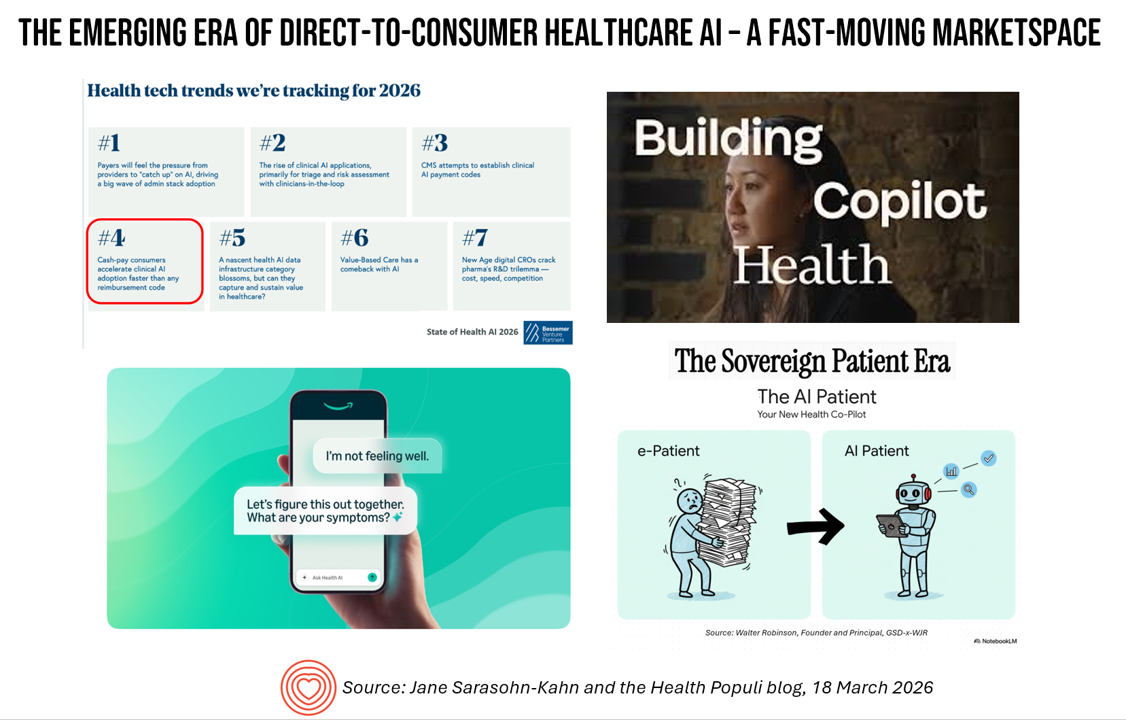
In early 2026, the direct-to-consumer healthcare AI landscape is accelerating rapidly, with major technology companies launching new tools that promise personalized medical insights, symptom evaluation, and care navigation—often without requiring insurance reimbursement or physician oversight. This surge follows growing consumer interest in taking greater control of their health through accessible, AI-powered platforms, a trend highlighted by industry analysts and physicians alike. As these tools move from experimental pilots to widespread availability, questions about safety, accuracy, privacy, and the appropriate role of AI in self-care are becoming increasingly urgent for users, regulators, and healthcare providers.
The momentum behind consumer health AI reflects a broader shift in how people engage with their well-being. Rather than waiting for traditional healthcare systems to adopt new technologies, many individuals—particularly younger adults—are embracing AI as a first point of contact for health questions. This “Sovereign Patient” mindset, as described by health futurist Walter Robinson, emphasizes personal agency, health literacy, and the apply of digital tools to prepare for clinical encounters. However, experts like Dr. Eric Topol warn that the rapid pace of commercial deployment may outstrip the evidence needed to ensure these tools are safe and effective for high-stakes medical decisions.
One of the most notable developments came in March 2026, when CVS Health and Google Cloud announced a strategic partnership to launch Health100, an omnichannel, agentic-AI platform designed to help consumers manage their health journey. According to the companies’ joint press release, the platform aims to provide real-time proactive support, improve access to care, increase cost transparency, and integrate pharmacist-led care management as a trusted clinical touchpoint. The announcement positioned Health100 as a response to consumer demand for tools that reduce the burden of navigating healthcare while empowering users with actionable insights.
Around the same time, Amazon expanded its Health AI agent to all U.S.-based Prime members, offering free access to personalized medical advice through its app and website. Built on technology from its acquisition of One Medical in 2022, the service can explain lab results, summarize diagnoses, answer medication questions, and facilitate prescription renewals through Amazon Pharmacy or a user’s preferred pharmacy. When professional care is needed, the AI connects users directly to One Medical providers via messaging, video, or in-person visits. Amazon describes the offering as an “introductory offer” that includes up to five no-cost Direct Message Care treatments—normally priced at $29 each—for eligible Prime members.
Microsoft also advanced its consumer health AI efforts with the launch of Copilot Health, a secure space within its broader Copilot ecosystem designed specifically for medical intelligence. Unlike general-purpose AI assistants, Copilot Health is intended to help users make sense of their personal health data—including information from wearable devices like Fitbit and Oura rings—to arrive at medical appointments better prepared. The company states that Copilot Health does not replace doctors but aims to make clinical visits more effective by helping users inquire the right questions and understand their own health patterns. As of early 2026, Microsoft reported handling over 50 million health-related queries daily through Copilot and related consumer-facing AI tools.
Meanwhile, OpenAI and Anthropic have intensified their competition in the healthcare AI space, each launching integrated medical record tools within days of each other in January 2026. OpenAI’s ChatGPT Health and Anthropic’s Claude for Healthcare were developed following OpenAI’s $100 million acquisition of Torch, a move CB Insights described as signaling the start of a head-to-head race for dominance in clinical AI infrastructure. Both platforms allow users to link their medical records and receive AI-generated explanations, summaries, and guidance—though early evaluations have revealed limitations in high-risk scenarios.
A study published in Nature Medicine in early 2026 raised concerns about the reliability of ChatGPT Health in emergency situations. When tested on simulated patient emergencies, the model failed to provide a definitive response in over 80% of cases, instead requesting additional context to improve its assessment. OpenAI acknowledged that while the tool can support routine health inquiries, it remains a work-in-progress for triage and urgent care applications. The findings underscore the importance of clear user expectations: AI may be helpful for explaining lab results or preparing for appointments, but it should not be relied upon for diagnosing serious or acute conditions without professional oversight.
Legal and privacy experts have also highlighted risks associated with consumer health AI platforms that operate outside traditional healthcare regulatory frameworks. Epstein Baker Green, a law firm specializing in healthcare compliance, noted that many direct-to-consumer AI tools are not covered by HIPAA, meaning user data may be protected only by state privacy laws, consumer protection statutes, and emerging AI transparency requirements. This creates potential vulnerabilities, particularly when sensitive information—such as mental health symptoms or chronic disease management—is shared with third-party wellness companies for product recommendations or targeted advertising.
Phil Alexander, founder and CEO of AnswerMyQ, echoed these concerns in a Forbes interview, stating that the greatest risk in healthcare AI is not a lack of information but uncontrolled interpretation. “If AI is answering benefit or clinical workflow questions,” he said, “those responses have to be compliant, auditable, and role aware. Otherwise, you’ve just moved the confusion upstream.” His warning reflects a growing consensus that AI in health must be designed with clinical workflows, accountability, and patient safety as core principles—not afterthoughts.
Despite these challenges, adoption continues to grow. A Forrester survey cited in Comcast’s 2026 Healthcare Technology Trends report found that 39% of younger adults are comfortable using generative AI tools to evaluate symptoms. Similarly, a RadNet study presented at the Radiological Society of North America (RSNA) in 2024 found that 36% of women were willing to pay $40 out-of-pocket for AI-enhanced mammography screening, indicating strong consumer willingness to invest in AI-driven preventive care even without insurance coverage.
These trends suggest that consumers are not waiting for payment models or regulatory approvals to embrace AI in health. As Bessemer Venture Partners observed, cash-paying users may accelerate clinical AI adoption faster than any reimbursement code could. This shift places new pressure on technology companies to ensure their products are accurate, transparent, and safe—and on healthcare systems to integrate these tools responsibly into clinical workflows rather than resist or ignore them.
For users navigating this evolving landscape, experts recommend starting with low-risk applications: using AI to explain lab results, track fitness metrics, or prepare questions for doctor visits. More complex uses—such as interpreting symptoms, managing chronic conditions, or addressing mental health concerns—should involve clinical oversight. Users are also advised to review privacy policies carefully, understand how their data may be used or shared, and remain cautious about platforms that make definitive medical claims without clear evidence or regulatory clearance.
The future of direct-to-consumer healthcare AI will likely depend on how well companies balance innovation with responsibility. As regulatory bodies begin to examine these tools more closely, and as real-world evidence accumulates from millions of user interactions, clearer standards may emerge for what constitutes safe, effective, and ethical AI in self-care. For now, the era of “Everything, Everywhere, All At Once” in health AI demands both optimism and caution—empowering patients to engage with their health while reminding them that technology, however advanced, is a tool, not a replacement for professional medical judgment.
Official updates on AI in healthcare can be found through the U.S. Food and Drug Administration’s Digital Health Center of Excellence, which provides guidance on software as a medical device (FDA Digital Health). The Federal Trade Commission also offers resources on AI and consumer protection (FTC AI Guidance).
What are your experiences with AI-powered health tools? Have they helped you better understand your health or prepare for medical appointments? Share your thoughts in the comments below, and consider sharing this article with others navigating the growing world of direct-to-consumer healthcare AI.
Keep reading