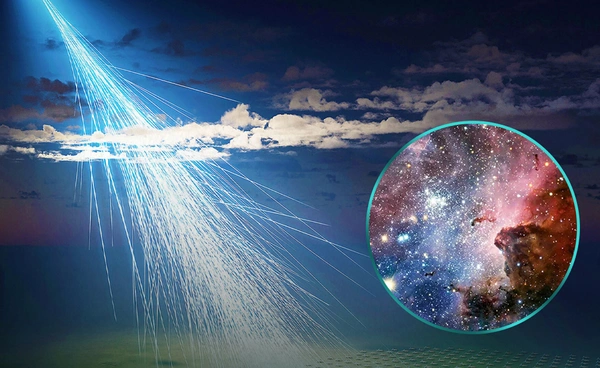
Scientists are intensifying their search for the origins of ultra-high-energy cosmic rays, often dubbed “the goddess particles of the sun,” in an effort to unravel the mysteries surrounding these powerful phenomena. This research, gaining momentum in early 2026, aims to shed light on the sources of cosmic radiation that bombard Earth, potentially revealing recent insights into the workings of the universe.
Cosmic rays, first identified in the early 20th century, are not rays in the traditional electromagnetic sense, but rather high-energy particles—primarily protons and atomic nuclei—traveling through space at nearly the speed of light. Their origins have long been a puzzle for physicists. While it was initially believed they were a form of electromagnetic radiation, scientists now understand they are composed of particles. These particles originate from outside our solar system, impacting Earth’s atmosphere and, occasionally, reaching the surface. Understanding their source is crucial to understanding the broader universe.
Unveiling the Sources of Cosmic Rays
Recent research, bolstered by data from the Large High Altitude Air Shower Observatory (LHAASO) in China, suggests that a significant portion of these cosmic rays originate from supernovae – the explosive deaths of massive stars. As reported in February 2025 by Mahidol University, LHAASO’s observations provide compelling evidence linking supernovae to the production of these high-energy particles. However, supernovae are not believed to be the sole source. Active galactic nuclei, powered by supermassive black holes, are similarly considered potential contributors.
The search for the origins of these particles is complicated by the fact that they are deflected by magnetic fields as they travel through space. This deflection makes it difficult to trace them back to their source. Scientists employ various techniques, including the study of air showers – cascades of secondary particles created when cosmic rays collide with Earth’s atmosphere – to overcome this challenge. The LHAASO observatory, with its large detection area and high altitude, is particularly well-suited for this type of research.
The Role of Black Holes in Particle Acceleration
The connection between black holes and high-energy particle acceleration is a key area of investigation. According to researchers like Prof. Zhen Cao of the Institute of High Energy Physics, Chinese Academy of Science, and Prof. Dr. David Ruffolo of Mahidol University, black holes can act as powerful particle accelerators. The intense gravitational fields around black holes can accelerate particles to incredibly high energies, potentially explaining the origin of the most energetic cosmic rays.
The process by which black holes accelerate particles is not fully understood, but It’s believed to involve complex interactions between magnetic fields and the accretion disk – the swirling mass of gas and dust surrounding the black hole. These interactions can create electric fields that accelerate particles to near-light speed. Further research is needed to fully elucidate the mechanisms involved.
Understanding Cosmic Ray Energy and Impact
Cosmic rays span a vast range of energies. The energy spectrum of cosmic rays extends over many orders of magnitude, from relatively low energies to extremely high energies. The most energetic cosmic rays have energies millions of times greater than those achievable by even the most powerful particle accelerators on Earth. These ultra-high-energy cosmic rays are particularly rare and difficult to detect.
The impact of cosmic rays on Earth is multifaceted. They can interact with the atmosphere, creating secondary particles that contribute to the natural background radiation. They can also affect electronic devices, potentially causing malfunctions in satellites and aircraft. Some scientists believe that cosmic rays may have played a role in the evolution of life on Earth, potentially influencing mutation rates.
Radium and the Atmosphere
As detailed in Wikipedia, cosmic rays can cause “cascading of particles” that penetrate the Earth’s atmosphere. This interaction can have measurable effects on atmospheric composition and processes. The study of these interactions is crucial for understanding the broader impact of cosmic radiation on our planet.
Recent Developments and Future Research
The field of cosmic ray research is rapidly evolving, driven by advancements in detector technology and data analysis techniques. The LHAASO observatory, which began operation in 2021, represents a significant leap forward in our ability to detect and study ultra-high-energy cosmic rays. Its large detection area and high altitude allow it to observe a greater number of air showers, providing a more comprehensive picture of the cosmic ray spectrum.
In February 2026, scientists continue to analyze data from LHAASO and other cosmic ray observatories around the world. These efforts are focused on identifying the sources of cosmic rays, understanding the mechanisms by which they are accelerated, and assessing their impact on Earth. Future research will likely involve the development of even more sensitive detectors and the use of advanced data analysis techniques to unravel the remaining mysteries surrounding these enigmatic particles.
The ongoing investigation into the origins of cosmic rays, often referred to as “the goddess particles of the sun,” is not merely an academic pursuit. It represents a fundamental quest to understand the universe and our place within it. By unraveling the secrets of these high-energy particles, scientists hope to gain new insights into the workings of the cosmos and the forces that shape our world.
The next major update from the LHAASO collaboration is expected in late 2026, when they plan to release a more detailed analysis of their data on the sources of ultra-high-energy cosmic rays. Stay tuned to World Today Journal for continued coverage of this exciting field of research. Share your thoughts and questions in the comments below.
Related reading