
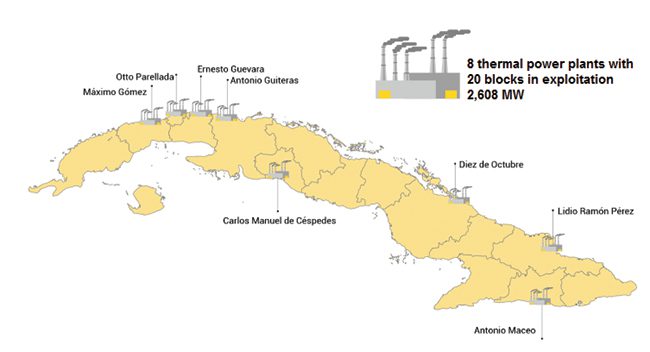
Cuba’s electricity grid is projected to face a critical shortfall of 2,000 megawatts (MW) during peak demand hours, according to the country’s Union of Electric Workers (UNE), threatening widespread blackouts across the island. The announcement comes as thermal power plants—responsible for a significant portion of Cuba’s energy supply—struggle with maintenance and fuel shortages, while officials warn that the situation could worsen without urgent investment.
The projected deficit, which could affect nearly two-thirds of the island’s population simultaneously, highlights the deepening energy crisis in Cuba, where power outages have become a daily reality for millions. According to UNE, the country’s thermal plants—including the frequently malfunctioning Guiteras plant, which has experienced at least 15 failures this year alone—require at least $10 billion in upgrades to meet demand, a figure that underscores the scale of the challenge.
While the government has not yet confirmed the exact timeline for the shortfall, energy experts and independent reports suggest the situation could intensify within weeks, particularly as summer temperatures rise and demand for air conditioning surges. The crisis has already prompted comparisons to past blackouts, including the major island-wide outage in April 2024, which left nearly 67% of Cuba without power for hours.
Why Is Cuba Facing a 2,000 MW Shortfall?
Cuba’s energy grid has been under severe pressure for years, but the current crisis stems from a combination of factors, including:

- Aging infrastructure: Many of Cuba’s thermal power plants date back to the Soviet era and have not received sufficient maintenance or modernization.
- Fuel shortages: The country’s reliance on imported fuel—particularly diesel and heavy fuel oil—has been disrupted by economic sanctions and global supply chain issues.
- Underinvestment: Officials have repeatedly stated that Cuba needs at least $10 billion to upgrade its thermal plants and expand renewable energy sources, a figure that has been cited in multiple reports, including those from Cubanet and 14ymedio.
- Renewable energy delays: While Cuba has made progress in developing wind and solar projects, these have not yet scaled to offset the decline in thermal capacity.
The Guiteras thermal plant, located in the province of Matanzas, has been a particular point of failure, with reports indicating it has malfunctioned at least 15 times since the beginning of 2024. This plant alone accounts for a significant portion of Cuba’s thermal generation, and its repeated outages have exacerbated the overall grid instability.
Who Is Affected and What Are the Consequences?
The projected 2,000 MW shortfall during peak hours—typically between 6 PM and 10 PM—could lead to rolling blackouts or simultaneous power cuts affecting up to 67% of the island’s population, according to Infobae. This would disproportionately impact:

- Hospitals and healthcare facilities: Reliable power is critical for medical equipment, refrigeration of vaccines, and life-support systems.
- Residential areas: Millions of Cubans already face daily power rationing, and further disruptions could worsen living conditions.
- Industrial and agricultural sectors: Factories and farms rely on consistent electricity for production and food storage.
- Tourism infrastructure: While tourism has been a key economic driver, power instability could deter visitors and harm the sector.
In the past, such outages have led to water shortages, disruptions in telecommunications, and increased reliance on generators—many of which use diesel, further straining fuel reserves. The government has yet to announce specific contingency measures, but past responses have included:
- Encouraging the use of solar panels and small-scale generators.
- Implementing strict energy-saving measures in public buildings.
- Rationing power supply by region to prevent total grid collapse.
How Does This Compare to Past Energy Crises in Cuba?
Cuba’s current energy crisis is not unprecedented. The island has faced recurring power shortages for decades, but the scale and frequency of recent outages have raised concerns among officials and analysts. A comparison of key events:
| Event | Year | Impact | Cause |
|---|---|---|---|
| Island-wide blackout | 2004 | Near-total power loss for hours | Hurricane Charley damaged infrastructure |
| Recurring thermal plant failures | 2016–2019 | Daily rationing, 4–8 hours without power | Fuel shortages, maintenance backlogs |
| April 2024 outage | 2024 | 67% of island affected simultaneously | Guiteras plant malfunction, fuel shortages |
| Projected 2,000 MW shortfall | 2024 (imminent) | Potential island-wide disruptions | Thermal plant capacity limits, underinvestment |
While past crises were often tied to natural disasters or fuel embargoes, the current situation reflects a structural failure in Cuba’s energy system. Unlike previous events, the projected shortfall is not tied to a single incident but rather a sustained inability to meet demand—a trend that analysts warn could persist without significant foreign investment or technological upgrades.
What Are the Government’s Next Steps?
As of now, Cuba’s government has not provided a detailed plan to address the 2,000 MW shortfall, but officials have indicated several potential avenues:
- Foreign investment: Cuba has sought partnerships with companies and governments to modernize its energy sector, including discussions with Russian and Chinese firms for thermal plant upgrades.
- Renewable energy expansion: The government has accelerated wind and solar projects, but these require years to scale to meaningful levels.
- Energy rationing: Further restrictions on non-essential power use may be implemented, similar to measures taken during the 2021–2022 energy crisis.
- Emergency fuel imports: Cuba has historically relied on fuel imports from Venezuela and other allies, but sanctions and economic constraints limit these options.
The next critical checkpoint will be the release of official updates from the Ministry of Energy and Mines, which has not yet commented on the UNE’s projections. Analysts suggest that if the shortfall materializes, the government may announce additional measures within the next 30 days, particularly as summer approaches.
Key Takeaways
- Immediate threat: A 2,000 MW shortfall during peak hours could cause island-wide blackouts affecting up to 67% of Cuba’s population.
- Root cause: Aging thermal plants, fuel shortages, and underinvestment in renewable energy are the primary drivers of the crisis.
- Historical context: While Cuba has faced energy shortages before, the current situation reflects a systemic failure rather than a one-time event.
- Government response: No detailed plan has been announced, but officials are expected to rely on foreign investment, rationing, and renewable energy projects.
- Human impact: Hospitals, homes, and industries are most vulnerable, with potential disruptions to healthcare, food supply chains, and tourism.
For real-time updates, residents and businesses are advised to monitor official announcements from the Ministry of Energy and Mines and local energy providers. The situation remains fluid, and further developments are expected in the coming weeks.
This story will be updated as new information becomes available. In the meantime, readers with firsthand accounts or additional details are encouraged to share their experiences in the comments below.