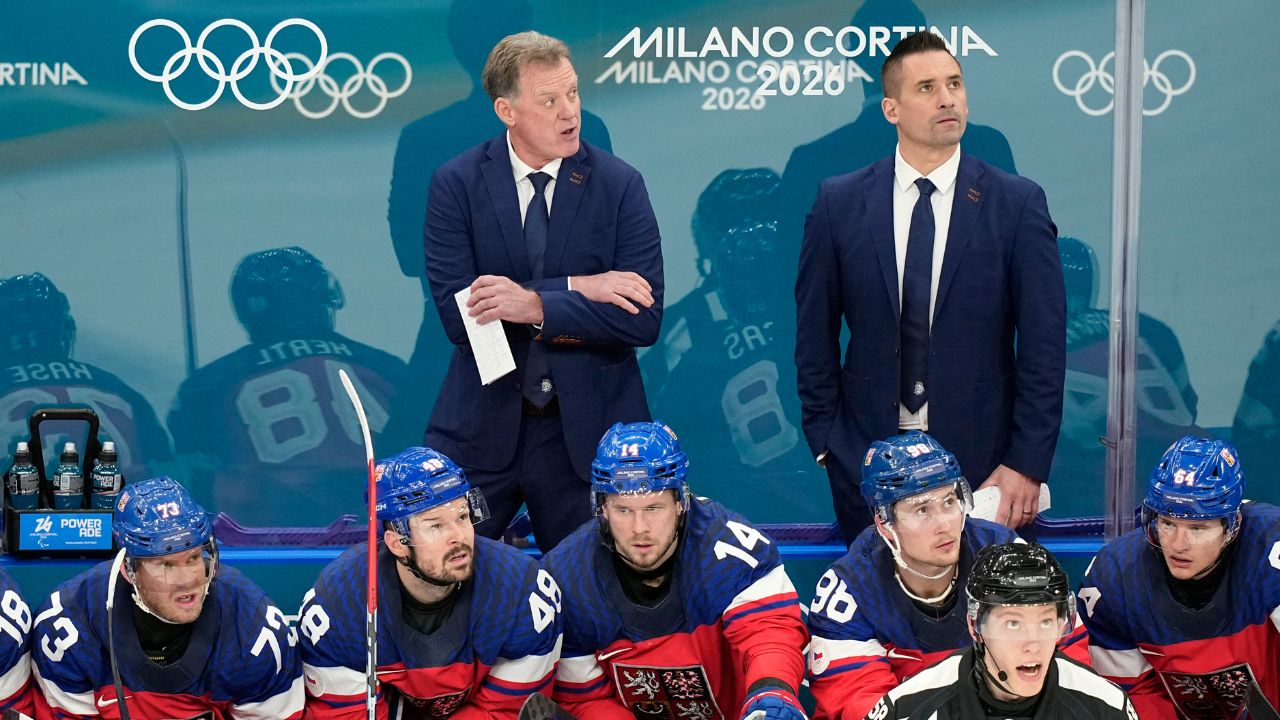
MILAN, Italy – The Czechia men’s hockey team suffered a heartbreaking 4-3 overtime loss to Canada in the quarterfinal round of the 2026 Winter Olympics on Wednesday, but the final score hardly tells the full story. In the aftermath of the defeat, Czechia head coach Radim Rulík unleashed a scathing critique of the officiating, alleging a clear bias against his team and suggesting the referees were intimidated into avoiding calls against the heavily favored Canadians. The controversy centers not only on missed penalties during play but too on an astonishing oversight – a moment where Czechia briefly played with eight skaters on the ice, a violation that went completely unnoticed by the officials.
Rulík’s frustration boiled over in a post-game press conference, where he accused the referees of allowing unacceptable behavior from the Canadian team and expressed a belief that they were afraid to make calls against them. “The referees really worry me. What they’re allowing against us is unacceptable,” Rulík stated, as translated and reported by multiple sources. “After every game, we send them two or three clips where they confirm that the opponent should have been penalized. I don’t understand it. I just don’t get it. I feel like everyone is afraid to call anything against Canada.” The coach went further, claiming his team was effectively “playing against six players,” a sentiment that underscores the depth of his dissatisfaction with the officiating crew.
Missed Calls and a Growing Sense of Frustration
The game, officiated by American Chris Rooney (NHL) and Sweden’s Mikael Holm (SHL), saw Canada awarded three power plays to Czechia’s two. But, the disparity in calls wasn’t the sole source of contention. Rulík pointed to specific instances where he believed his team was unfairly disadvantaged. One such example involved Macklin Celebrini of Canada being called for interference on a play that appeared to be a routine icing call for Czechia, leading to a power-play goal for David Pastrnak. Conversely, a blatant interference on Sidney Crosby by Ondrej Palat, where the Canadian captain was checked into the boards in the neutral zone, went unpenalized.
Adding to the frustration, Rulík felt a penalty called on Radko Gudas for roughing was a “makeup call” stemming from an earlier incident where Gudas injured Crosby. He argued that Drew Doughty of Canada should have received a similar penalty for a hit on Pastrnak. “We should have had power plays against Canada,” Rulík asserted. “But they were afraid Pasta or (Martin) Nečas would score another power-play goal. And if Gudas was penalized, then (Drew) Doughty should have been too for the hit on Pasta.” These perceived inconsistencies fueled Rulík’s belief that the officiating was unfairly skewed in Canada’s favor.
The Unseen Eighth Skater: A Moment of Chaos
However, the most glaring error of the game occurred during the third period, a moment that has sparked widespread discussion and disbelief. In a bizarre sequence, Czechia briefly had eight players on the ice during a play, resulting in six skaters celebrating a go-ahead goal. Astonishingly, the infraction went unnoticed by the officials. “Eight Czech skaters were on the ice. Six gathered to celebrate the go-ahead marker,” reported sources covering the game. “And still, there was no call for too many men.”
The oversight was so complete that even the players themselves were unaware of the extra skater until after the game. Canada’s captain, Connor McDavid, expressed his surprise, stating, “Not aware at all,” twice when questioned about the incident. “I’m not sure how we missed it. Nobody even mentioned it until after the game. So, we’ve got to do a better job paying attention. The refs do too. Everybody can. I feel like everybody missed it. It was kind of a weird play that way, but we have to pay more attention.”
The International Ice Hockey Federation (IIHF) acknowledged the error, confirming that the goal was reviewed but the infraction was missed. An IIHF spokesperson told The Athletic’s Pierre LeBrun that while the mistake was identified during review, “mistakes happen.” Had Canada not ultimately won the game in overtime, the uncalled penalty likely would have ignited a major international controversy.
A History of Disparity? The NHL-European Referee Dynamic
Rulík’s complaints extend beyond the specific game against Canada, highlighting a broader concern about the integration of NHL and European referees at the Olympic level. He believes the differing styles and interpretations of the rules create an uneven playing field. “The mix of NHL and European referees hasn’t worked — everyone calls the game differently,” Rulík explained. He noted that he regularly reviews NHL games and observes that plays like the hooking incident involving Martin Nečas, which went uncalled, are consistently penalized in the North American league.
This disparity in officiating styles raises questions about the consistency and fairness of the game at the highest international level. The 2026 Winter Olympics in Milan and Cortina d’Ampezzo have already seen scrutiny regarding refereeing decisions, and Rulík’s outspoken criticism is likely to fuel further debate about the require for standardized officiating protocols across different leagues and international competitions. The IIHF has not yet responded to requests for comment regarding Rulík’s broader concerns about the refereeing mix.
The Aftermath and What’s Next
Canada ultimately prevailed in overtime, securing a 4-3 victory and advancing to the next round of the Olympic tournament. Czechia’s elimination marks a disappointing end to their Olympic campaign, overshadowed by the controversy surrounding the officiating. The incident has sparked a wider conversation about the role of referees in international hockey and the potential for bias, whether intentional or unintentional, to influence the outcome of games.
The IIHF is expected to review the officiating performance throughout the tournament, and Rulík’s comments are likely to be a key part of that assessment. While the outcome of the game against Canada cannot be changed, the incident serves as a stark reminder of the importance of accurate and consistent officiating in ensuring the integrity of the sport. The focus now shifts to the remaining games of the men’s hockey tournament and whether further officiating controversies will emerge.
The next step for the IIHF is a scheduled meeting on February 22nd to discuss referee assignments for the semi-final matches, as reported by the official IIHF website. Fans and analysts alike will be watching closely to notice if any adjustments are made in response to the concerns raised by Rulík and the broader officiating debate.
What are your thoughts on the officiating in the Czechia-Canada game? Share your opinions and join the discussion in the comments below. Don’t forget to share this article with your fellow hockey fans!
Related reading