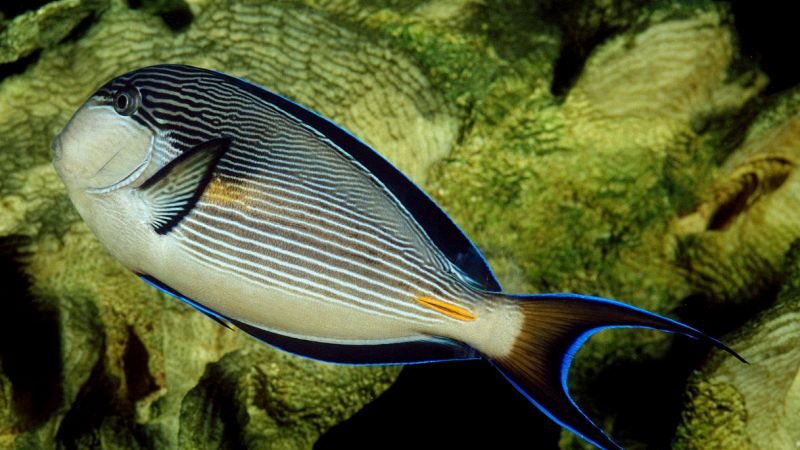
The Adriatic Sea is facing a recent and unexpected challenge as a tropical intruder from the Atlantic Ocean establishes a permanent presence in European waters. The Monrovia surgeonfish in the Adriatic Sea, a species native to the warm waters of Liberia and the eastern Atlantic, has officially migrated into the region, sparking warnings among divers, fishermen, and coastal residents.
Known colloquially as the “fish with the razors” due to its dangerous anatomy, the Acanthurus monroviae is not merely a passing visitor. Recent scientific findings indicate that the species has successfully navigated the Mediterranean and entered the Adriatic via the Strait of Otranto, moving from its ancestral homes in West Africa to the coastlines of Croatia.
The arrival of this species represents a significant shift in local marine biodiversity. Unlike many invasive species that enter the wild via accidental releases from home aquariums, researchers have determined that the Monrovia surgeonfish has migrated naturally, demonstrating a resilient ability to adapt to the changing temperatures and environments of the Mediterranean basin.
The “Scalpel” Fish: Anatomy of a Danger
The Monrovia surgeonfish earns its nickname—and its scientific classification as a “surgeonfish”—from a pair of formidable weapons located at the base of its tail. The fish possesses two erectile bony spines that are as sharp as surgical scalpels according to reports on the species’ characteristics. These spines are used for defense and are deployed through sudden, whip-like movements of the tail, which can cause deep and serious wounds to humans who attempt to touch or handle the fish.
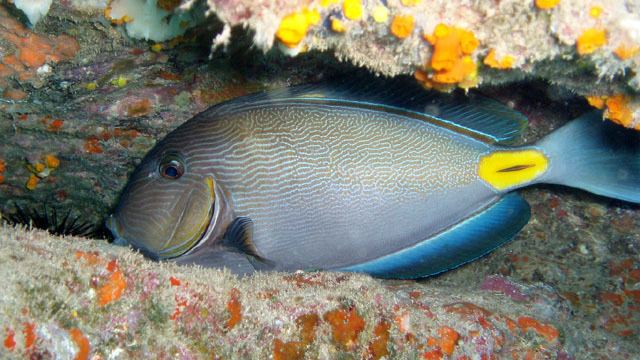
Visually, the fish is designed to warn potential predators of its lethality. Its elliptical body is primarily brownish, marked by 20 longitudinal lines of yellow and blue-violet. Most notably, two prominent oval yellow spots on its flanks surround the caudal blades, serving as a biological warning sign to stay away as documented in recent sightings.
In terms of size, the Acanthurus monroviae is considered a modest-to-medium-sized fish. Typical specimens can reach lengths of 48 centimeters, though some related species in the surgeonfish family can grow as large as 70 centimeters, with an average weight of approximately 500 grams per reported data. While not characterized as extremely aggressive, the fish is highly territorial, which increases the likelihood of defensive strikes if its space is encroached upon.
Scientific Discovery and the Croatian Connection
The official confirmation of the species’ presence in the Adriatic is the result of rigorous documentation by a team of Croatian scholars. The research team—comprising Jakov Dulčić, Pero Ugarković, Jure Miočić-Stošić, and Pero Tutman—documented their findings on the international platform Reabic in a report titled “First report of the Monrovia surgeonfish in the Adriatic Sea”.
The timeline of the invasion began in the summer of 2024. The very first specimen was spotted on June 2, 2024, near the locality of Kostrena, Croatia according to the scientific report. The fish was observed feeding on algae on a rocky seabed at a depth ranging between 3 and 5 meters. Following this initial sighting, subsequent observations and reports by Croatian public television confirmed that the fish was not a solitary wanderer but part of a growing, stable presence in the region.
Key Facts: Acanthurus monroviae in the Adriatic
| Feature | Detail |
|---|---|
| Scientific Name | Acanthurus monroviae |
| Origin | Liberia / Eastern Atlantic |
| First Sighting | June 2, 2024 (Kostrena, Croatia) |
| Primary Weapon | Two erectile bony caudal spines |
| Migration Route | Via the Strait of Otranto |
| Typical Depth | 3 to 5 meters |
What In other words for Marine Safety
The arrival of the Monrovia surgeonfish has set subaquatic enthusiasts and professional fishers on high alert. The primary directive from authorities and researchers is simple: “Do not touch it.” As the fish’s defensive mechanism is a rapid reflex, injuries can occur even if a person is not attempting to capture the animal.
The stability of the population suggests that the Adriatic is becoming a viable habitat for this tropical species, likely aided by rising sea temperatures that allow Atlantic and tropical fish to survive further north. This migration through the Strait of Otranto highlights the increasing permeability of the Mediterranean to non-native species, which can disrupt local ecological balances and pose new risks to human activity in the water.
For those spending time in the waters off the Croatian coast or the wider Adriatic, vigilance is advised. Recognizing the distinctive yellow spots and blue-violet lines of the Acanthurus monroviae is the first step in avoiding a potentially deep and painful injury.
Marine biologists and the team at Reabic continue to monitor the spread of the species to determine if the population will expand toward the Italian coast or remain concentrated in the eastern Adriatic. Further updates on the distribution of the Monrovia surgeonfish are expected as more sightings are logged by the scientific community.
Do you have sightings of unusual marine life in your area? Share your experiences in the comments below or contact our world desk.
Keep reading