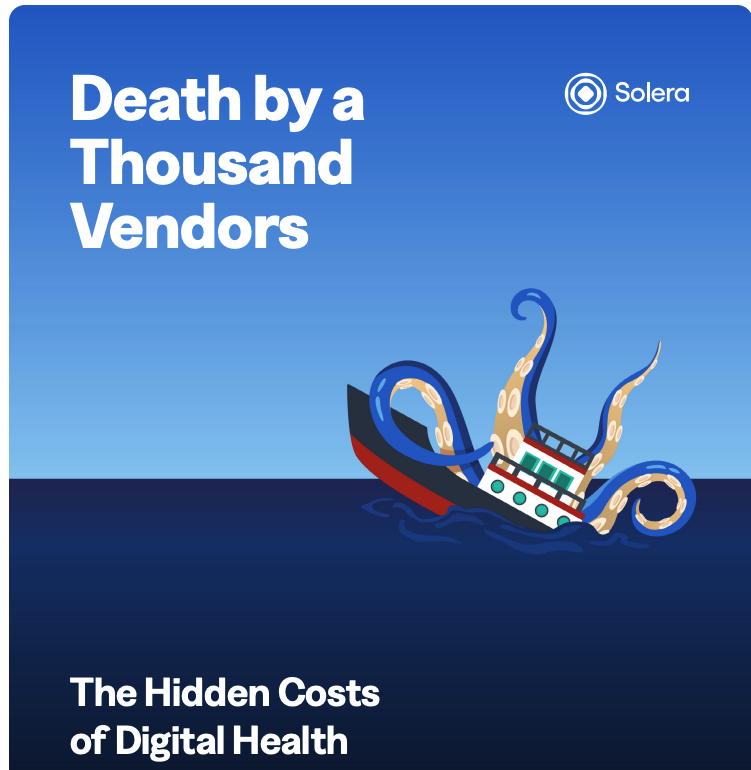
For years, the digital health industry has presented self-insured employers with a seductive promise: for every specific health challenge, there is an app. From diabetes management and physical therapy to mental health and weight loss, the “point solution” era encouraged organizations to build a digital toolkit designed to lower population healthcare costs through targeted, specialized interventions.
Still, a new research report from Solera Health suggests that this additive approach has backfired, creating a phenomenon described as “Death by a Thousand Vendors.” The research reveals that the hidden costs of digital health are no longer just about the subscription fees for the software, but the staggering administrative and operational burden required to keep these fragmented systems running.
The report, titled “Death by a Thousand Vendors: The Hidden Costs of Digital Health,” is based on a survey of 106 senior benefits leaders at organizations with 1,000 or more employees according to industry data. The findings highlight a growing disconnect between the intended strategic impact of digital health investments and the operational reality of managing them.
The Financial Burden of Vendor Fragmentation
The financial scale of digital health adoption is immense, but the “hidden tax” of management is beginning to rival the actual savings these tools were designed to produce. According to the research, 90% of surveyed organizations spend more than $1 million annually on digital health as reported by Solera Health. In some cases, the investment is even higher, with 60% of employers spending $2.5 million or more annually per Globe Newswire.
Beyond the direct cost of the benefits, the operational overhead is significant. The estimated median annual cost of simply managing these vendors—which includes the cost of full-time employees and outside consultants—is approximately $580,000 on top of the actual benefits budget per the Solera report. This creates a precarious financial situation where the cost of administration erodes the potential return on investment (ROI).
The complexity scales as the number of vendors grows. The report found that 75% of employers now manage four or more digital health vendors, although over 40% are juggling eight or more according to Solera’s research. In extreme cases, some large employers are managing 20, 30, or even 40-plus separate point solutions, each requiring its own contract, payment model, eligibility feed, and quarterly review cycle.
The Administrative Treadmill: Time and Human Capital
The burden of this fragmentation falls heavily on HR and benefits teams, who often find themselves trapped on an “administrative treadmill.” The research indicates that 80% of these teams spend five or more hours per week managing vendors, a time drain that pulls them away from high-level strategic planning. The primary sources of this overhead include troubleshooting app issues, fielding employee questions, and managing day-to-day operations.
To cope with this workload, many organizations have been forced to expand their headcount. Nearly 74% of surveyed organizations have dedicated two or more full-time employees solely to managing vendor relationships. When internal capacity is reached, employers often turn to external help. 72% of employers are now hiring outside brokers or consultants to manage the complexity.
Even with additional staffing, the logistical challenges persist. The report notes that in 81% of cases, implementation delays for one solution created a ripple effect that impacted other digital health benefits initiatives, further compounding the operational strain.
An Architecture Problem, Not a Staffing Problem
A critical takeaway from the research is that adding more headcount or budget is not solving the underlying issue. Even organizations that spend over $500,000 on consultants still find themselves intervening in vendor issues on a weekly basis. This suggests that the crisis is not one of insufficient staffing, but of flawed architecture.
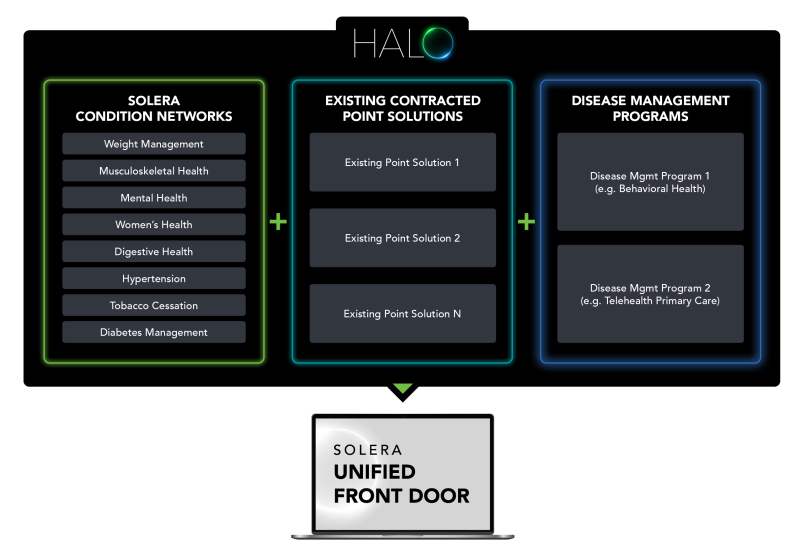
Glenn Alphen, Chief Commercial Officer at Solera Health, emphasizes that while individual programs are often well-intentioned, the cumulative complexity becomes unsustainable. “The catch-22 is that every one of those programs was well-intentioned, but the cumulative complexity becomes so administratively burdensome that CFOs often dismantle the whole thing before it delivers value,” Alphen stated as quoted in Globe Newswire.
The “point solution” model—where separate apps are used for separate conditions—creates silos of care and data. When asked how to alleviate the burden, 43% of benefits leaders pointed to the need for automated feeds and better data integration. Alphen argues that the solution lies in moving toward a single integrated infrastructure, asserting that “Employers are spending six figures just to manage the vendors that were supposed to save them money. That’s not a staffing problem; it’s an architecture problem.”
Key Takeaways from the Solera Health Report
- Vendor Sprawl: 75% of employers manage 4+ digital health vendors; over 40% manage 8+ per Solera Health.
- The Management Tax: The median annual cost to manage these vendors is approximately $580,000, separate from the benefits spend per report data.
- Resource Drain: 80% of teams lose 5+ hours weekly to vendor management, and 74% require 2+ dedicated full-time employees to handle the workload.
- Financial Scale: 90% of organizations spend over $1 million annually on digital health, with 60% spending $2.5 million or more according to research findings.
- Root Cause: The issue is identified as an “architecture problem” caused by fragmented point solutions rather than a lack of HR staffing.
As CFOs and benefits leaders continue to evaluate the ROI of their digital health portfolios, the focus is shifting from the quantity of tools offered to the sustainability of the infrastructure supporting them. The transition toward integrated network models may be the only way to realize the promised savings of digital health without succumbing to the administrative costs of vendor sprawl.
For those seeking further details on the operational impact of digital health complexity, the full research findings can be accessed via the Solera Health benefits leader report.
World Today Journal encourages readers to share their experiences with digital health tools in the comments below. How is your organization managing the balance between innovation and administrative overhead?