
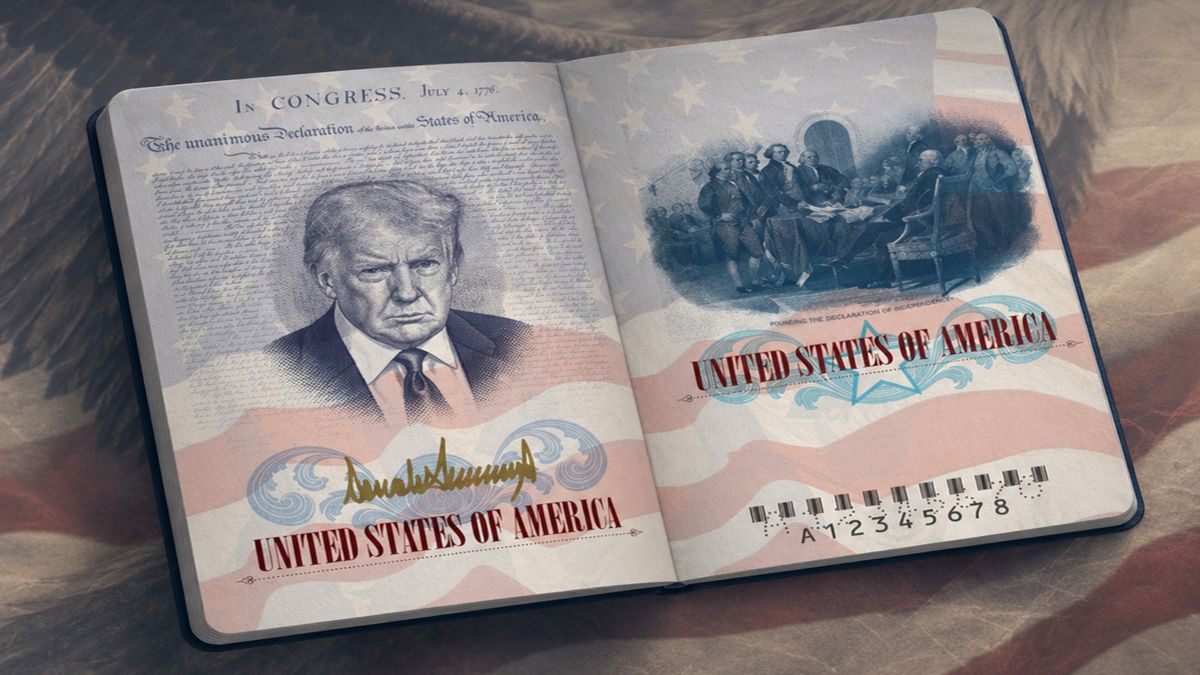
Former U.S. President Donald Trump has unveiled a promotional graphic featuring a mocked-up, limited-edition United States passport bearing his own likeness, a move that has drawn immediate attention to the intersection of political branding and national symbols. The image, shared across his social media platforms, depicts a passport cover embossed with the presidential seal alongside a stylized portrait of the former president, accompanied by a warning regarding the current state of border security.
The release of this digital mockup serves as a continuation of Trump’s ongoing efforts to utilize personalized merchandise and high-profile visual messaging to communicate with his base. While the document is not an official government-issued identity credential, the imagery highlights the former president’s focus on immigration policy, a central pillar of his political platform as he continues to engage with voters ahead of future electoral cycles. According to the U.S. Department of State, the Bureau of Consular Affairs remains the sole authority for the issuance and design of official U.S. passports, which are governed by strict federal regulations under Title 22 of the United States Code.
The Intersection of Political Branding and Federal Identity
The use of national symbols in political campaigns is a long-standing practice, though the application of a candidate’s face onto a document as highly regulated as a passport is an unconventional approach. Political analysts note that such imagery is designed to resonate with supporters who prioritize national sovereignty and strict border enforcement. By framing the passport as a limited-edition item, the campaign taps into the collector-driven market that has characterized much of the recent Trump-branded merchandise, ranging from digital trading cards to specialized apparel.

Official U.S. passports are standardized documents, and the unauthorized manufacture or sale of items that replicate these documents can trigger scrutiny from federal authorities. Under 18 U.S. Code § 1541, the issuance or reproduction of passports without lawful authority is strictly prohibited. While the shared image is presented as a promotional graphic rather than a product for sale, the use of government symbols in political advertising often occupies a complex space in federal election law. The Federal Election Commission (FEC) provides guidance on the use of campaign funds and the depiction of government property, which can be reviewed in the FEC Campaign Guide.
Border Security Policy and Public Discourse
The warning accompanying the image reiterates Trump’s long-standing criticisms of current U.S. immigration policies and border management. Throughout his political career, Trump has consistently emphasized the necessity of physical barriers and more stringent vetting processes for entry into the United States. This messaging remains a primary driver of his engagement with the electorate, as he frequently contrasts his administration’s policies with those of his successors.

Current data regarding U.S. border encounters and immigration enforcement is tracked regularly by U.S. Customs and Border Protection (CBP). The agency provides monthly updates on the number of unauthorized entries and the status of enforcement operations at the southern border. These statistics serve as the primary source for evaluating the efficacy of federal immigration strategies and are frequently cited by both political parties to support their respective policy proposals.
Regulatory Framework for Official Documents
The U.S. passport is a vital document that serves as proof of citizenship and identity for international travel. Its design, security features, and issuance procedures are managed by the Department of State to prevent fraud and ensure global security standards. Any deviation from these standards, or the public marketing of a document that mimics a passport, often prompts questions regarding the potential for consumer confusion.
The Department of State’s Travel website offers comprehensive information for citizens regarding how to obtain, renew, and protect their passports. The agency maintains that official documents should never be replicated for non-official purposes, as this can undermine the integrity of the travel credential system. For citizens seeking to understand their rights and responsibilities regarding the use of federal documents, official government portals provide the most accurate and legally binding guidance.
Looking Ahead to Upcoming Political Milestones
As the political landscape continues to evolve, observers expect that the use of digital imagery and social media-first messaging will remain a core component of the former president’s communication strategy. These tactics allow for rapid dissemination of themes that prioritize national identity and border control. The next significant checkpoint for these policy discussions will likely coincide with upcoming congressional hearings on border security and future campaign rallies where the former president is expected to outline his platforms in greater detail.
 "Looking Ahead to Upcoming Political Milestones")
Readers interested in following the official developments regarding U.S. immigration policy and passport regulations are encouraged to monitor the White House Briefing Room and the Department of Homeland Security newsroom for verified updates. Engagement and discourse regarding these matters are invited; feel free to share your thoughts on the role of political branding in the comments section below.
- MP Adib Abdel Masih Meets Syrian Chargé d’Affaires to Strengthen Lebanon-Syria Relations
- Illinois and States Sue Trump Administration Over Commercial Driver Data Access
- Trump Claims Total US Control of Strait of Hormuz as Iran Rejects Assertions (archyworldys.com)
- Eccentrica Unveils V12 Roadster: A Re-Engineered Lamborghini Diablo Open-Top (time.news)