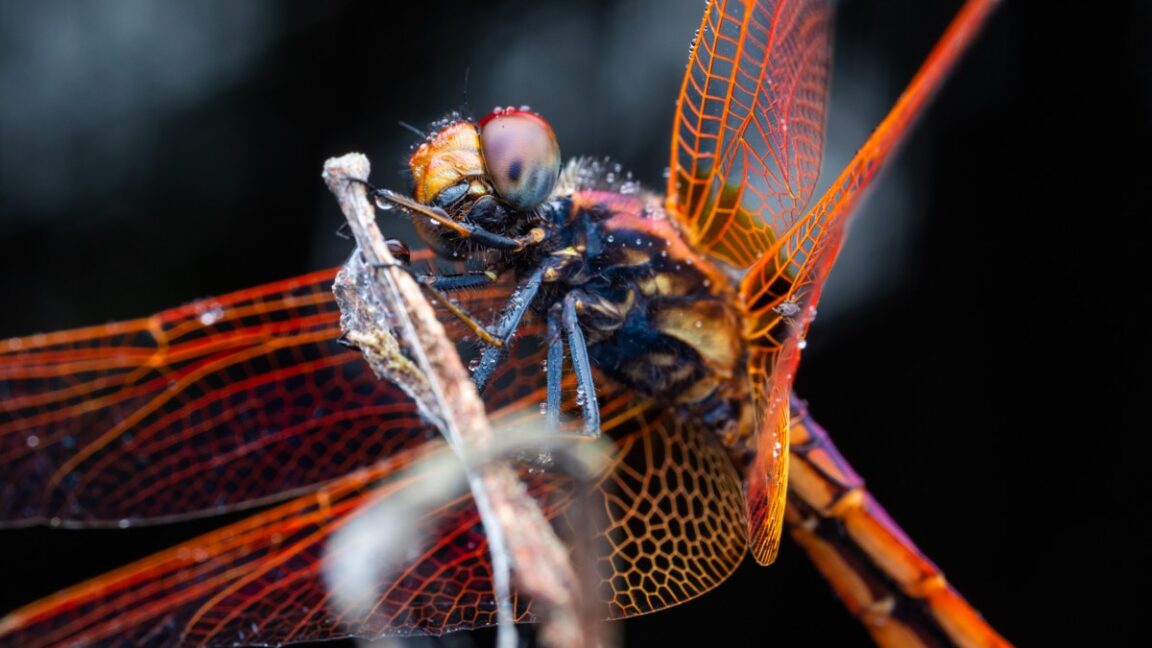
Male dragonflies use tactical positioning and simple vision-based rules to maneuver during territorial disputes, mimicking the “dogfight” strategies used by human fighter pilots. According to a study published in the Journal of the Royal Society Interface, these insects employ a mutual pursuit strategy to defend breeding grounds, which differs significantly from the asymmetric maneuvers used when hunting prey.
Researchers led by Samuel T. Fabian analyzed the 3D kinematics of the Trithemis aurora species to determine how these insects maintain an advantage over rivals. The findings suggest that the ability to navigate complex aerial battles relies on relatively simple guidance laws rather than high-level computation, providing a potential blueprint for the development of smarter drones capable of navigating with simple, vision-based guidance.
The study focused on Trithemis aurora because the males are crimson-colored and fiercely territorial, often congregating around ponds to defend specific perches. This behavior allowed the team to observe frequent, high-intensity interactions in a natural setting.
How do dragonfly “dogfights” differ from hunting?
Flight trajectories in the insect world typically fall into two categories: asymmetric and mutual. According to the researchers, classic pursuits—such as hunting prey or mating rituals—are asymmetric. In those scenarios, there is a clear chaser and an evader, with each role requiring a distinct set of maneuvers to either capture or escape.

Male-on-male interactions, however, function as a mutual pursuit. In these territorial disputes, both dragonflies are simultaneously attempting to outmaneuver the other to secure a tactical advantage. The authors noted that by studying these trajectories, they could uncover the specific guidance laws that govern how an animal maintains a superior position during a conflict.
What technology was used to track 3D flight paths?
To move beyond the limitations of previous research, which relied on single-camera recordings or basic visual observation, the team implemented a portable stereovideographic rig. This system utilized two shutter-synchronized cameras capable of recording in both color and monochrome.
Using this equipment, the researchers reconstructed 102 paired male-on-male flight trajectories to capture precise 3D kinematics. For a baseline comparison, the team also reconstructed nine trajectories of dragonflies intercepting prey. This comparative data allowed the researchers to develop a model for the rules governing the flight behavior.
Why does this matter for drone development?
The discovery that dragonflies use simple, vision-based rules to achieve complex aerial maneuvers has direct implications for robotics. The research could lead to the development of smarter drones capable of navigating with simple, vision-based guidance rather than complex computation.
The study suggests that drones could be made "smarter" and more agile by implementing similar guidance laws.
Do you think bio-inspired drones will replace traditional navigation systems? Share your thoughts in the comments below.