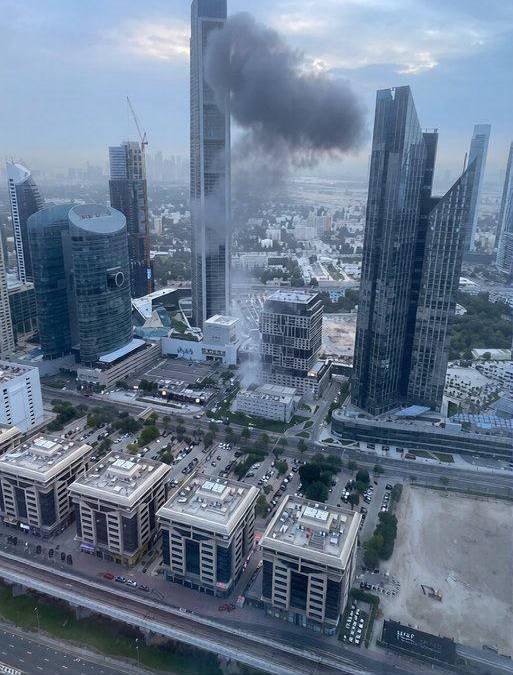
Iranian Drone Strike Targets Dubai Financial Center Amid Escalating Middle East Tensions
Dubai, United Arab Emirates – Explosions rocked the heart of Dubai’s financial district on Friday, March 13, 2026, as a drone originating from Iran struck near the Dubai International Financial Centre (DIFC). The attack, part of a broader pattern of escalating hostilities in the Middle East, sent a plume of smoke rising over the city and prompted a swift response from Emirati air defenses. Even as no injuries were immediately reported, the incident underscores the growing vulnerability of commercial hubs in the region and raises concerns about the potential for further disruptions to global finance and trade. The attack on the DIFC, a key economic zone, represents a significant escalation in the conflict, moving beyond infrastructure targets to directly threaten the financial stability of a major regional power.
According to reports from the Dubai Media Office, debris from the intercepted drone impacted the exterior of a building in central Dubai. Authorities characterized the interception as “successful,” emphasizing that the damage was limited to the building’s facade. However, the incident triggered sirens across Sheikh Zayed Road, a major thoroughfare, and sparked a sense of unease among residents and workers. The attack comes as tensions remain exceptionally high following recent airstrikes and retaliatory actions involving Iran, Israel, and the United States. The situation is further complicated by warnings issued to British nationals in the UAE regarding the sharing of images or videos documenting war-related incidents, highlighting the sensitivity surrounding information dissemination during the conflict.
The Dubai International Financial Centre (DIFC) is a leading financial hub in the Middle East, operating as an economic free zone that attracts international banks, capital traders, and wealth management firms. Beyond its financial significance, the DIFC is likewise home to upscale restaurants, nightclubs, and luxury establishments catering to Dubai’s elite. Targeting this area carries symbolic weight, striking at the heart of the emirate’s economic prosperity and international standing. Following the incident, several international banks, including HSBC and Citi, temporarily closed their offices in Dubai and Doha, signaling a heightened level of caution among financial institutions operating in the region. This disruption to business operations underscores the potential economic fallout from continued instability.
Regional Escalation: Attacks Reported Across the Gulf
The attack on Dubai is not an isolated incident. Reports indicate a wider pattern of aerial attacks across the Gulf region. Saudi Arabia’s defense forces reported intercepting approximately 50 Iranian drones launched in multiple waves. In Oman, tragically, two individuals lost their lives after drones crashed in an industrial area near Sohar, according to the Oman News Agency. Sirens sounded in Bahrain, alerting residents to incoming fire. These coordinated attacks demonstrate a significant escalation in regional tensions and suggest a deliberate attempt to destabilize the area. The coordinated nature of these attacks suggests a unified strategy, raising concerns about the potential for a broader conflict.
The attacks follow a statement from Iran’s supreme leader, Ayatollah Mojtaba Jamenei, vowing to “avenge the blood” of Iranians killed in recent airstrikes. Jamenei also issued a direct warning to Arab Gulf states, calling for the closure of U.S. Military bases within their territories, asserting that U.S. Protection promises are “nothing but a lie.” This rhetoric underscores Iran’s increasingly assertive stance and its willingness to challenge the existing regional security architecture. The escalation in rhetoric and military action raises the specter of a prolonged and potentially devastating conflict in the Middle East.
Economic Repercussions: Oil Prices Surge Amidst Uncertainty
The escalating conflict is already having a tangible impact on global economic markets, particularly the energy sector. The price of Brent crude, the international benchmark for oil, has surpassed $100 per barrel, reaching levels not seen in months. At times during Friday’s trading, the price approached $120, representing a roughly 40% increase since the start of the U.S.-Israel offensive against Iran. The market is particularly focused on the Strait of Hormuz, a strategically vital waterway through which approximately 20% of the world’s oil supply transits. Iran’s control and influence over this crucial chokepoint raise the risk of a significant supply disruption, potentially triggering a global energy crisis. Turkiye Today reports on the intensifying attacks and their potential impact on regional stability.
Impact on Air Travel and Tourism
Beyond the financial markets, the conflict is also disrupting air travel and tourism in the region. Previous incidents, including drone strikes near Dubai International Airport, have led to flight suspensions and widespread disruption for travelers. The ongoing instability is likely to deter tourists and business travelers, further impacting the economies of the Gulf states. The disruption to air travel and tourism adds another layer of economic strain to a region already grappling with heightened security concerns and geopolitical uncertainty.
Looking Ahead: Regional Stability Remains Precarious
The situation in the Middle East remains highly volatile and unpredictable. The attacks on Dubai and other Gulf states represent a dangerous escalation in the conflict, raising the risk of a wider regional war. Diplomatic efforts to de-escalate tensions are urgently needed, but the prospects for a swift resolution appear dim. The international community must work to prevent further escalation and to protect civilian populations from the devastating consequences of conflict. The coming days and weeks will be critical in determining whether the region can avert a full-scale war.
Authorities are continuing to assess the damage in Dubai and are working to maintain security in the wake of the attack. Further updates are expected from the Dubai Media Office and the UAE government in the coming hours. The situation remains fluid, and World Today Journal will continue to provide comprehensive coverage of developments as they unfold. Readers are encouraged to share their perspectives and insights in the comments section below.
Worth a look
- Japan Airlines Shares Drop 1.4% Following Latest Earnings Report
- Google Pulls Nano Banana 2 From Google Earth After OSINT Backlash
- Dow Hits Record High as US-Iran Tensions Ease and Amazon Tops $3 Trillion (time.news)
- UFC Fighter Allan Nascimento Dies at 34 After Apparent Heart Attack (archyworldys.com)