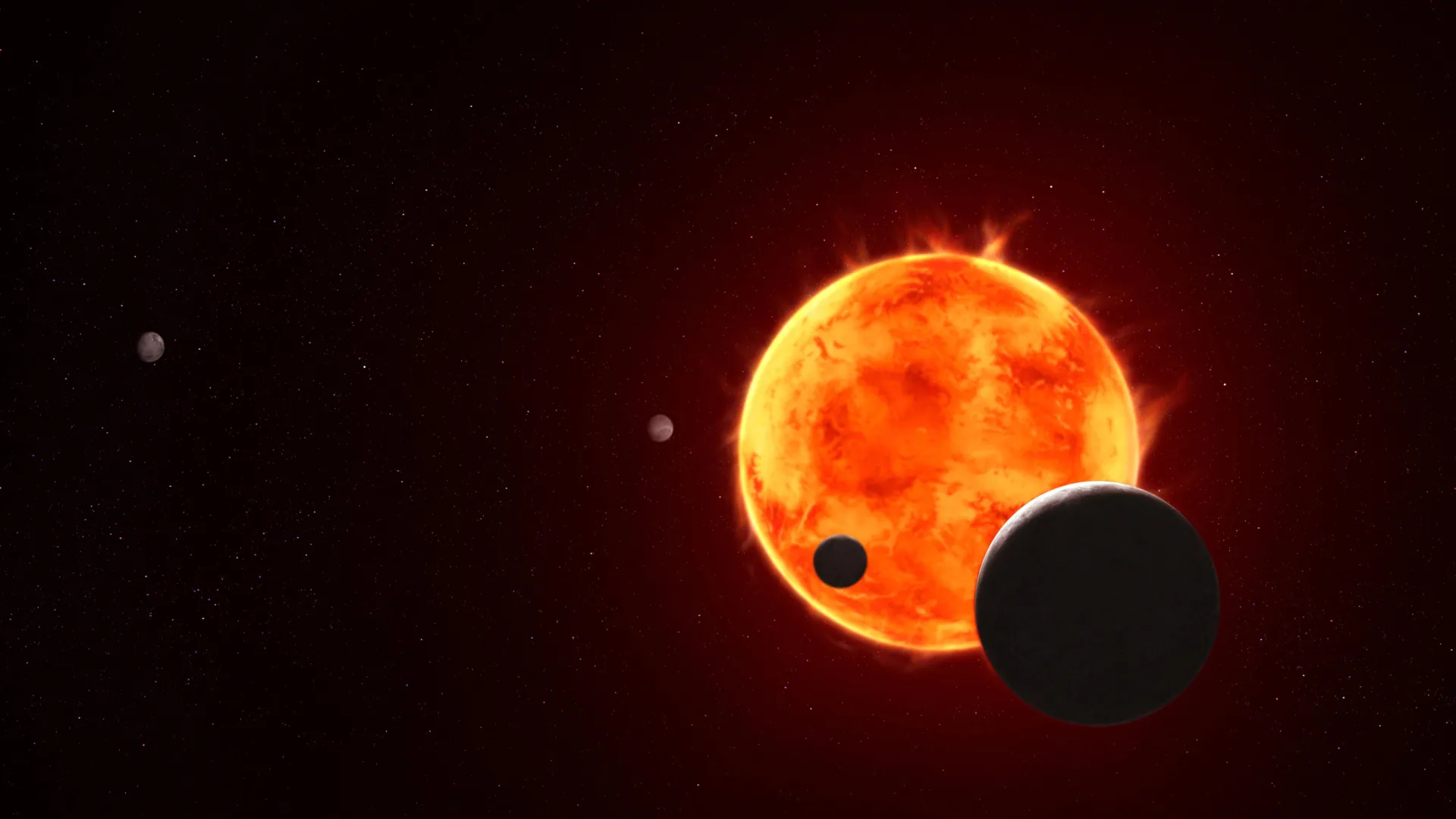
The Search for Breathable Worlds: Unraveling the Atmospheric Mystery of TRAPPIST-1e
For decades, the quest to find life beyond Earth has focused on identifying planets within the “habitable zone” – the region around a star where liquid water could exist on a planet’s surface. Now, with powerful new tools like the James Webb Space Telescope (JWST), scientists are moving beyond simply finding possibly habitable worlds to characterizing their atmospheres, a crucial step in determining if they could truly support life. Among the most intriguing targets in this search is TRAPPIST-1e, a planet orbiting a small, cool star just 40 light-years away, and the focus of intense scrutiny by a team led by Dr. Nikku Ranjan at the University of Arizona’s Lunar and Planetary Laboratory (LPL).
TRAPPIST-1e: A Promising,Yet Puzzling World
The TRAPPIST-1 system,named after the Transiting Planets and Planetesimals Small Telescope,is remarkable for hosting seven Earth-sized planets orbiting an ultracool red dwarf star. These planets are tightly packed,completing orbits in just days – a stark contrast to Mercury’s 88-day year. TRAPPIST-1e, roughly the same size and mass as Earth, resides within the habitable zone, making it a prime candidate for possessing liquid water and potentially, life.
Though, habitability isn’t guaranteed. A planet needs an atmosphere to regulate temperature and shield its surface from harmful radiation. “the basic thesis for TRAPPIST-1e is this: If it has an atmosphere, it’s habitable,” explains Dr. Ranjan. “But right now,the first-order question must be,’Does an atmosphere even exist?'”
Decoding Starlight: How JWST Hunts for Atmospheres
Answering this question requires a sophisticated approach. The team leveraged the unparalleled capabilities of JWST’s Near-Infrared Spectrograph (NIRSpec) to analyze the starlight filtering through any potential atmosphere surrounding TRAPPIST-1e. this technique, known as transit spectroscopy, relies on observing the planet as it passes - or “transits” – in front of its star.
During a transit, certain wavelengths of light are absorbed by gases in the planet’s atmosphere, creating a unique spectral “fingerprint.” By meticulously measuring these absorption patterns, astronomers can identify the atmospheric composition. The process is repeated across multiple transits to refine the analysis and build a clearer picture of the planet’s atmospheric chemistry.
The Methane Mystery and the Challenges of Red Dwarf Stars
Initial observations using this method revealed faint indications of methane in TRAPPIST-1e’s potential atmosphere. while methane is often associated with biological activity on Earth, its presence doesn’t automatically signify life. Moreover,interpreting data from planets orbiting red dwarf stars like TRAPPIST-1 presents unique challenges.
“TRAPPIST-1 is an ultracool red dwarf, significantly smaller, cooler, and dimmer than our sun,” Dr. Ranjan clarifies. “This means it has different physical properties, and we must be especially cautious when interpreting any potential planetary signal.” Unlike our sun, which emits a broad spectrum of light, TRAPPIST-1’s cooler temperature allows for gas molecules to exist in its atmosphere, potentially mimicking signals from a planetary atmosphere.
The team’s modeling efforts explored various methane-rich atmospheric scenarios, but the analysis revealed a troubling conclusion: the observed methane signal was more likely attributable to the star itself, rather than a genuine atmospheric feature. “based on our most recent work, we suggest that the previously reported tentative hint of an atmosphere is more likely to be ‘noise’ from the host star,” Dr. Ranjan states. “Though, this does not mean that TRAPPIST-1e does not have an atmosphere - we just need more data.”
Looking ahead: New Missions and Innovative Techniques
Despite the challenges, the search for an atmosphere on TRAPPIST-1e continues. Dr. Ranjan emphasizes that JWST, while revolutionary, wasn’t specifically designed to study small, Earth-sized exoplanets. “It was designed long before we knew such worlds existed, and we are fortunate that it can study them at all,” he notes. “Ther’s only a handful of Earth-sized planets in existence for which it could potentially ever measure any kind of detailed atmosphere composition.”
Fortunately,future missions are poised to build upon JWST’s findings. NASA’s Pandora mission, scheduled for launch in early 2026, is specifically designed to study exoplanet
Related reading