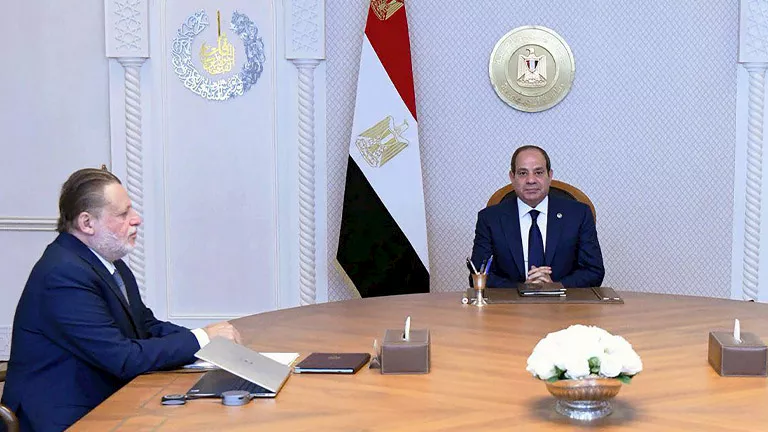
Cairo – Egyptian President Abdel Fattah el-Sisi met with Hassan Abdullah, Governor of the Central Bank of Egypt (CBE), this week to discuss the nation’s economic performance and future monetary policy. The meeting underscored a period of significant gains for Egypt’s foreign reserves and a strengthening financial sector, signaling increased economic stability despite ongoing global challenges. The discussion focused on the CBE’s role in supporting macroeconomic stability and acting as a financial advisor to the Egyptian government.
The CBE, under Governor Abdullah’s leadership, has overseen a notable increase in Egypt’s net international reserves, reaching a historic high of $52.6 billion in January 2026. This represents a substantial improvement from the $33.1 billion recorded in August 2022, providing the country with approximately 6.9 months of import cover – exceeding internationally recommended levels. This surge in reserves is a key indicator of Egypt’s improved financial position and its ability to weather external economic shocks. The strengthening of the Egyptian pound and increased investor confidence are directly linked to these positive developments.
Strengthening Financial Indicators and International Confidence
Beyond the increase in foreign reserves, the CBE reported a rise in the net foreign assets of the banking sector to $25.5 billion in December 2025, the highest level since February 2020. This growth was driven by improvements in the net foreign assets of commercial banks, reaching $12.2 billion in December 2025, alongside a record influx of remittances from Egyptians abroad, increased tourism revenues, and growing foreign direct and portfolio investment in Egyptian government debt instruments. The CBE’s own net foreign assets stood at $15.1 billion in January 2026. These figures collectively paint a picture of a financial system gaining strength and attracting international capital.
The positive economic indicators have also attracted the attention of international credit rating agencies. Standard & Poor’s (S&P) upgraded Egypt’s long-term credit rating to ‘B’ from ‘B-’ with a stable outlook, marking the first upgrade in seven years. As reported by Al-Masry Al-Youm, this upgrade reflects S&P’s confidence in Egypt’s economic reforms and its ability to manage its debt obligations. Fitch Ratings also affirmed Egypt’s long-term foreign-currency issuer default rating at ‘B’ with a stable outlook. These upgrades are expected to further enhance investor confidence and lower borrowing costs for the Egyptian government and private sector.
Focus on Financial Inclusion and Digital Transformation
The meeting between President Sisi and Governor Abdullah also addressed the importance of enhancing financial inclusion and accelerating digital transformation within the Egyptian economy. These initiatives are seen as crucial for building a more inclusive and sustainable economic future, expanding economic opportunities for all citizens. The CBE has been actively promoting digital payment systems and fintech innovation to broaden access to financial services, particularly for underserved populations. These efforts align with Egypt’s Vision 2030, a national development plan focused on sustainable growth and social equity.
the CBE and the banking sector’s contributions to corporate social responsibility (CSR) were discussed, with a particular emphasis on healthcare and education. The CBE has been actively involved in partnerships and national initiatives aimed at improving social welfare and supporting vulnerable communities. These initiatives demonstrate a commitment to sustainable development and responsible banking practices.
Addressing Inflation and Supporting Private Sector Growth
President Sisi emphasized the demand to continue curbing inflation through careful monitoring of policies and measures aimed at stabilizing markets and ensuring the availability of essential goods at stable prices. Controlling inflation is seen as vital for maintaining economic resilience and achieving sustainable growth. The CBE has been implementing a series of monetary policy measures, including interest rate adjustments, to manage inflationary pressures. According to Masrawy, the central bank is focused on balancing the need to control inflation with the goal of supporting economic growth.
The President also directed officials to continue strengthening policies that support financial stability, transparency, and sustainable growth, while expanding incentives to capitalize on available economic opportunities. He stressed the importance of creating a favorable environment for the private sector to drive economic growth and attract further investment. The government is committed to reducing bureaucratic hurdles and promoting a more competitive business environment.
Governor Abdullah outlined the CBE’s ongoing efforts to enhance the regulatory framework for the financial sector, promoting transparency and accountability. These measures are designed to attract foreign investment and foster a more stable and resilient financial system. The CBE is also working to strengthen its supervisory capacity to ensure the soundness of the banking sector and protect depositors’ interests.
Looking Ahead: Continued Stability and Growth
The recent positive developments in Egypt’s economic indicators, coupled with the CBE’s proactive policies, suggest a promising outlook for the country’s economic future. The increase in foreign reserves, the improvement in credit ratings, and the focus on financial inclusion and digital transformation are all contributing to a more stable and sustainable economic environment. Yet, challenges remain, including global economic uncertainty and the need to address structural reforms to unlock the full potential of the Egyptian economy.
The CBE’s commitment to maintaining price stability, promoting financial inclusion, and supporting sustainable growth will be crucial in navigating these challenges and ensuring that Egypt continues on a path of economic prosperity. The ongoing collaboration between the government and the central bank is essential for achieving these goals. The next key event to watch will be the potential renewal of Hassan Abdullah’s term as acting governor, with a decision expected around August 18, 2026, as his current term is set to expire. Al-Masry Al-Youm reports that a decision on his future role is anticipated in the coming months.
Key Takeaways:
- Egypt’s net international reserves reached a record high of $52.6 billion in January 2026.
- S&P upgraded Egypt’s long-term credit rating to ‘B’ with a stable outlook.
- The CBE is prioritizing financial inclusion and digital transformation.
- President Sisi emphasized the need to control inflation and support private sector growth.
We encourage readers to share their thoughts and perspectives on Egypt’s economic outlook in the comments section below. Your insights are valuable as we continue to follow this important story.
Keep reading