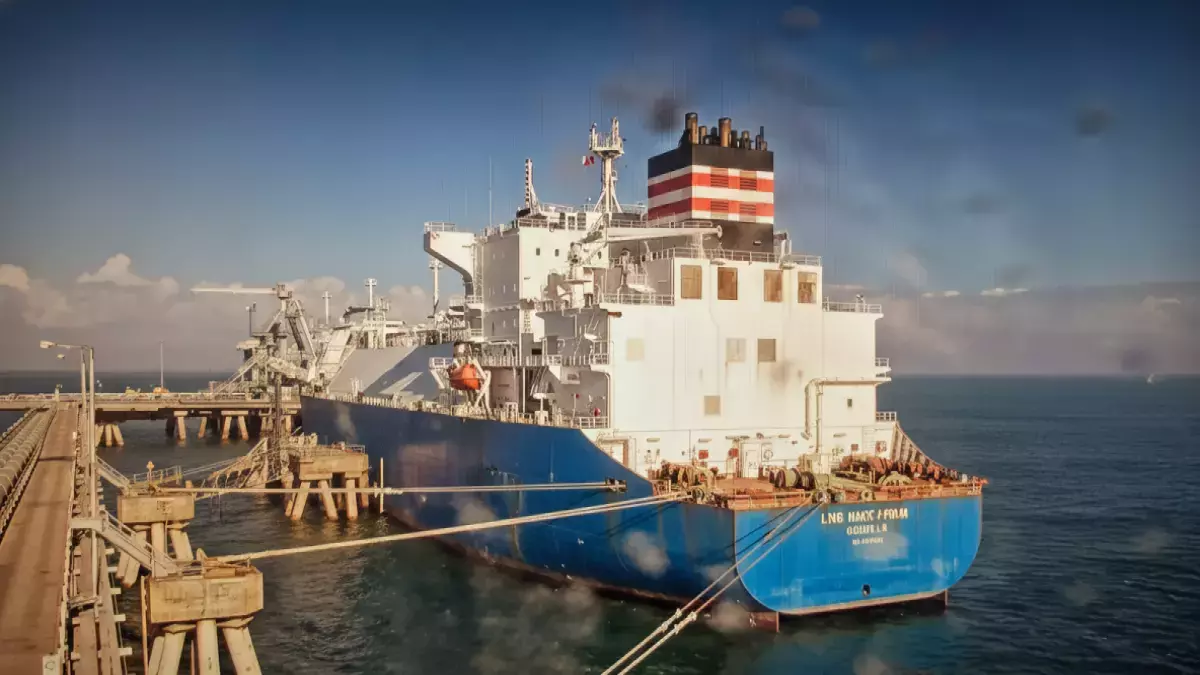
Cairo, March 8, 2026 – A decade after relying on gas imports to meet its energy needs, Egypt is rapidly transforming into a significant energy exporter. In a landmark shift, the Egyptian Natural Gas Holding Company (EGAS) has begun exporting liquefied natural gas (LNG) from the Idku LNG complex, signaling a new era for the nation’s energy sector and its role in global markets. This development marks a significant turnaround for a country that, as recently as 2016, was heavily dependent on foreign gas supplies.
The first LNG shipment in 2026 departed from the Idku terminal aboard the LNG Endeavour, destined for Shell, a global energy giant. This initial export is part of a carefully orchestrated government strategy designed to incentivize foreign investment in Egypt’s natural gas production. The agreement allows partner companies to export their share of new production through Egyptian liquefaction facilities, effectively unlocking further investment and boosting domestic output. This move underscores Egypt’s ambition to become a regional energy hub, leveraging its strategic location and expanding infrastructure.
From Importer to Exporter: A Decade of Transformation
Egypt’s journey from a net importer to an exporter of natural gas is a story of strategic investment and policy reform. Years of declining domestic production and increasing demand led to a critical energy shortfall in the mid-2010s. The country was forced to import LNG to meet its power generation and industrial needs. However, significant discoveries of natural gas in the Eastern Mediterranean, particularly the Zohr field discovered in 2015, changed the trajectory. Reuters reported on the Zohr field’s potential to transform Egypt’s energy landscape shortly after its discovery.
The Zohr field, operated by Eni, has been instrumental in boosting Egypt’s gas production. Combined with other discoveries and ongoing exploration efforts, Egypt now produces enough gas to meet domestic demand and have a surplus for export. The Idku LNG complex, with a capacity of 1.35 billion cubic feet per day, and the Damietta LNG plant, with a capacity of 750 million cubic feet per day, are crucial components of this export capability. These facilities allow Egypt to convert natural gas into LNG for transportation to international markets.
Balancing Import and Export: A Strategic Approach
While increasing exports, Egypt is also maintaining a strategic balance by continuing to import LNG. In February 2026, the AKTORAS tanker delivered a shipment of LNG to the Sokhna port, highlighting this dual approach. This simultaneous import and export activity demonstrates a sophisticated energy policy aimed at ensuring supply security and maximizing economic benefits. The import of LNG is partially facilitated by the Energos Force regasification unit, which Egypt leased in the second half of 2025 and stationed in Aqaba, Jordan. CNN Business Arabic detailed this arrangement, explaining that the unit receives LNG shipments and converts them back into natural gas for transport via a pipeline connecting Egypt and Jordan.
This strategic balance is particularly important during peak demand periods and allows Egypt to optimize its energy resources. The ability to both import and export LNG provides flexibility and resilience in a volatile global energy market. It also allows Egypt to capitalize on price differentials, buying low and selling high when opportunities arise.
Incentivizing Investment and Boosting Production
A key driver of Egypt’s energy turnaround has been the government’s efforts to incentivize foreign investment. This includes settling outstanding payments to partner companies and increasing their share of production revenues. These measures are designed to encourage further investment in exploration and production, ultimately increasing Egypt’s gas output. According to reports from December 2025, EGAS began pumping 300,000 cubic meters of natural gas to the Idku complex for liquefaction and export, with an estimated value of $80 to $90 million. Almurakib.com reported on this development, emphasizing its alignment with the government’s strategy to attract investment and enhance domestic production.
The initial shipments are primarily destined for European markets, reflecting the growing demand for LNG in the region. Egypt’s ability to supply LNG to Europe contributes to the continent’s energy security and diversification efforts. In January 2026, the Ministry of Petroleum announced another shipment to Turkey, further expanding Egypt’s export reach. EGAS has reached an agreement with QatarEnergy to supply up to 24 LNG shipments to Egypt during the summer of 2026, demonstrating the growing confidence in Egypt’s role as a regional energy player.
Egypt’s Emerging Role as a Regional Energy Hub
The recent developments signal a fundamental shift in Egypt’s position in the global energy landscape. No longer solely a recipient of foreign gas, Egypt is now actively contributing to global supply. This transformation is underpinned by significant investments in infrastructure, strategic partnerships, and a supportive regulatory environment. The country’s location, straddling the Mediterranean Sea and the Suez Canal, makes it an ideal transit route for energy supplies between the Middle East, Africa, and Europe.
Egypt’s ambition is to become a major regional energy hub, attracting international companies to utilize its advanced facilities and leverage its strategic location. The government is actively promoting investment in LNG infrastructure, pipeline networks, and renewable energy projects. This comprehensive approach aims to create a diversified and sustainable energy sector that can meet both domestic needs and contribute to global energy security.
Key Takeaways
- Egypt has transitioned from a net importer to an exporter of natural gas within a decade.
- The Zohr gas field and investments in LNG infrastructure have been crucial to this transformation.
- The government is incentivizing foreign investment through financial settlements and revenue-sharing agreements.
- Egypt is strategically balancing LNG imports and exports to ensure supply security and maximize economic benefits.
- The country aims to become a major regional energy hub, leveraging its location and infrastructure.
Looking ahead, Egypt is expected to continue expanding its LNG export capacity and attracting further investment in its energy sector. The ongoing exploration efforts in the Eastern Mediterranean hold the potential for additional gas discoveries, further bolstering Egypt’s production capabilities. The next key development to watch will be the full implementation of the agreement with QatarEnergy for the supply of 24 LNG shipments during the summer of 2026, which will provide further insight into the scale of Egypt’s emerging role as a major LNG exporter.
The transformation of Egypt’s energy sector is a compelling story of strategic vision, investment, and policy reform. It demonstrates the potential for countries to overcome energy challenges and emerge as key players in the global energy market. We encourage readers to share their thoughts and perspectives on this evolving situation in the comments below.