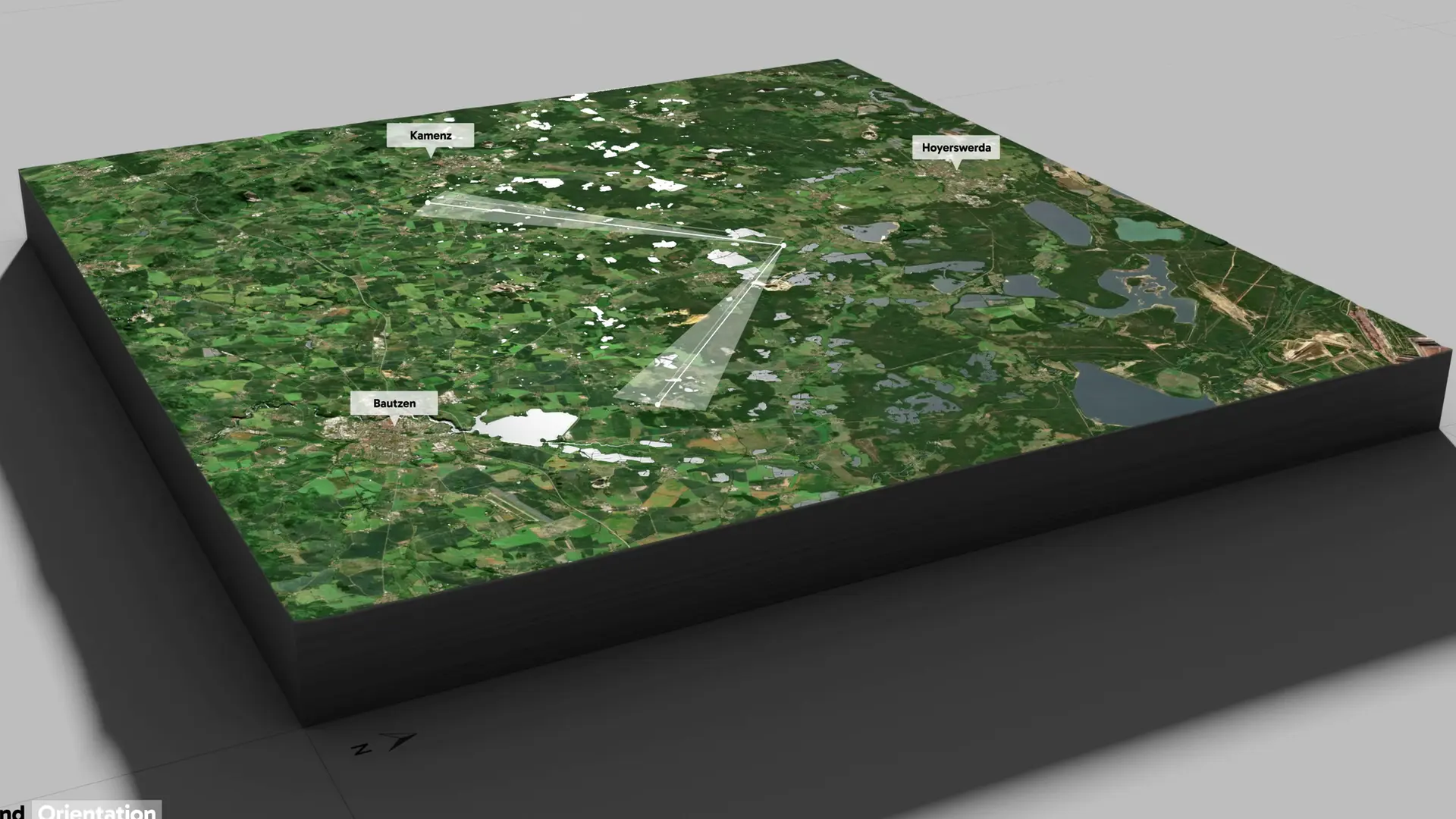
The international scientific community is advancing preparations for the Einstein Telescope, a planned underground gravitational-wave observatory designed to detect ripples in spacetime with unprecedented precision. As researchers evaluate candidate locations in the Lausitz region of Germany and the island of Sardinia in Italy, recent visual animations released by project planners have offered a detailed look at what the subterranean infrastructure could resemble. These visual models outline the complex triangular layout deep beneath the earth, illustrating the immense scale of the facility required to push gravitational-wave astronomy into its next generation.
Gravitational waves, first predicted by Albert Einstein in his general theory of relativity, are disturbances in the curvature of spacetime generated by massive accelerating objects such as colliding black holes and neutron stars. While current detectors like LIGO in the United States and Virgo in Italy have successfully recorded numerous cosmic events, scientists need vastly more sensitive instruments to peer deeper into the universe. The Einstein Telescope aims to bridge that gap by operating at cryogenic temperatures inside an underground triangular tunnel system stretching 10 kilometers per side, shielding the ultra-sensitive lasers and mirrors from seismic and acoustic interference on the surface.
The selection process for the host site involves rigorous geological, environmental, and socio-economic assessments across competing European regions. According to project updates coordinated by the European Gravitational Observatory and associated research bodies, local stakeholder engagement and preliminary underground soundings are moving forward concurrently in both candidate areas. The Lausitz region in eastern Germany presents a strong industrial and academic network backed by regional transformation funds, while the Sos Enattos mine area in Nuoro, Sardinia, offers exceptionally low seismic noise levels ideal for high-precision physics measurements.
Underground Infrastructure and Engineering Design
Constructing a facility of this magnitude requires deep subterranean engineering on a scale rarely seen in scientific research. According to technical concept reports published by the Einstein Telescope collaboration, the observatory will be housed in caverns situated between 200 and 300 meters underground. This depth is necessary to isolate the sensitive optical equipment from surface vibrations caused by traffic, wind, and human activity.

The released animations illustrate the massive scale of the underground tunnels, which will form a closed equilateral triangle. Each side of the triangle will span 10 kilometers, housing vacuum tubes where laser beams bounce between heavy, suspended mirrors. To achieve the required sensitivity, the facility will incorporate two complementary detectors within the same infrastructure: a low-frequency detector operating at cryogenic temperatures to minimize thermal noise, and a high-frequency detector using high-power lasers. Planners note that the geological stability of both the Lusatian granodiorite formations and the Sardinian metamorphic rock formations is currently undergoing extensive core sampling to confirm suitability for these massive cavities.
Comparing Candidate Sites: Lausitz and Sardinia
The competition between the Lausitz region and Sardinia has mobilized regional governments, scientific institutes, and local communities, each emphasizing distinct advantages for hosting the multi-billion-euro research infrastructure.

In Germany, the Lausitz coal-mining region is undergoing a massive structural transition. State officials and researchers from institutions such as the Helmholtz-Zentrum Dresden-Rossendorf argue that hosting the Einstein Telescope would provide a powerful economic and technological anchor for the area. The project aligns with regional revitalization efforts, promising to attract high-tech industries, specialized engineering firms, and top-tier scientific talent to eastern Saxony and Brandenburg.
Conversely, Sardinia’s primary asset is its unique geological quietness. The former mine site in Nuoro features some of the lowest seismic background noise levels in densely populated Europe, a critical parameter for instruments designed to measure minuscule shifts smaller than the fraction of a proton’s diameter. The Italian government, alongside regional authorities in Sardinia, has pledged robust financial and infrastructural backing, emphasizing that the island’s geographic isolation from major industrial vibrations offers an optimal environment for fundamental physics.
Timeline and Next Steps for the Collaboration
The decision-making process governing the final site selection is structured around a series of technical milestones and intergovernmental consultations. Representatives from partner countries participating in the Einstein Telescope consortium continue to review environmental impact assessments, infrastructural cost estimates, and governance frameworks.
While preliminary design studies and public outreach campaigns—including the recent animation releases—are actively shaping public awareness, a definitive site selection decision is anticipated later in the decade. Construction on the chosen host site is projected to take nearly a decade, with scientific commissioning expected to commence in the 2030s. Official updates, technical documentation, and ongoing public consultation schedules are maintained through the official Einstein Telescope project portal managed by the participating European research institutions.