

2026-01-21 12:11:00
It’s hard to live in Sweden for more than a few months without adopting some of the local food habits, with meatballs, fredagsmys, A-fil and even aberrations like tuna paste among the foods now regularly eaten by foreigners who answered The Local’s survey.
Almost all of the respondents to our shamelessly unscientific survey said they had adopted at least some Swedish food habits since moving to the country and only four out of 29 respondents said they had stuck exclusively to their national cuisines. Of the rest, four said they had gone entirely local, twelve said they had adopted several Swedish food habits, and eleven said they had adopted several local food habits.
Fika, the Swedish habit of tightly scheduled breaks for coffee and cakes, led the list of Swedish food habits foreigners had ended up adopting, with eight out of 29 respondents saying it had become a part of their day, or at least their week.
Meatballs were the strong runner up, cited as a new habit by six respondents. Two respondents, a British venture capital investor based in Stockholm and an Indian design researcher based in Malmö, said that meatballs and mashed potato had become weekly staples. Five respondents said they now regularly ate herring (sill in Swedish). Four cited open sandwiches, or mackor and three said they were drinking more coffee.
Unsurprisingly, the Swedish ‘fika‘ tradition was popular among respondents, who seemed to particularly like pastries spiced with cardamom. Photo: Adam Ihse/TT
Respondents explained their adoption of fika (coffee and cake breaks) as a way to communicate better with Swedish colleagues. “Fika is the only moment people talk to each other at work,” grumbled a post-doctoral researcher from the Aegean region, while Iain, a pathology worker in Falun, said “fika time (09.30) at work is compulsory.”
Kat, a British preschool worker based in Gothenburg said, however, that for her, fika was more of a family affair: “It’s nice to sit down with my kids at fika time, as it’s something we enjoy together.” There was only one fika refusenik, an engineer from Italy based in Västerås, who listed “mandatory fika” as the Swedish food habit he was still resisting.
Advertisement
Going local
A British woman who said she had become a full-blown Swede in her food habits said she had made the conversion because she felt Swedish food was “healthy”, a position that was echoed by Japanese-Brazilian Juliana, based in Gothenburg, who said she also liked “the practicality”.
“A savoury breakfast is better for you than a sweet one and fredagsmys [literally ‘Friday cosiness’] is fun on Fridays,” said the Brit. She had a long list of Swedish foods she had adopted, including meatballs, traditional Tex-Mex-style tacos eaten on Fridays, rye bread, ‘Toast Skagen’ prawn salad sandwiches, the marzipan-topped prinsesstårta cream cakes, cheese made by Arla, Swedish style mackor and kvarg, a type of thick fresh dairy product similar to yoghurt.
“I mostly make food directly from ingredients and seldom buy pre-made food,” she said.
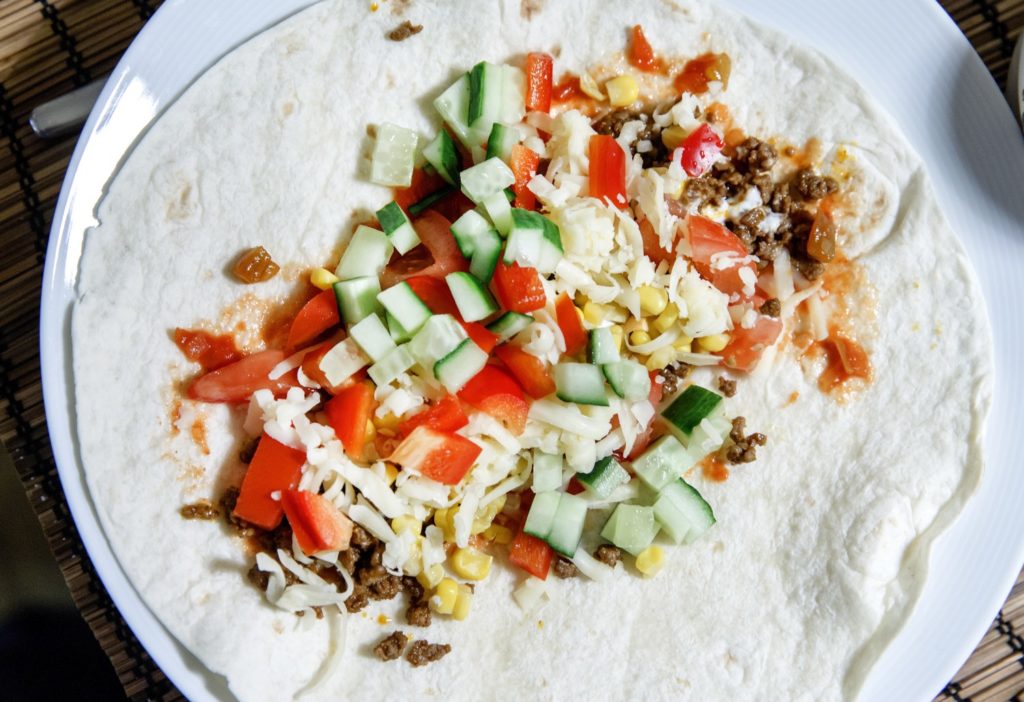
Tex-Mex-style tacos are popular among Swedes on Fridays. Photo: Gorm Kallestad/NTB Scanpix/TT
Juliana cited having an early lunch at 11am, mini carrots as snacks, Finncrisp (a type of crispbread), herring, full-grain sourdough bread, smoked salmon, fika pastries, and “all local mushrooms” as habits she had taken on, adding that at Christmas she had gone full Swedish, preparing and eating “all food in a julbord, julmust, and saffron lussekatter.”
Mauricio, a digital manager based in Malmö, has also adopted foods that you might think would be far from the tastes of his native Chile, expressing a love of leverpastej (liver paté) and tonfiskpastej (tuna paté), both of which come in tubes, writing the “flavour combinations are really good” and had “lots of similarities with my home country cuisine”.
Michael, from the US, who also claimed to have gone almost wholly native, listed “sandwiches for breakfast, pickled herring, and cardamom in my pastries” as some of the habits he had adopted.
Iain from the UK, living in Falun, cited a long list of highly Swedish food habits he had taken on. “I absolutely love sill and potatis [pickled herring with potato] as a quick and healthy meal in the evening. Crispbread with squeezy bacon-cheese is a winner.”
Advertisement
He was also a fan of marzipan cream cake prinsesstårta, as well as its odd cousin smörgåstårta, a type of savoury cake made of bread and various sandwich fillings often featuring large amounts of mayonnaise or cream cheese.
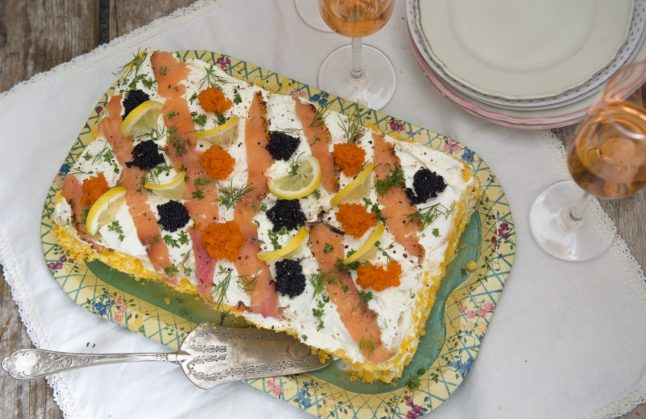
Smörgåstårta, a savoury cake made of bread with various sandwich fillings. Photo: Jonas Ekströmer/TT
“Falukorv [a type of highly-processed pre-cooked sausage extremely popular among Swedish children] is a dire form of ultra-processed food that looks like it’s grown in a lab, but as I live in Falun I feel I need to fly the flag for local cuisine,” he added.
Marion, who described herself as coming from “France and the UK”, was one of two respondents listing A-Fil as a favourite. A-Fil is a fermented dairy product somewhat like yoghurt, but fermented using a different type of bacteria which results in a milder, more buttery flavour. It was, she said “exactly the right consistency of dairy that I have been looking for my whole life”, and she particularly appreciated the fact that it is “the perfect consistency to enjoy crunchy cereals. They don’t get soggy like in milk.”
Thomas Overfield, from the US, however took the opposite position, saying he disliked “breakfasts of miscellaneous flaked grains in weak yoghurt”.
Advertisement
Kalles kaviar and other divisive foods
Perhaps the most divisive food was Kalles kaviar, a sweet and salty paste made with smoked fish roe, which an Indian based in Malmö declared “a must for breakfast with boiled eggs”, and which also won the approval of Iain in Falun.
The British woman who said she had otherwise became a full-blown Swede said that Kalles was the only Swedish food she refused to consume, while a New Zealander said she also found it “disgusting”.
The Indian based in Malmö drew the line at eating meat with berry jams. “I will never add lingonberry jam to my food. It’s a weird concept to me, and I feel it worsens the taste of the meal,” she explained. The New Zealander, on the other hand, cited “jam with meat” as one of the habits she’d taken on.
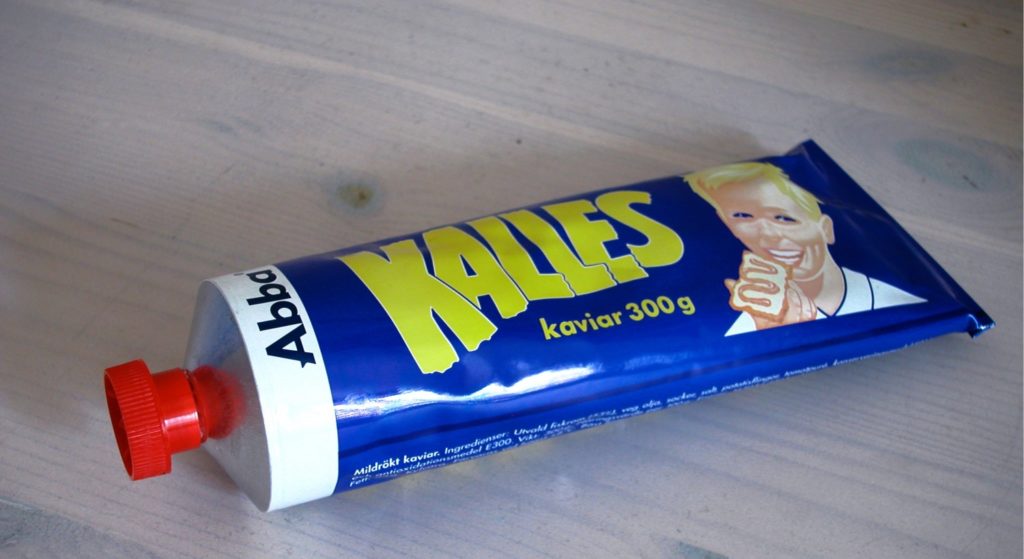
Kalles kaviar is one of many tube foods popular in Sweden. Photo: Hasse Holmberg/Scanpix via TT
Other dishes foreigners refuse
Several respondents said they refused to eat Swedish so-called fulpizza (meaning “ugly pizza”) variants, with David Rondon, a Venezuelan engineer based in Göteborg, saying he refused both kebab pizza and banana on pizza, Kat saying she rejected kebab pizza, and an Indian student citing “banana curry pizza” (and indeed “any dish that decided to mix ripe and sweet bananas with savoury dishes”) as a no-no.
“I adore Italian food so I can’t betray it,” Rondon explained. A British researcher based in Uppsala agreed that for her “weird pizza toppings” were “disgusting”. “I am a purist when it comes to pizza,” agreed Olga; a public policy specialist based in Stockholm.
“Given what these savages do to pizza, the less said the better, I’m just amazed Italy hasn’t declared war yet,” joked Iain.
Kat in Helsingborg said that ketchup on plain pasta was another Swedish habit she refused to adopt.
Chris, a tech worker in Stockholm from London, said that he rejected most Swedish foods. “It’s like being in 1970s Britain,” he complained.
Advertisement
French-British Marion’s big complaint was the Swedish way of preparing vegetables.
“I refuse to boil yet another vegetable to death. Every veggie seems to be boiled, even the fresh-from-the-garden green beans or the new potatoes. There are (flavourful) forms of cooking vegetables!” she moaned.
Iain also said he refused to touch lutefisk, dried cod preserved with lye. “I’ve heard horror stories from even hardcore Swedes,” he joked, adding that he also hated liquorice, especially the salt variety. “Open sandwiches are totally inferior to a proper closed sarnie,” he added.
Three respondents singled out surströmming, Sweden’s famously smelly fermented herring delicacy, as something they refused to ever touch, with Iain being the only one to express curiosity. “I may just try it one summer, just to tick that box,” he said.
Advertisement
What do foreigners insist on eating from home?
The four Indian respondents all said they insisted on continuing eating their home cuisine, even if doing so could be inconvenient.
“Spicy South Indian pickles with ghee are my go-to for any rice based dish,” said one. “It’s a bang of flavour and texture, spice and sourness (depending on the pickle). The Priya brand of pickles is the closest to the real deal, but sadly they don’t stock it anymore at the Indopak store near me.”
“Some of our dishes traditionally require a relatively longer prep time. But, you can bulk cook them for weekly meal preps which makes it convenient,” said another. “On top of that, they’re extremely delicious and it makes me feel at home.”

Brits missed Marmite, a yeast extract spread often eaten on toast. Photo: AP Photo/Alastair Grant via TT
Ronson said he couldn’t live without arepas, the filled cornbreads which he said were “part of my identity as a Venezuelan”, and a number of respondents from warmer climates missed the fruits available back home.
A couple of Brits cited Marmite, a brand of yeast extract spread, while several mentioned tea. The venture capitalist said “a proper English breakfast on the weekend” was essential for him.
French-British Marion had perhaps the most refined requirement. “Duck and chestnut cream, separately obviously. They are both delicious, but so incredibly hard to find in Sweden.”
Have you gone Swedish and adopted any of these habits? Is there a Swedish food or food tradition you adore or else one you absolutely refuse to touch? Tell us in the comments below.


