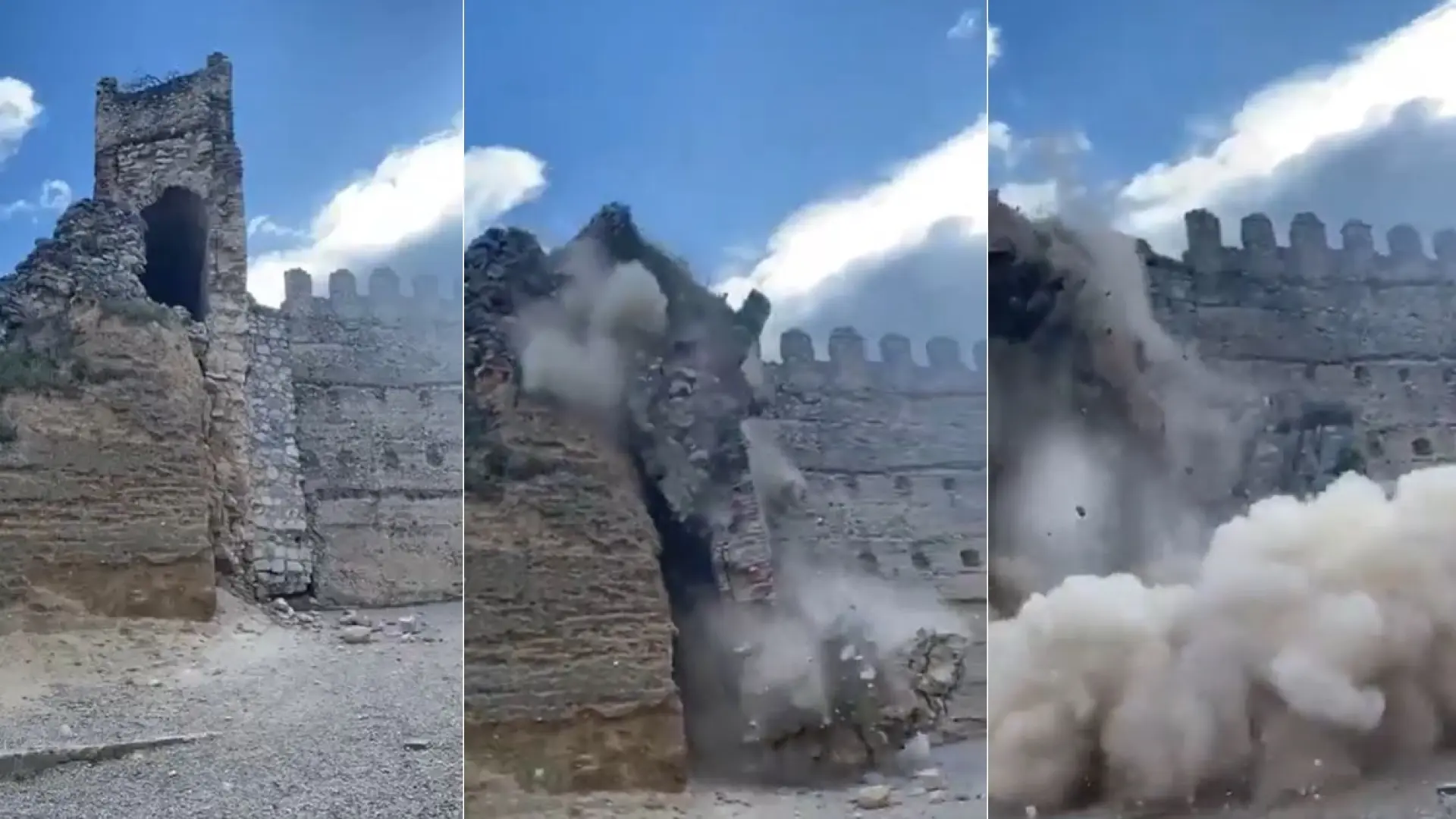
ESCALONA, Spain – A tower at the historic Castillo de Escalona in the province of Toledo, Spain, collapsed on Saturday morning, prompting an immediate assessment of the medieval fortress and the suspension of all visitor access. Fortunately, no injuries were reported, as the collapse occurred before scheduled tours were due to commence. The incident has sparked concern for the structural integrity of the remaining sections of the castle, a landmark recently opened to the public after decades of being closed.
The tower, described as an albarrana tower – a defensive structure standing apart from the main castle walls – came down around 10:30 AM local time. Witnesses reported hearing cracking sounds and seeing dust billowing from the site before the tower fully collapsed. Videos circulating online show the dramatic moment of the collapse, with onlookers expressing concern for nearby vehicles. “It’s going to fall all down,” one person can be heard saying in a video, urging others to move their cars. The Castillo de Escalona, with a history stretching back over 1,000 years, has become a focal point for tourism in the region, and the sudden loss of a portion of its structure is a significant blow.
Álvaro Gutiérrez, the mayor of Escalona, expressed his relief that no one was hurt, stating that the timing of the collapse was incredibly fortunate. “We are, within the absolute sadness, within the misfortune that has occurred, released from the tragedy,” Gutiérrez said, according to reports from infoCLM. He confirmed that the collapse appears to be linked to the accumulation of water following recent heavy rains. The castle had only recently reopened to the public, having been acquired by the town council in October 2024 and welcoming visitors from April 26, 2025.
Castle Closed for Comprehensive Structural Assessment
Following the collapse, the area around the castle has been cordoned off, and access has been suspended indefinitely. Mayor Gutiérrez announced that the town hall has contacted various administrations to begin evaluating the damage and assessing the condition of the remaining structures. A team of architects and personnel from the Directorate-General for Heritage of the Regional Board of Education of Castilla-La Mancha are expected to arrive on Sunday to conduct a thorough audit of the castle walls, both internal and external. The assessment will focus on identifying any further potential dangers and determining the extent of the necessary repairs.
The immediate priority is to determine the stability of the remaining structures. “We are going to evaluate, see the damage, see the structure and actions to take in the coming days,” Gutiérrez stated. The assessment will not only focus on the collapsed tower but will encompass the entire castle complex to ensure the safety of future visitors and residents. The town council is also investigating the possibility of securing funding for restoration work, with plans for a tender process already underway prior to the incident. “It’s a shame, especially now that we were very advanced in a bid for the works to restore some towers,” Gutiérrez lamented, adding that the timing was unfortunate as the tender process had not yet been finalized.
Recent Rainfall a Likely Contributing Factor
Preliminary investigations suggest that the recent period of intense rainfall played a significant role in the tower’s collapse. The accumulation of water within the structure’s walls is believed to have weakened the materials, ultimately leading to the structural failure. The region has experienced unusually heavy precipitation in recent weeks, contributing to saturated ground and increased pressure on historic buildings. While a full investigation is needed to determine the precise cause, the mayor indicated that water damage is the primary suspect. This highlights the challenges faced in preserving historic structures in the face of increasingly unpredictable weather patterns.
The collapse has understandably caused distress among the local community. Gutiérrez emphasized that the entire town is “absolutely saddened” by the event, not just the town hall. While some vehicles parked in the castle esplanade were reportedly affected by falling debris, authorities confirmed that no one was seriously injured. The incident serves as a stark reminder of the fragility of historical landmarks and the importance of ongoing maintenance and preservation efforts.
Historical Significance of Castillo de Escalona
The Castillo de Escalona boasts a rich and complex history, dating back to medieval times. Its strategic location overlooking the Tagus River made it a crucial defensive stronghold for centuries. The castle has witnessed numerous conflicts and changes in ownership throughout its history, reflecting the turbulent past of the Iberian Peninsula. The fortress’s architecture is a blend of different styles, reflecting the various periods of construction and renovation. The albarrana tower that collapsed was a key element of the castle’s defensive system, providing an additional layer of protection against potential invaders.
The recent reopening of the castle to the public was a significant event for Escalona, promising to boost tourism and revitalize the local economy. The town council had invested considerable resources in restoring the castle and making it accessible to visitors. The collapse of the tower is a setback for these efforts, but authorities remain committed to preserving the castle for future generations. The incident underscores the ongoing need for investment in the maintenance and restoration of Spain’s rich cultural heritage.
Looking Ahead: Restoration and Safety Measures
The immediate focus remains on ensuring the safety of the site and conducting a comprehensive structural assessment. The team from the Directorate-General for Heritage will be tasked with identifying any further risks and recommending appropriate remedial measures. The town council is expected to work closely with heritage experts to develop a restoration plan that respects the historical integrity of the castle while ensuring its long-term stability. The timeline for the restoration work remains uncertain, but authorities have indicated that it could take several months, if not years, to complete.
The incident at Castillo de Escalona highlights the challenges faced by many historic sites around the world in adapting to the impacts of climate change and the need for proactive preservation strategies. Increased rainfall, extreme temperatures, and other weather events are putting increasing strain on historic structures, requiring ongoing monitoring and maintenance. The collapse of the tower serves as a cautionary tale, emphasizing the importance of investing in the preservation of cultural heritage for future generations.
The next update from the authorities is expected on Monday, March 16th, following the initial assessment by the Directorate-General for Heritage team. Residents and visitors are encouraged to stay informed through official channels and to respect the cordoned-off area. The town council has pledged to keep the public updated on the progress of the investigation and the restoration efforts. We encourage readers to share their thoughts and experiences in the comments below.