
Mount Etna, Europe’s most active volcano, continues to challenge scientific understanding of how such geological formations develop. Recent research from the University of Lausanne suggests the Sicilian volcano may have formed through a process different from the three classical models traditionally used to explain volcanic activity. This new perspective positions Etna as a potential member of a rare group known as “petit-spot” volcanoes, which derive their magma from deep within the Earth’s upper mantle rather than from shallow crustal processes or nearby hotspots.
The study, published in the Journal of Geophysical Research: Solid Earth on April 7, 2026, indicates that magma feeding Etna does not form immediately before eruptions. Instead, small portions of magma have long resided in the upper mantle, approximately 80 kilometers below the surface. These magma pockets slowly move upward through the crust in response to complex tectonic stresses generated by the ongoing collision between the African and Eurasian plates. This mechanism allows Etna to maintain its frequent eruptive activity without relying on a direct mantle plume or subduction zone melting, which are typical drivers of volcanism elsewhere.
Despite its proximity to a subduction zone where the African plate dives beneath Eurasia, Etna’s chemical composition more closely resembles that of volcanoes associated with hotspots—yet no such hotspot exists nearby. This mismatch has long puzzled geologists, who have struggled to fit Etna into any of the three standard volcanic formation models: mid-ocean ridge volcanism, subduction-related volcanism, or hotspot volcanism. The researchers argue that Etna’s behavior reflects a more nuanced interplay of deep mantle dynamics and plate tectonics, particularly the fracturing and deformation of the lithosphere under compressional forces.
Standing over 3,000 meters above sea level and estimated to be more than 500,000 years old, Etna erupts several times each year, making it one of the most closely monitored volcanoes on Earth. Its persistent activity provides scientists with a natural laboratory for studying magma movement, volcanic gas emissions, and the long-term evolution of volcanic edifices. The volcano’s frequent eruptions also impact surrounding communities on Sicily, occasionally disrupting air travel and requiring temporary closures of summit areas for public safety.
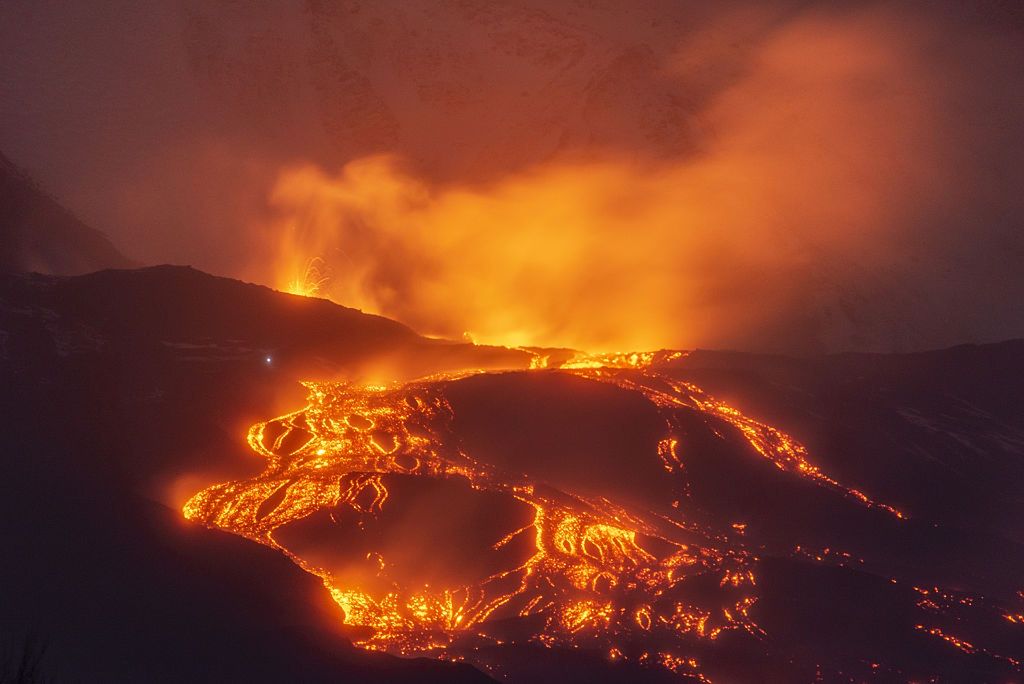
Recent observations confirm that Etna remains geologically active. In August 2025, the volcano opened a new fissure on its flank, releasing lava flows and prompting authorities to issue an orange alert level. While the lava advanced slowly and posed no immediate threat to populated areas, the event produced significant ash emissions that affected nearby towns such as Bronte and Cesarò. These episodes highlight the ongoing tension between Etna’s scientific fascination and its real-world presence in densely inhabited regions.
The concept of “petit-spot” volcanism originated from discoveries beneath the Pacific Ocean, where small, young volcanoes were found far from any plate boundary or hotspot. These features are thought to arise when the bending of tectonic plates creates fractures that allow deep-seated magma to ascend. Applying this model to Etna would imply that the volcano’s magma source lies not in a localized plume but in a broader region of the upper mantle where mantle material can be tapped due to lithospheric stress—a process that could explain its longevity and chemical signature.
If validated, this hypothesis would reshape how scientists view volcanic systems in compressional tectonic settings, particularly in regions where plate collisions create complex stress fields without clear subduction volcanism. It also raises questions about whether other anomalous volcanoes worldwide might similarly be reclassified under this framework. For now, the University of Lausanne team emphasizes that further geochemical analysis and seismic imaging are needed to confirm the depth and mobility of Etna’s magma reservoirs.
As research continues, Etna remains a powerful reminder of the dynamic processes shaping our planet. Its enduring activity offers both scientific insight and a vivid demonstration of Earth’s internal energy—one that captivates researchers and residents alike.