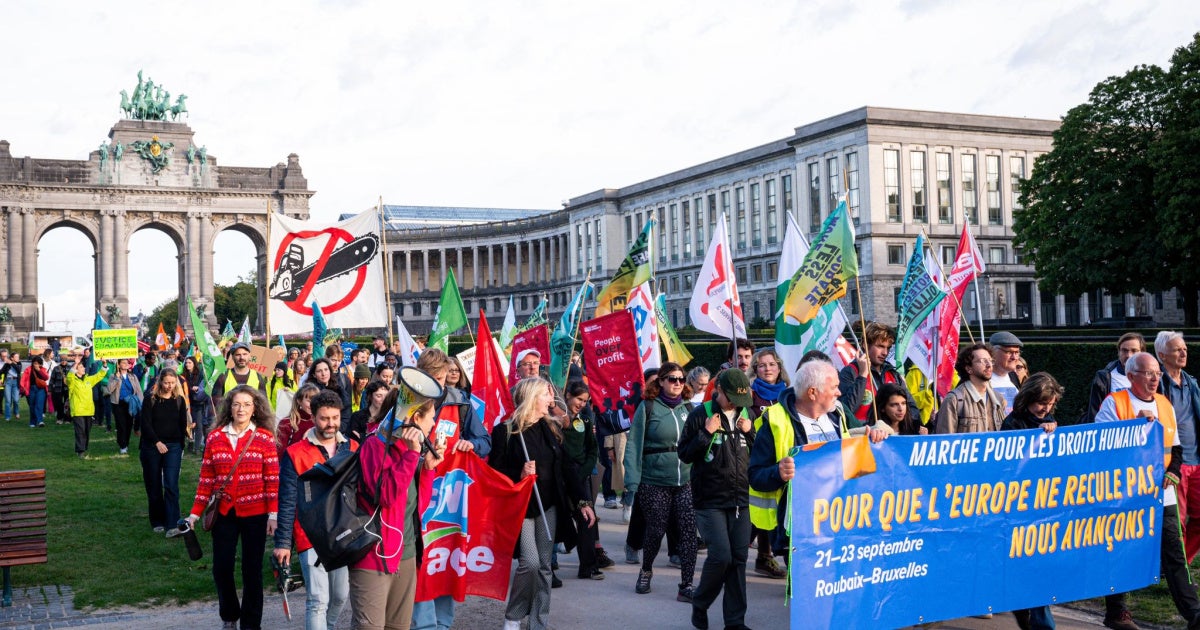
Landmark EU Supply Chain Due diligence Law Significantly weakened, Raising Concerns for Human Rights and climate Action
Brussels, Belgium – A pivotal piece of European legislation aimed at holding companies accountable for human rights abuses and environmental damage within their global supply chains has been substantially diluted following intense political maneuvering and compromises wiht far-right factions. the Corporate Sustainability Due diligence Directive (CSDDD), once heralded as a potential global standard, has been significantly weakened, sparking criticism from human rights organizations and environmental groups.
For years, advocates have pushed for a law requiring companies to proactively identify, prevent, mitigate, and account for adverse impacts of their business activities on human rights and the environment – not just within their direct operations, but throughout their entire supply chain. The initial proposal aimed to cover a broad range of companies, establishing a robust framework for corporate accountability. However, recent amendments, secured through votes involving far-right parties, have dramatically altered the scope and ambition of the directive.
What Remains of the CSDDD?
Despite the setbacks, the amended law retains some crucial elements. Companies will still be obligated to establish comprehensive human rights and environmental due diligence processes across their entire supply chain - a critical win against attempts to limit the scope to only direct suppliers. This means businesses must actively investigate potential risks, implement preventative measures, and address any abuses discovered. A risk-based approach will remain central, prioritizing intervention in the most severe cases while requiring ongoing attention to all identified or potential harms.
(Understanding Supply Chains: A company’s supply chain encompasses every stage of a product’s journey,from raw material sourcing to manufacturing,distribution,and retail. Ensuring ethical and sustainable practices throughout this complex network is paramount to responsible business conduct.)
Key Concessions and Their implications
The most meaningful compromises center around climate action and the breadth of corporate coverage.Notably, the requirement for companies to develop and implement climate transition plans aligned with the Paris Climate Agreement – a landmark international accord ratified by EU member states – has been removed. This omission is especially concerning given that companies covered by the law,even in its reduced form,are collectively responsible for nearly two-thirds of the EU’s annual carbon dioxide emissions,according to recent data from Global Witness.
Moreover, the number of EU corporate groups subject to the law has been slashed by approximately 70%, plummeting from 3,363 to just 980. This dramatic reduction significantly limits the law’s potential impact. A crucial provision mandating member states to establish a unified system for holding companies legally accountable in EU courts for human rights violations has also been eliminated, creating significant obstacles for victims seeking redress. This fragmented approach will likely complicate legal proceedings and hinder access to justice.
(The Paris Agreement: This international treaty, adopted in 2015, commits nations to limit global warming to well below 2 degrees Celsius, preferably to 1.5 degrees Celsius, compared to pre-industrial levels.)
Expert Reaction and Future Outlook
“The amended law is a far cry from the groundbreaking corporate accountability legislation it initially promised to be,” states sarah de Rengervé, a leading expert in business and human rights. “However, communities, workers, and civil society organizations should leverage the remaining provisions to continue fighting for justice for victims of corporate abuses worldwide.”
(Understanding Civil Society: Civil society encompasses a diverse range of non-governmental organizations,including community groups,advocacy organizations,labor unions,and others that work to address societal challenges and promote positive change.)
Why This Matters: A Shift in EU Leadership on Sustainability
The weakening of the CSDDD signals a potential shift in the EU’s commitment to leading the global movement towards corporate sustainability. The concessions made to secure passage raise questions about the influence of vested interests and the challenges of enacting ambitious environmental and social legislation in a polarized political landscape.
Looking Ahead:
While the CSDDD in its current form represents a significant setback, it is not a complete failure. The remaining due diligence requirements still establish a baseline for corporate duty. However, the effectiveness of the law will depend on robust implementation by member states, diligent enforcement, and continued pressure from civil society organizations to hold companies accountable. The fight for a truly just and sustainable global economy continues.
Sources:
* [https://www.europarl.europa.eu/RegData/commissions/juri/lpag/2025/12-10/JURI_LA(2025)781394_EN.pdf](https://www.europarl.europa.eu/RegData/commissions/juri/lpag/2
Related reading