
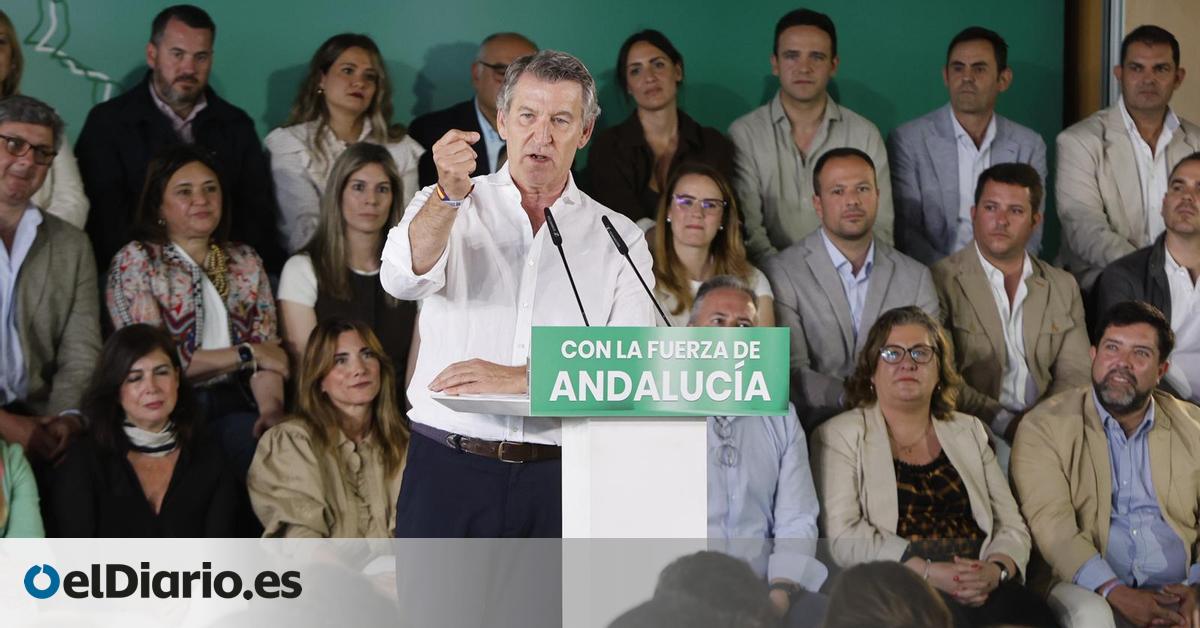
Alberto Núñez Feijóo, president of Spain’s People’s Party (PP), has called on party supporters to “pelear cada voto” (fight for every vote) in the upcoming Andalusian regional elections on May 17, 2026, urging them to secure an absolute majority for incumbent President Juanma Moreno without relying on the far-right Vox party. Speaking at a public event in Lepe, Huelva, on April 21, 2026, Feijóo emphasized that Moreno is a president of “primera categoría” (first category) who “cumple” and “sirve” the citizens, and stressed that greater PP support translates to more stability for Andalusia and Spain as a whole.
The appeal comes shortly after the PP formed governing pacts with Vox in both Extremadura and Aragón earlier in the week. On April 20, 2026, María Guardiola was invested as president of Extremadura’s regional government through a PP-Vox agreement. Hours later, on April 21, the PP and Vox finalized a similar pact for Aragón, allowing the far-right party to re-enter the regional government and implement its “prioridad nacional” (national priority) policy framework. These developments prompted criticism from Spanish Prime Minister Pedro Sánchez, who accused the PP of violating constitutional principles during a parliamentary control session.
In his Lepe address, Feijóo directly responded to Sánchez’s allegations, questioning the Prime Minister’s objections to the PP’s electoral success in Extremadura. He noted that while the PSOE lost the regional elections there, the PP won and therefore bears the responsibility to “darle estabilidad a los gobiernos” (provide stability to the governments). Feijóo framed stability as essential for progress, stating: “Consiguiendo un gobierno estable en esta tierra, estaremos dando un paso más para conseguir un gobierno estable en el conjunto de España” (Achieving a stable government in this land, we will be taking another step toward achieving a stable government across all of Spain). He identified Andalucía, La Rioja, Madrid, and Galicia as regions where the PP currently governs with absolute majorities and thus exemplifies this stability.
Feijóo’s Campaign Message for Andalusia
During his speech in Lepe, Feijóo outlined several reasons for re-electing Juanma Moreno, highlighting the Andalusian PP’s governance approach. He praised Moreno’s administration for “governing for the people,” effective problem-solving through sound management, and upholding decency in contrast to what he described as corruption surrounding Pedro Sánchez’s PSOE. Feijóo as well emphasized the non-negotiable nature of equality among Spaniards, asserting that it “no se negocia, no se trocea” and “no se vende” (is not negotiated, not divided, and not sold).
The PP leader urged activists not to assume victory, declaring: “No pensemos que está hecho, no lo está. Aquí no se ha ganado nada. Hay que pelear cada voto, uno a uno, hasta el final” (Let’s not think it’s done, it’s not. Here nothing has been won. We must fight for every vote, one by one, until the end). This message was delivered alongside local PP figures including Huelva province president Manuel Andrés González, Lepe mayor Adolfo Verano, and Andalusian regional candidate Loles López, who heads the PP list for Huelva.
Context of PP-Vox Agreements in Extremadura and Aragón
The PP’s alliance with Vox in Extremadura led to María Guardiola’s investiture as regional president on April 20, 2026, following regional elections in which the PP won the most seats but fell short of an absolute majority. The agreement allows Vox to hold key cabinet positions while implementing its policy agenda, including measures related to immigration, language, and cultural heritage under the banner of “prioridad nacional.” Similarly, in Aragón, the PP-Vox pact signed on April 21, 2026, enables the far-right party to join the regional government after the PP emerged as the largest force in the 2023 Aragón elections but required coalition support to govern.

These arrangements have drawn national scrutiny, particularly from Sánchez, who argued during a congressional control session that such pacts undermine constitutional values by legitimizing a party he characterizes as extremist. Feijóo rejected this framing, maintaining that the PP’s agreements are necessary to ensure governability and prevent political instability caused by fragmented parliaments. He reiterated that the PP’s goal in Andalusia is to avoid similar dependencies by securing an outright majority through voter mobilization.
Stability as a National Priority
Feijóo positioned regional stability as a cornerstone of his broader strategy for national governance. By pointing to Andalucía, La Rioja, Madrid, and Galicia as examples of PP-led regions with absolute majorities, he argued that such outcomes reduce reliance on smaller or ideologically distant parties, thereby enhancing policy continuity and administrative efficiency. This stance aligns with the PP’s national messaging ahead of the 2026 general election, where the party seeks to capitalize on perceptions of economic management and institutional credibility.

The Andalusian election on May 17, 2026, is viewed as a key indicator of political momentum heading into the national contest. Moreno’s current administration, in power since 2019, has highlighted economic growth, reduced unemployment, and infrastructure investment as achievements under PP leadership. The party aims to expand its mandate by convincing voters that absolute majorities yield better outcomes than coalitions requiring concessions to Vox or other parties.

As campaigning intensifies across Andalusia, the PP continues to frame the choice as one between stable, moderate governance and the uncertainty of fragmented authority. Feijóo’s repeated calls to “apretar” (tighten up or push harder) reflect the party’s recognition that while Moreno leads in polls, complacency could risk losing the absolute majority threshold needed to govern independently.
The upcoming vote will determine whether Andalusia joins the list of Spanish regions where the PP governs without external support, reinforcing Feijóo’s argument that local stability contributes to national cohesion. Official results will be released following the May 17 polls, with no further procedural steps required before the new regional government assumes office.
For updates on the Andalusian election campaign and candidate platforms, readers can consult the official websites of the Junta de Andalucía and the Partido Popular de Andalucía.