
Michael Pollan
2026-01-26 15:05:00
Anyone who thinks the contemplative life amounts to a form of quietism or a retreat from the world’s suffering should spend some time shadowing Joan Halifax, the Zen priest and anthropologist. I’d been curious about Halifax for years, ever since I heard about an annual trek that she leads through the mountains of Nepal, bringing a cadre of doctors and dentists to remote mountain villages with little access to health care.
Each summer over the course of two weeks or so, this Nomads Clinic covers more than 100 miles on foot and horseback, at altitudes of nearly 18,000 feet. These “medical mountaineers,” as they’ve been called, all volunteers, sleep in tents, often in freezing temperatures. But after some 40 annual trips to Nepal—Halifax is normally based in Sante Fe—she recently decided it was time to hang it up. She had just turned 80.
In addition to bringing medical care to remote mountain villages half a world away, Halifax has ministered to the dying in hospice, worked with the homeless in New Mexico, cared for prisoners on death row, and led countless protests for peace. I don’t know if Halifax has shed the last remnants of her ego—she would say she hasn’t—but the selflessness she manifests in the conduct of her life is something to behold, a reminder of what the exploration of human consciousness can lead a person to do and be. This, too, is a Buddhist principle—that overcoming one’s own small self should lead to greater compassion for others, and that the suffering alleviated when we transcend the ego is not only our own.
For more than 30 years, Halifax has been the abbot at Upaya Zen Center, the retreat she founded in Santa Fe in 1990. I’ve had the chance to meet her a couple of times; once, we appeared together on a panel to talk about psychedelics. Halifax was married to the pioneering Czech psychiatrist Stanislav Grof for several years in the 1970s. Working together, they gave transformative doses of LSD to the dying. For a period of time, Halifax regularly took large doses of LSD herself. Her first psychedelic trip, while wandering the streets of Paris in 1968, showed her “that there was beauty behind the beauty I perceived, and that mind was both in here and out there. I was dumbstruck.”
I could relate. After years of curiosity about psychoactive plants, my own experimentation with mushrooms and LSD in recent years fundamentally changed the way I understand the mysteries of consciousness and the self. So in 2024, I emailed Halifax to see if I might pay a visit to Upaya. My idea was to spend a week or so in residence, meditating with the aspiring monks, performing monkish chores, interviewing Halifax, and seeing if I could make a little more progress untying the knot of self. “Upaya is a factory for the deconstruction of selves,” she had told me. I was curious to find out how that worked.
But Roshi Joan, as everyone calls her, had other plans for me. She decided I should spend a day or two at Upaya and then accompany her up to “the refuge,” an off-the-grid compound of tiny houses and huts stretched out across a broad hammock of meadow at 9,400 feet in the Sangre de Cristo Mountains, north of Santa Fe. Whenever she’s not traveling or running conferences or teaching, Halifax retreats to these mountains, where she meditates and hikes and paints and writes and doesn’t have to play the role of abbot. She dispatches students to the refuge when she deems them in need of a period of monastic solitude—for years at a time, in some cases.
“After you’ve acclimated to the altitude, we’ll drive up to the refuge,” she said by email before my arrival in Santa Fe. “You can stay in the cave.” This was not put in the form of a question.
The cave?
Halifax explained that even though it had neither plumbing nor electricity nor an internet connection, this was “a five-star cave” and I would be comfortable—or, more likely, I’d be uncomfortable in a spiritually productive way. I’m not much of a camper but decided I might as well put myself in her hands to see what the experience would yield.
The first thing you notice about Joan Halifax is her undiminished beauty—the shining blue eyes and the easy smile and the generous sweep of white hair. That she’s 83 is hard to believe. She moves through Upaya’s little village of low-slung adobes and tended gardens with a graceful authority. Yet abbot is a role that, these days, she’s more than happy to trade for the solitude and freedom of the refuge.
The refuge is at the end of a 25-mile-long rutted dirt road that climbs through a shadowy forest of pine and spruce, punctuated by the sparkle of the occasional stream or meadow. Though it was well into June, spring was still unfolding at this altitude, the meadow grasses and spruce tips bright green and the groves of ivory-trunked aspen just leafing out. After we unloaded our SUV at the main house, where we would gather for meals (and connect to the outside world, as the house has a satellite internet connection), Halifax escorted me to my lodgings, a hike of half a mile along a path through meadows lined with aspen trees, their new leaves fluttering gently. Along the way, she identified the scat of elk, deer, and bears.
The cave was a 12-by-15-foot cell dug into a south-facing hillside and lined with brown stucco; it was windowless except for a sliding glass door overlooking the meadow. In one corner stood a spartan single bed, in the other a small woodstove. Between them, against the back wall, a meditation cushion sat on a raised platform, beneath an embroidered fabric depicting a Buddhist figure I didn’t recognize. I pictured myself seated cross-legged on the platform, like one of those levitating yogis in a New Yorker cartoon. The room also had a small sink fed by a five-gallon jug of water suspended above it, a two-burner camp stove, some shelving for clothes and books, and a car battery hooked up to a small solar panel outside. This produced just enough juice to power a reading light and charge a phone, though with no cell service or internet connection, what was the point?
What was the point? Why did Roshi Joan want me here rather than at Upaya or the main house, with its creature comforts? (And why did she keep putting off our interview?) I came to suspect she had decided that the questions I had for her—questions regarding Buddhist ideas about the self and consciousness and her own path from psychedelics to Zen—were best approached obliquely, perhaps by way of firsthand experience rather than words; that I should answer them myself. When I’d told her what I was working on, she had diagnosed me as hopelessly stuck in my head. Better to spend several days alone with myself meditating and navigating these hills than in the more familiar landscape of concepts, something to which I should have known a Zen priest would be allergic. When we finally did sit down for our interview, in the main house on the morning of the third day, Roshi Joan began by saying, somewhat cryptically, that she had “divested from meaning.” Okay.
It took me a while to realize that for Halifax, the practice of Buddhism was everything and theories were of little use or consequence. It was only through doing that she had learned her most enduring life lessons, whether that meant sitting with death-row inmates who taught her how powerlessness ferments into anger, or ministering to people in their last days and hours. “You learn to be nimble toward whatever is arising, because there’s no one death,” she said, “and if you cling to expectations, you will experience futility.” It was here, in doing the work, that Buddhist ideas about impermanence, conditioning, and dependent arising became flesh.
I took the hint. When I asked Halifax about herself or about Buddhist philosophy, she often ducked my questions or directed me elsewhere, so during one of our daily walks, I instead asked her to describe exactly how her factory for the deconstruction of selves operated.
People come on silent retreat for a week or two at a time and spend most of their days sitting in the Zendo—the meditation hall—facing a wall or tracing walking meditations on the gravel paths that meander through Upaya’s gardens. (I’d witnessed this glacial parade of earnest zombies.) I asked if novices received any guidance or technique. Not much, she said. Students are instructed about posture, and beginners are told to follow the breath, which “unifies body, mind, and space.” As Halifax has written, zazen, or sitting, “is not a mental exercise, a thing you do with your mind.” Rather, “it is about being radically open to things just as they are, not grasping at or rejecting phenomena, but simply being present and at ease with moment-to-moment uncertainty and groundlessness” and “letting openness or not-knowing deconstruct our version of reality. It is the method of non-method.” Just sitting, upright—that, apparently, is all there is to zazen.
“Zen is the hardest school,” Halifax explained, “because there is so little support.” But at Upaya, she told me, “there is the jungle gym of structure”—the strict rules and rituals and routines that govern life on retreat.
“There’s a certain point at about day three where you can feel the whole room go poof,” she said. “And everyone realizes we’re now in one body, one mind.” I asked her how this transformation was achieved. “We don’t say we’re deconstructing the self, but that is what we’re doing,” she told me. “Living in silence means you can’t start a conversation, so there’s no opportunity for self-presentation. Then there are the rituals that organize the day. These draw people into the group and relieve them of having to make decisions. Rituals take the place of a certain amount of volition.” It hadn’t occurred to me that ritual and silence could serve as tools to change consciousness and breach the hard shell of self.
But it is the agony of meditating for hours at a time that finally breaks down the ego. I asked her what people meditate about. “Mostly they ruminate and plan,” she said. “They do that until they can’t stand the thought of themselves any longer. You’re just sitting there for hours on end, and the entertainment value of watching the same reruns all day long diminishes over time. Pretty soon, it becomes unsustainable; they’re exhausted and uncomfortable, and that’s when they drop in.”
To “drop in,” Halifax explained, is to enter a state of being completely present in time and space, experiencing “the sense field”—the world as it appears to our senses prior to thought—without conceptualizing, and surrendering the sense of a separate self. The recipe was simpler (and much less appetizing) than I would have imagined: To transcend the self, force yourself to be alone with it long enough to get so bored and exhausted that you are happy to let it go.
Poof!
Halifax, who did anthropological fieldwork in Africa, thinks of the Zen retreat as an initiation ceremony, or rite of passage, and like most such rites, it involves the metaphorical death of the ego followed by rejoining the group. She regards the psychedelic trip as another rite of initiation, but “it’s a shortcut,” and one she’d rather her students not take. I wondered if this helped explain why she preferred that I stay at the refuge rather than mingle with her students at Upaya. Perhaps she thought contact with me would undermine the process by encouraging them to take the psychedelic shortcut.
“There is a lot gained when we give up the self,” she noted. “We break out of rumination. We discover we’re part of something larger, and we learn it feels good to care for others.” When I asked Halifax if she had succeeded in exorcising her own self, she allowed that she can be self-righteous at times. “There is moral injury, moral outrage, moral apathy—all of them are products of either a sense of superiority or inferiority,” she said. “So they’re all ego-based.”
I came to understand that Roshi Joan had sent me to the cave because there were no words or ideas she could offer that would teach me as much as simply being completely alone with myself in the middle of these mountains, with no phone or any other screens (and no toilet). Her idea, I eventually saw, was to pose a kind of experiential koan for me to puzzle and, perhaps, to help me unlearn some of the things I thought I had learned about consciousness and the self.
Cave life quickly stripped down to the bare essentials: collecting, splitting, and stacking wood; building fires; hauling water; digging pits in the woods; sweeping the floor and threshold; and, for hours each day, meditating on the platform. I’ve meditated for several years now, but never as easily or as deeply or as strangely as I did in my little cave. It may have been the silence, which felt bottomless, or the certainty that I would not be interrupted or distracted. Even the air there felt different, as if the absence of the electromagnetic waves that normally surround and pass through us made it easier to empty the mind of its usual detritus. I found I could sit for hours at a time, something I’d never managed to do before.
It helped that there was nothing else I needed to do, except maybe brew a cup of tea or sweep the cave again. Somehow, these seemed like particularly cave-appropriate activities. I fell into a routine so elemental and repetitive that it began to feel like ritual. The only snafu came the first time I attempted to use my hand-dug pit toilet and, failing to position myself properly, managed to pee into my sneaker. Now I was a shoeless monk. Which also seemed cave-appropriate.
One morning, I decided to try a meditation I’d learned from my time with the Nepalese French Buddhist monk Matthieu Ricard, who has written extensively on the self as an illusion. To see this, he suggested I explore the rooms of my mind, one by one, as if searching for a thief—what he called “the thief of self.” Looking within, I found all sorts of mental stuff but, as Ricard had predicted, none of it qualified as a self. Rather, I witnessed a parade of unbidden, free-floating perceptions, feelings, images, sensations, and thoughts, but I could locate no thinker of these thoughts or perceiver of these perceptions.
The longer I sat, the stranger these appearances became, as the space of my awareness became an empty stage. Picture a circus ring where all kinds of images might suddenly and inexplicably appear out of nowhere. Why is there now a bank of three old-timey telephone booths with men inside making calls? And what’s this hammer suddenly coming down on a knee?! Or that automatic glass door swinging open for no one? These stray images were then blasted away by a blazing sun that completely filled the space of awareness before transforming itself into a gigantic eyeball—a sighted sun with a black circle of iris. Could this be the anarchic mind that emerges when the ego relinquishes its hold?
Maybe, and yet these dreamy, hypnagogic images were more curious than frightening, probably because it was easy enough to chase them away, to change the mental channel, simply by willing it. So then who, or what, did the chasing? The source of that will, that inchoate “I,” might have escaped introspective detection, yet it could still make things happen or stop happening. The self might well be illusory, I decided, but no more so than color or any other construct of the mind. Put another way, the self can be both illusory and real, or real enough.
Initially, I found I was talking to myself out loud, trying to fill the vast space of silence, which made it feel as though I had doubled my self rather than eliminated it—given it a little company. “Should I brew a cup of tea? Put another log on the fire?” I would ask. And I would answer: “Sure,” or “Good idea.” But after a day or two, I fell in love with the silence, and the voices stopped. I found the handful of chores completely absorbing, as if nothing in the world mattered as much as splitting firewood, fully occupying my attention and leaving no remainder of thought, self-consciousness, or anticipation. The distance between living and meditating had narrowed to a sliver. When I described the satisfactions of my routine to Roshi Joan during one of our hikes, she smiled: “That’s the sacredness of the everyday.”
Something was happening to my sense of self, and it seemed to have everything to do with what was happening to my sense of time. I had never given much thought to the relationship between self and time, but it explains a lot. When the self is deprived of time past (memory) and future (anticipation), it melts away. Absorbed in meditation, or in my chores, or in watching a small herd of elk graze in the meadow below at sunset, I could feel my time horizon shrink. The feeling was unfamiliar, since my usual mental coordinates place me somewhere in the proximate future, a locus of anticipation and, all too often, unfocused worry. But now, for longer and longer stretches, I was simply here, being, with no thought of the past or the future.
To my surprise, these moments of simple and more or less self-less consciousness did not occur when my eyes were closed—in fact, the darkness sent me zooming off to all kinds of strange places. No, now it was when my eyes were open that the stream of thought stilled and pooled, and not only on the meditation platform; it could happen when I was moving around the cave doing chores or hiking in the woods. The miraculous everyday fact of consciousness loomed larger than “the hard problem” of how a brain produces subjective experience.
Had I “dropped in”? There were moments when all I experienced was what Roshi Joan had called the “sense field.” This happened especially upon opening my eyes in meditation, but it was never very long before I slipped back into reflection and then the inevitable jotting-down of notes, and all at once I was back in the self-world. To stay in that state of unthinking presence was like walking a tightrope only to suddenly look down, panic, and come plunging back to Earth.
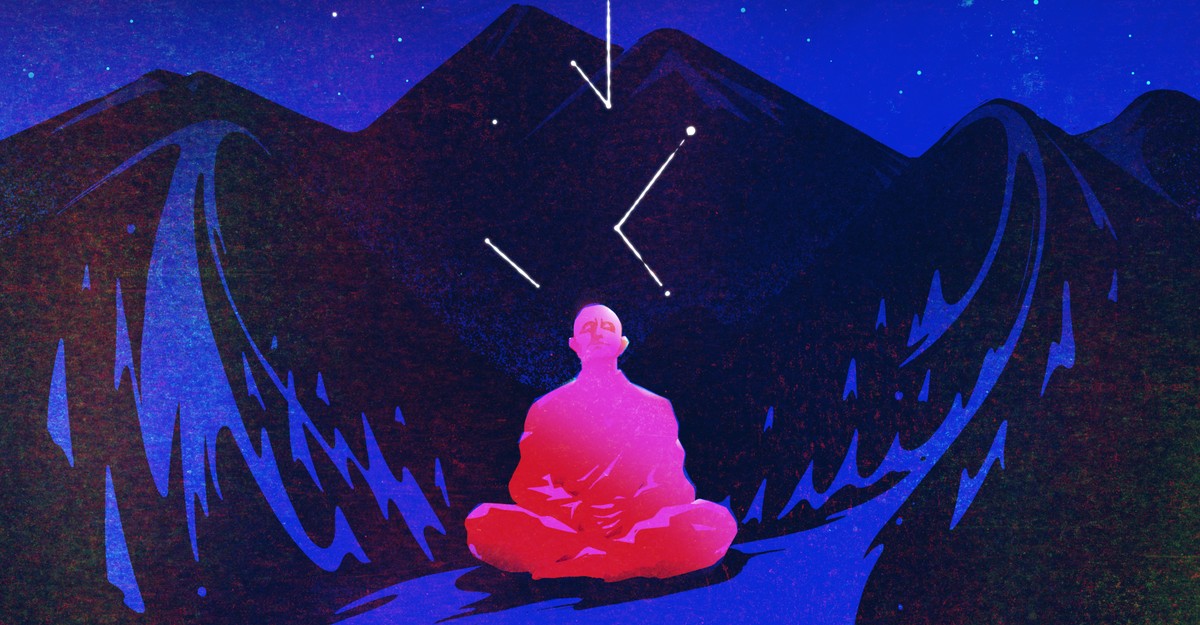
Except once, when I managed to look not down but up. I had woken up in the middle of the night and stepped outside into the cold night air. There was a new moon, and the only light in the world was that of the stars, which were out in force, brighter and more numerous than I’d ever seen them, but also strangely different. Instead of dotting the same black scrim, like pinholes in a two-dimensional theater backdrop, the stars were scattered through space at dramatically varying distances, a vast swarm of them filling every last corner of an even vaster, more numinous, and emphatically three-dimensional darkness. Even stranger, the negative space between the stars had flipped to positive, forming a soft, almost palpable blackness that embraced the stars and reached all the way to Earth, enveloping it and me in the same intergalactic blanket. For the first time, I could see—no, could feel—that the stars and I shared the same infinite space.
My brain’s usual priors, predictions, and inferences about the night sky had broken down, it seemed, allowing me to see more of the galaxy and space itself than I ever had. There was hugely more of it and less of me, rendered infinitesimal in the presence of this immensity. I felt as though every previous experience I’d had of the night sky had been filtered through some idea or model or expectation and so had been something less than completely conscious. And I understood that this state—abstracted, distracted—had been my default. A line in a poem by Jorie Graham came to me:
This is what is wrong: we, only we, the humans, can retreat from ourselves and
not be
altogether here.
Only we, the humans. Yes! What other animal can afford to be anything less than completely conscious?
This moment of being fully, freshly present to the universe stopped me cold and made me wonder if all my hard thinking about consciousness had missed something crucial about it. The more I focused the narrow beam of my attention on what consciousness is and what it does and how it came to be, the less of it I was actually experiencing—whatever it was. My time in the cave and, now, beneath this night sky showed me the price of my impatience with the mystery.
“Always keep a don’t-know mind,” Roshi Joan had said to me. Sometimes not knowing opens us to possibilities that knowing, or trying to know, or thinking we already know, closes off. In the years since I had embarked on this inquiry, desperate to know, I had narrowed the aperture of my awareness, sacrificing this, the glory of the night sky, for a keen intellectual focus. But as my days of solitude in these mountains had shown me, that wider circle of light, that numinous lantern of awareness, is still available to us, so long as we can break the spell of self and its distractions. Consciousness is a miracle, truly, and remains the deepest of mysteries, yes, but it is also so very simple that it can fit into a sentence: I open my eyes and a world appears.
This essay was adapted from Michael Pollan’s book, A World Appears: A Journey Into Consciousness, published next month.
When you buy a book using a link on this page, we receive a commission. Thank you for supporting The Atlantic.





