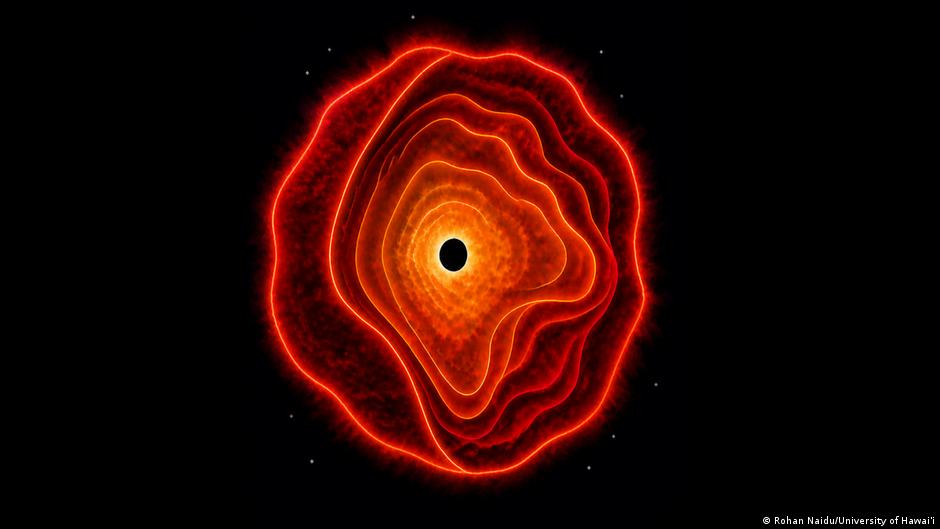
Astronomers analyzing data from deep-space observatories have identified a perplexing cosmic phenomenon that challenges standard models of stellar evolution: a celestial object exhibiting characteristics of both a massive star and a black hole. Detected through anomalous red emissions captured by advanced space telescopes, this discovery has prompted researchers to reconsider how the earliest structures in the universe formed and evolved.
According to recent astronomical reports and observations utilizing space-based observatories like the James Webb Space Telescope, these unusual objects—frequently characterized by researchers as massive red entities—display properties that do not fit neatly into traditional astrophysical classifications. Rather than functioning as ordinary luminous stars powered solely by nuclear fusion, these anomalous bodies appear to harbor dense central cores or mechanisms resembling black holes, drawing intense scrutiny from the global scientific community.
Modern deep-space instrumentation continues to overturn long-held assumptions in astrophysics.
Decoding the Anomalous Red Signatures in Deep Space
The discovery centers on unusual optical and infrared signatures detected in distant regions of the universe. Researchers analyzing data from advanced infrared instruments noted unusually intense red light emanating from compact sources that appeared far too bright and massive to be explained by standard stellar populations alone. According to findings discussed in astronomical literature, these sources possess mass configurations and energy output levels that defy conventional stellar physics.
Astrophysicists evaluating these targets suggest that the anomalous red glow might originate from material interacting with a compact, dense core.
The implications extend directly to how scientists understand the assembly of galaxies. Identifying objects that blur the boundary between stellar mass accumulation and black hole growth offers a vital missing link for researchers tracking cosmic evolution.
Observational Challenges and Future Verification
As research groups publish supplementary data sets and peer-reviewed analyses, the astronomical community remains cautious.
To stay informed on the latest updates regarding deep-space discoveries and official telescope data releases, readers can monitor announcements from major space research institutions and scientific journals. We welcome your thoughts and analysis on these findings—join the conversation in the comments below.
Worth a look