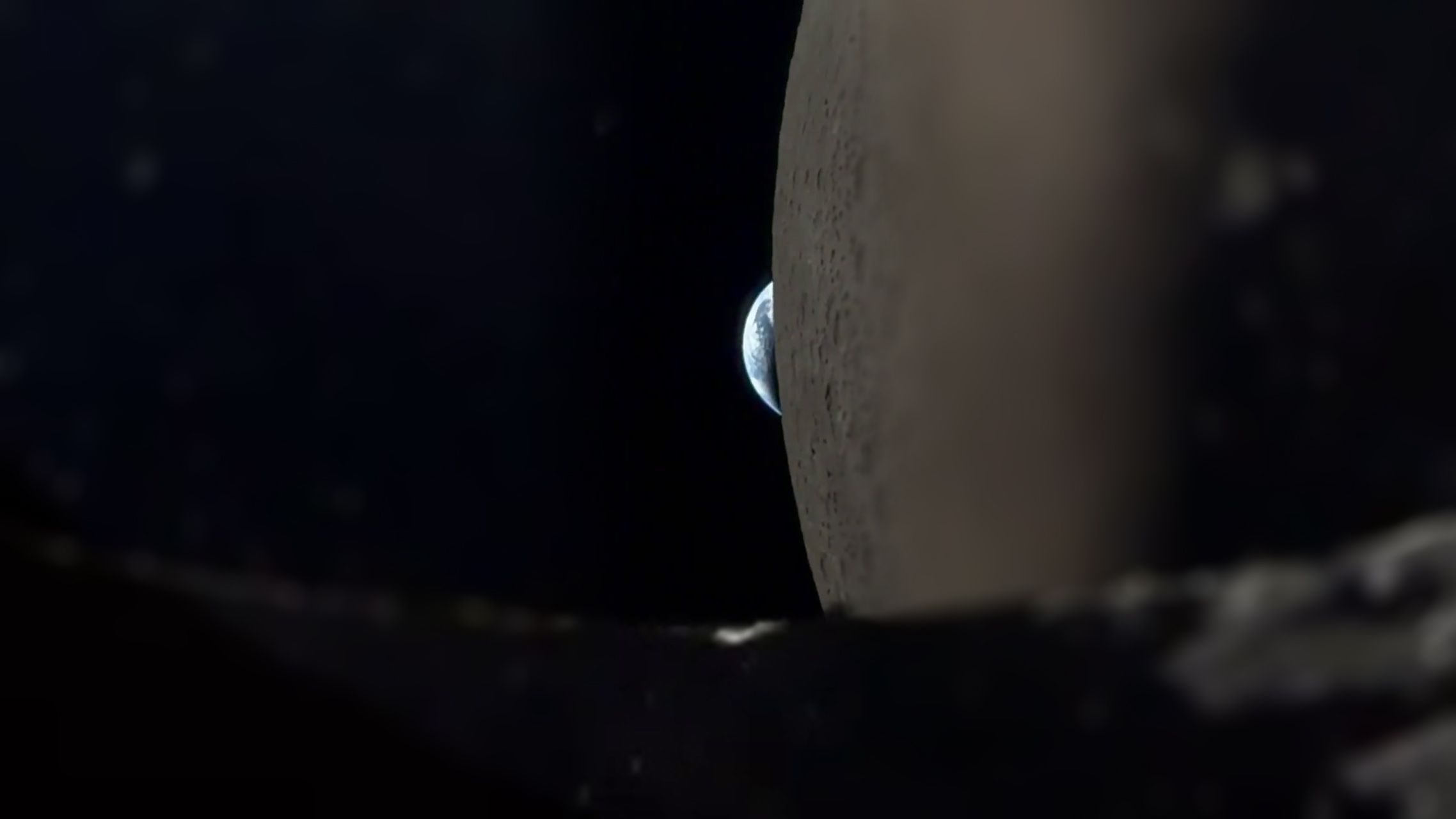
NASA astronaut Reid Wiseman has shared a remarkable video captured during the Artemis II mission, showing the Earth disappearing behind the Moon—a phenomenon known as an “Earthset.” The 53-second clip, filmed from the Orion capsule’s docking hatch window using an iPhone 17 Pro Max, marks the first time such a view has been recorded on a mobile device in deep space. Wiseman posted the video to his X account on April 19, 2026, describing it as a “once-in-a-lifetime” moment and comparing the experience to watching a sunset from the most remote vantage point imaginable.
The footage begins with a brief focus adjustment as Wiseman switches to 8x optical zoom, after which the lunar surface comes into sharp relief, revealing detailed crater formations as the Earth gradually moves out of frame. The astronaut noted that at this magnification, the view through the iPhone closely resembled what the human eye would perceive from the spacecraft’s position. The video has since drawn widespread attention for its technical achievement and emotional resonance, offering a rare glimpse of spaceflight from a crewed mission’s perspective.
This milestone builds on NASA’s earlier decision to qualify iPhones for extended leverage in spaceflight environments. In February 2026, the agency confirmed that the iPhone 17 Pro series met stringent safety and performance standards for operation aboard the Orion spacecraft, including resistance to radiation, thermal extremes, and electromagnetic interference. The qualification followed months of testing at NASA’s Johnson Space Center, where devices were evaluated for use in both intravehicular activities and documentation tasks during Artemis missions.
During Artemis II, which launched in April 2026, astronauts used the iPhone 17 Pro Max not only for Earthset imagery but likewise to capture a series of high-resolution still photographs of the lunar surface and spacecraft interior. These images were later shared through NASA’s official channels as part of the mission’s public engagement efforts. The use of commercial smartphones reflects a broader trend toward leveraging accessible, high-performance consumer technology for spaceflight documentation, reducing reliance on specialized equipment while maintaining image quality suitable for scientific and outreach purposes.
The iPhone 17 Pro Max features a tetraprism lens system enabling up to 5x optical zoom, with digital enhancement extending to 8x in video mode—a capability Wiseman highlighted in his post. Apple’s ProRAW and ProRes video formats, combined with improved low-light performance and stabilization, allow for detailed captures even in the high-contrast lighting conditions near the Moon. These specifications were validated through independent testing by spaceflight imaging specialists prior to mission approval.
Reid Wiseman, a veteran NASA astronaut and commander of Artemis II, has been an active advocate for sharing authentic mission experiences with the public. His social media updates throughout the flight have included real-time reflections on life aboard Orion, Earth observations, and the technical challenges of deep-space navigation. Wiseman previously served as a flight engineer on Expedition 40/41 to the International Space Station and has logged over 165 days in space across two flights.
The Artemis II mission represents the first crewed flight of NASA’s Space Launch System (SLS) and Orion spacecraft, designed to test critical systems ahead of future lunar landings. While the mission did not involve a surface landing, it successfully conducted a circumlunar trajectory, taking the crew farther from Earth than any humans have traveled since the Apollo program. The Earthset video serves as a poignant visual reminder of mission progress and the unique perspective afforded by human spaceflight.
Officials at NASA’s Kennedy Space Center confirmed that all multimedia captured during Artemis II, including the iPhone footage, is being archived for engineering review and public dissemination. The agency continues to evaluate the role of consumer electronics in mission documentation, with future assessments planned for Artemis III and beyond. No official timeline has been released for the next opportunity to capture an Earthset from a crewed vehicle, as such events depend on precise orbital mechanics and mission phase alignment.
As space agencies and private companies push toward sustained lunar presence, the integration of everyday technology into mission workflows highlights evolving approaches to accessibility and public engagement. The ability to document spaceflight using widely available tools not only empowers astronauts to share their experiences directly but also inspires broader interest in science, technology, and exploration.
For updates on NASA’s Artemis program and related missions, visit the agency’s official website at nasa.gov. To view the Earthset video and other mission multimedia, explore NASA’s Image and Video Library at images.nasa.gov.
What are your thoughts on using smartphones for space documentation? Share your perspective in the comments below, and consider sharing this article with others interested in the future of human spaceflight.