
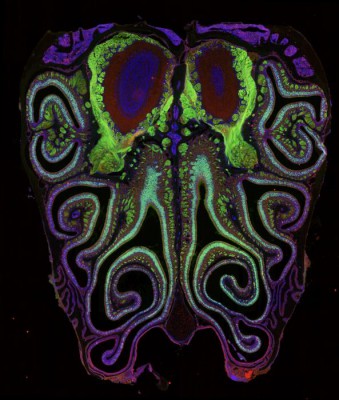
For decades, the scientific consensus on the sense of smell was relatively straightforward: the nose acted as a simple collector and the brain did all the heavy lifting. We believed that olfactory receptor neurons were scattered randomly across the nasal cavity, like a chaotic field of sensors, only finding order once they sent their signals to the olfactory bulb in the brain.
However, a groundbreaking shift in sensory neuroscience has overturned this long-held assumption. Researchers have discovered that the nose does not simply collect scents—it organizes them. For the first time, scientists have mapped a spatial organization of olfactory receptors within the nasal epithelium, revealing a sophisticated smell map
that pre-processes chemical signals before they ever reach the brain.
This discovery fundamentally rewrites the textbook understanding of how humans and other mammals perceive the world around them. By proving that the olfactory epithelium is structured rather than random, the research suggests that the periphery of our sensory system is far more intelligent and organized than previously imagined.
Beyond the Brain: The Nose’s Own Navigation System
To understand the magnitude of this find, one must first understand the traditional model of olfaction. In the old model, olfactory receptor neurons (ORNs) were thought to be distributed haphazardly throughout the olfactory epithelium—the specialized tissue lining the upper part of the nasal cavity. The theory was that while the receptors were random in the nose, they converged into specific clusters called glomeruli in the olfactory bulb, creating a map only at the destination.

The new research demonstrates that this mapping begins at the source. The study found that neurons expressing the same type of olfactory receptor are not randomly dispersed but are instead grouped in specific spatial zones within the nasal lining. This means the nose possesses its own internal coordinate system for scents.
This spatial arrangement acts as a primary filter. When volatile molecules enter the nostrils, they encounter a structured array of sensors. This organization likely enhances the efficiency of scent detection and allows the system to distinguish between similar chemical structures with greater precision.
Challenging a Century of Neuroscience
The transition from a random distribution model
to a spatial map model
is a seismic shift in neuroscience. For nearly a century, the olfactory bulb was considered the sole architect of smell organization. By identifying a map in the epithelium, researchers have shown that the sensory periphery is actively involved in the coding of olfactory information.
This discovery suggests that the olfactory system utilizes a dual-layer mapping process. The first map exists in the nasal cavity, and the second exists in the brain. This redundancy likely serves as a fail-safe and a refinement mechanism, ensuring that the brain receives a highly organized and clear signal regarding the identity and concentration of a smell.
The methodology used to uncover this map involved advanced imaging and genetic tagging, allowing researchers to visualize exactly where specific receptor types were located. By tracking these neurons, they observed a non-random, zonal pattern that remained consistent, proving that the smell map
is a biological blueprint rather than a coincidental arrangement.
Clinical Implications: From Anosmia to Artificial Scent
The discovery of the olfactory map is not merely a theoretical victory; it has profound implications for medicine and technology. Understanding the spatial organization of the nose provides a new lens through which to view olfactory dysfunction.
For patients suffering from anosmia (the total loss of smell) or hyposmia (a reduced sense of smell)—conditions that became widespread following the COVID-19 pandemic—this research offers a new target for treatment. If the spatial map in the epithelium is damaged or disrupted, the brain may struggle to interpret signals even if the neurons themselves are still functional. This suggests that regenerative therapies may need to focus not just on growing new neurons, but on restoring their specific spatial organization.
Beyond medicine, the map opens new doors for the development of synthetic olfaction. Current artificial “noses” used in food safety and chemical detection often struggle with the nuance of human perception. By mimicking the zonal organization of the human olfactory epithelium, engineers may be able to create sensors that can distinguish complex odors with human-like accuracy.
Key Takeaways of the Olfactory Map Discovery
- Spatial Organization: Olfactory receptor neurons are grouped in specific zones in the nose, not scattered randomly.
- Pre-Processing: The nose begins organizing scent information before it is sent to the brain.
- Dual Mapping: The sense of smell relies on a two-stage map—first in the nasal epithelium and then in the olfactory bulb.
- Medical Potential: This provides new insights into treating smell loss by focusing on the structural restoration of the nasal lining.
The Path Forward in Sensory Research
While the completion of this initial smell map is a milestone, it raises new questions for the scientific community. Researchers are now looking to determine if this spatial organization varies between different species and how it evolves throughout a human lifetime. There is also a pressing need to understand how the map is formed during embryonic development and how it maintains its structure despite the constant regeneration of olfactory neurons.

scientists are investigating whether certain zones of the nasal map are more susceptible to environmental pollutants or viral infections than others. If specific “scent zones” are more fragile, it could explain why some people lose the ability to smell specific categories of odors while retaining others.
The next confirmed step in this research involves larger-scale mapping projects to determine the exact boundaries of these olfactory zones and how they correlate with specific chemical families. As these maps become more detailed, we move closer to a complete molecular understanding of how we experience the aromatic world.
Do you believe our understanding of the human senses is still in its infancy? Share your thoughts in the comments below or share this article with others interested in the frontiers of neuroscience.