
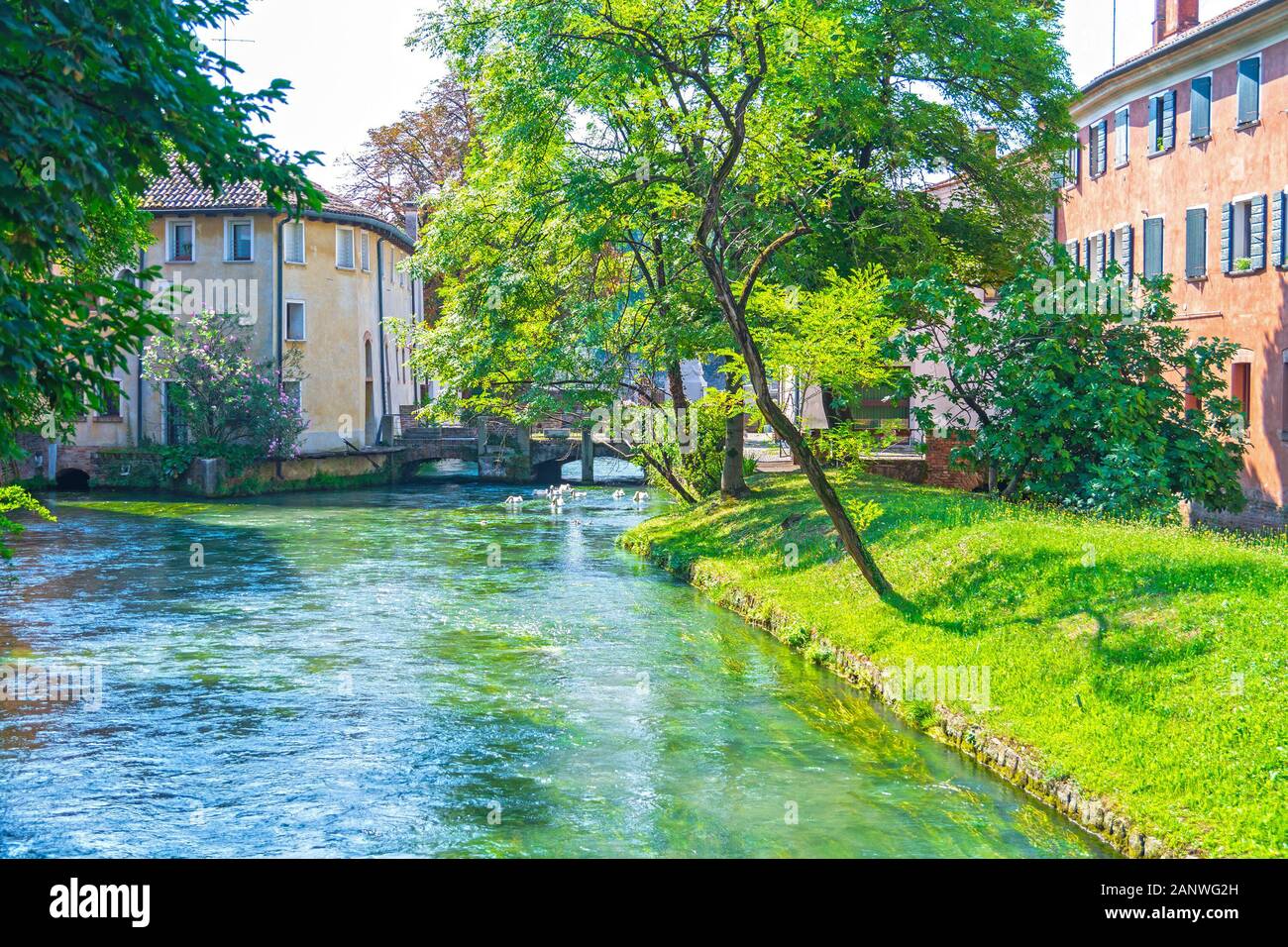
Along the quiet waterways of Treviso, Italy, a subtle tradition persists beneath the surface of daily life: street fishing. Known locally as pesca di strada, this practice sees anglers casting lines from narrow bridges, canal embankments, and quiet corners of the city’s historic center, where the cagnan canals wind like silver threads through centuries-old stone.
Treviso, often called “Little Venice” for its network of waterways fed by the Sile and Botteniga rivers, has long been shaped by its aquatic landscape. The canals, once vital for defense, trade, and powering watermills, now offer a different kind of sustenance — one measured not in commerce, but in quiet moments of connection between person and water.
Despite the city’s evolution from a medieval commune to a modern hub in Italy’s Veneto region, the act of fishing its canals endures as a quiet counterpoint to tourism and urban pace. Anglers, often older residents with decades of experience, speak of the ritual not as sport, but as a form of listening — to the rhythm of the water, the seasons, and the life moving just below the surface.
What draws them in is not just the possibility of a catch, but the access to a hidden layer of the city — one where time slows, and the boundary between urban and natural blurs. In the early morning light, when mist hovers over the Isolotto della Pescheria or the reflections of the Palazzo dei Trecento shimmer in the Canal Grande, fishing becomes a way of inhabiting Treviso more deeply.
The Fish Beneath the Bridges
The canals of Treviso support a surprising diversity of freshwater life, sustained by clean, flowing water from the surrounding Veneto plain. Among the most commonly encountered species are the common carp (Cyprinus carpio), known for their resilience and size; the European chub (Squalius cephalus), a slender, silver fish often found in slower currents; and the brown trout (Salmo trutta), which favors the cooler, oxygen-rich stretches near where the Sile and Botteniga converge.

These species are not stocked for sport but have established self-sustaining populations, benefiting from the canals’ stable flow and the absence of major pollution. Local environmental monitors, including those from the Veneto Regional Agency for Environmental Prevention and Protection (ARPAV), have noted in recent assessments that the urban canals maintain good ecological status, particularly in stretches where riparian vegetation buffers runoff and oxygen levels remain high.
Anglers typically use light tackle — small hooks, floats, and natural baits like worms or maggots — suited to the cautious nature of urban fish. Catch-and-release is common, especially among younger practitioners who view the activity as a form of ecological engagement rather than harvesting.
A Practice Rooted in Place
Street fishing in Treviso is not governed by formal clubs or permits in the way it might be in larger rivers or lakes. Instead, it operates through informal understanding: respect for private property along the canals, avoidance of disruptive behavior, and an unspoken agreement to abandon no trace. Many anglers arrive before dawn or after dusk, when the city is quietest and the fish most active.
Historically, fishing these waters was not merely recreational. In centuries past, when the canals powered mills and supplied water to households, fish from the cagnan supplemented diets, particularly during Lent or times of scarcity. Today, although subsistence is no longer the motive, the continuity of practice links present-day anglers to generations who knew the canals as providers.
This sense of continuity is echoed in the city’s broader relationship with its waterways. Restoration projects over the past two decades — including the repair of historic washhouses (lavanderie) and the revival of watermill mechanisms in the Quartiere Latino — have reinforced Treviso’s identity as a city shaped by water. Fishing, becomes another thread in the fabric of that relationship: not dominant, but persistent.
Where the Water Meets the Wall
Certain spots along the canals have become known among locals as reliable fishing grounds. The stretch near the Isolotto della Pescheria, where the Botteniga splits and reconverges around a small island, offers varied depths and cover from submerged roots and old stonework. Similarly, the quieter reaches along the southern leg of the Canal Grande, beneath the shade of weeping willows and away from the main tourist paths, attract those seeking solitude.
Anglers often note that success depends less on gear and more on timing and observation. A sudden rise in water level after rain can stir fish into motion; a prolonged dry spell may drive them to deeper, cooler holes. Knowledge of these patterns is passed not through manuals, but through years of returning to the same spots, watching, and learning.
While We find no official statistics on the number of people who fish Treviso’s canals, anecdotal evidence from long-time residents and canal-side café owners suggests a small but steady community — perhaps a few dozen regulars, with others joining sporadically during warmer months. The activity remains low-key, deliberately so, to preserve its character as a personal, reflective practice rather than a public spectacle.
Fishing and the Future of Urban Waterways
As cities across Europe reconsider their relationship with urban water — not just as infrastructure, but as ecological and social assets — practices like street fishing offer a lens into how humans inhabit these spaces meaningfully. In Treviso, where the canals are both historical artifacts and living ecosystems, fishing embodies a form of stewardship that is quiet, attentive, and rooted in place.

Environmental educators in the Veneto region have begun to note such informal interactions with waterways as valuable indicators of public engagement. When residents recognize the fish by name, notice changes in clarity or flow, and return week after week to the same bench or bridge, they become informal custodians — not due to the fact that they are appointed, but because they care.
This dynamic aligns with broader efforts by the Po River Basin Authority to promote “water citizenship” — the idea that urban populations should feel not just permitted, but invited, to engage with their local waterways in ways that are sustainable and respectful. While no formal program in Treviso currently supports or tracks street fishing, the practice itself reflects the spirit of such initiatives.
A Quiet Continuity
On a still morning in early spring, when the fog lifts slowly from the water and the first light hits the gilded weathervane atop the Loggia dei Cavalieri, an angler might stand silent on a footbridge, line in the water, waiting. No crowd gathers. No photo is taken. The moment belongs to the rhythm of the cast, the dip of the float, the sudden tug — or the absence of one.
In that pause, Treviso reveals another of its truths: that even in a city celebrated for its beauty and history, some of its most enduring connections are not seen, but felt — in the tug on a line, the ripple beneath a bridge, the quiet understanding that the water, and the life within it, are still here, still worth paying attention to.
For those who listen, the canals continue to speak — not in the language of gondolas or guidebooks, but in the quieter dialect of patience, presence, and the quiet joy of a world that exists just beneath the surface.
Keep reading
- Sky City by Jacqueline Crooks Review: A Haunting and Lyrical Portrait of Trauma
- Typhoon Dolphin Hits Asia: Flight Cancellations in Japan and Mass Evacuations in China
- Why Trout and Contreras Can Both Veto a Trade (daybreakwire.com)
- Schaerbeek Protests Urban Project Threatening Historic Avenue Trees (archyde.com)