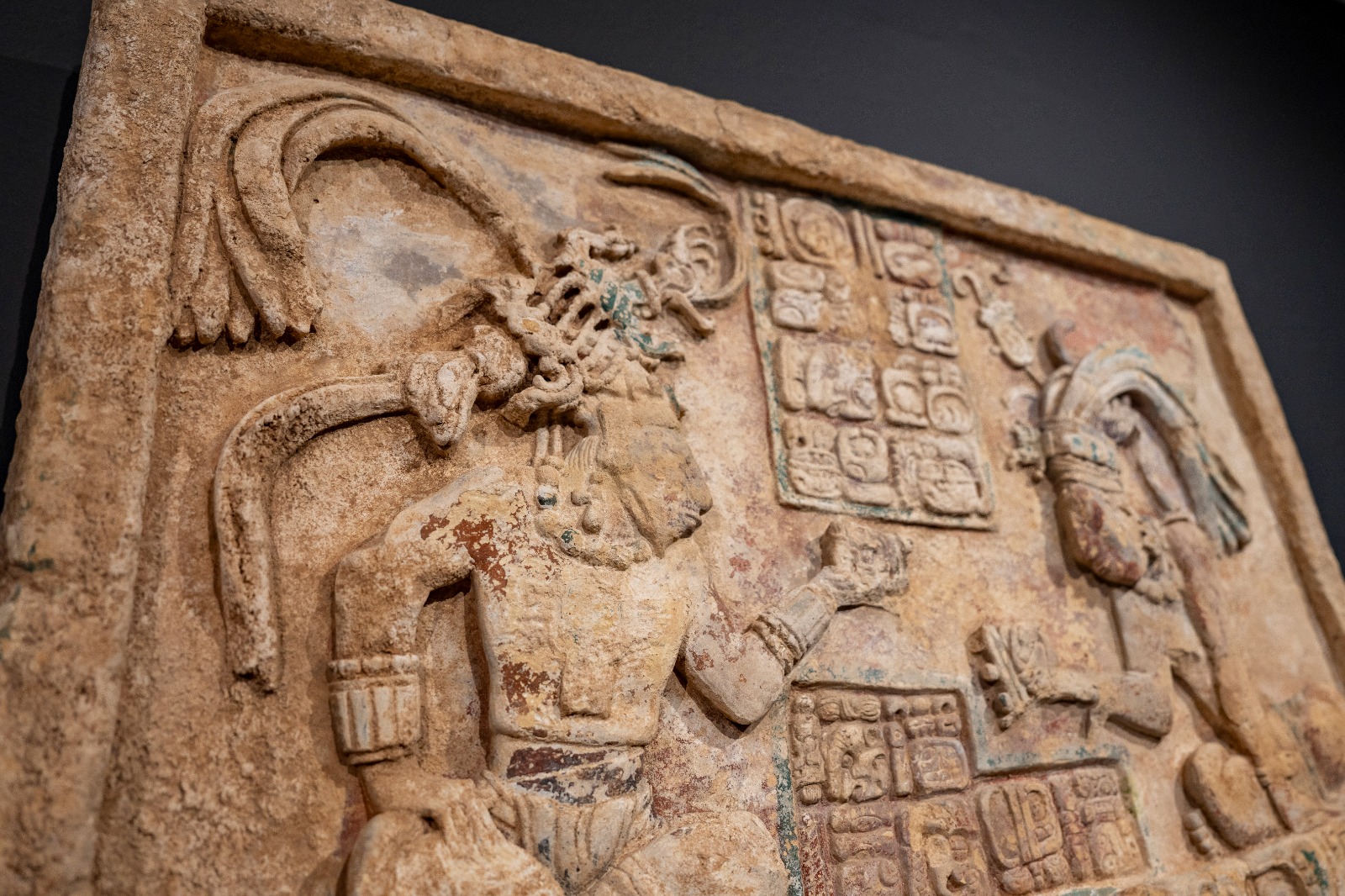
Archaeologists and cultural heritage officials in Central America are closely monitoring developments after a Guatemalan expert suggested that a carved stone lintel recently repatriated to Mexico may actually originate from Guatemala, not Mexico as initially believed. The artifact, which features intricate Maya glyphs and iconography, was formally handed over by U.S. Authorities in Fort Worth, Texas, during a ceremony attended by representatives from Mexico’s National Institute of Anthropology and History (INAH). However, questions about its true provenance have emerged following analysis by Dr. Edgar Houston, a specialist in Maya epigraphy based in Guatemala City.
According to Houston, who spoke with Prensa Libre, the lintel’s stylistic elements, glyphic syntax, and stone composition align more closely with monuments from the Petén region of northern Guatemala than with known sites in southern Mexico. He noted that the artifact’s iconography includes references to a ruler whose name appears in inscriptions from the Classic Period city of El Perú-Waka’, a major Maya center located in Guatemala’s Laguna del Tigre National Park. If confirmed, this would suggest the lintel was illegally removed from Guatemalan territory at some point during the 20th century, a period marked by widespread looting of archaeological sites during regional conflicts.
The repatriation from the United States to Mexico was framed as a bilateral cultural cooperation success, with U.S. Immigration and Customs Enforcement (ICE) stating the artifact had been seized during an investigation into illicit antiquities trafficking. ICE officials said the lintel was intercepted in 2021 at Dallas/Fort Worth International Airport after being misdeclared as a decorative stone panel. It had been destined for a private collector in Houston, Texas, before federal agents intervened under the Convention on Cultural Property Implementation Act, which enforces UNESCO’s 1970 treaty on the prevention of illicit import, export, and transfer of ownership of cultural property.
Guatemalan authorities have not yet formally claimed the artifact, but officials from the Ministry of Culture and Sports said they are reviewing the evidence presented by Houston and consulting with INAH to determine the appropriate next steps. “We accept any claim regarding our cultural patrimony exceptionally seriously,” said a spokesperson for the ministry, who requested not to be named pending ongoing consultations. “If there is credible evidence that this lintel originated in Guatemala, we will pursue all available diplomatic and legal channels to ensure its proper restitution.”
Experts emphasize that distinguishing between Maya artifacts from Guatemala and Mexico requires careful analysis, as the Maya civilization spanned both modern nations and shared artistic traditions. However, subtle differences in glyphic syntax, preferred stone types, and regional iconographic motifs can help pinpoint origin. Houston pointed to the lintel’s use of a specific variant of the Maya Long Count calendar notation, which is more commonly found in inscriptions from the Usumacinta River basin — a region that straddles both countries but contains a higher density of known Guatemalan sites.
INAH has not disputed the possibility of Guatemalan origin but maintains that, based on current research, the artifact is consistent with styles found in the Maya Lowlands of Campeche and Quintana Roo, Mexican states that were home to influential city-states like Calakmul and Becán. INAH officials said they welcome scholarly dialogue and are open to re-evaluating the artifact’s provenance if new evidence emerges.
The case highlights ongoing challenges in the global effort to combat the illegal trade of cultural heritage. According to UNESCO, looting and illicit trafficking of archaeological artifacts remain significant threats to cultural memory, particularly in regions with rich pre-Columbian histories like Mesoamerica. The organization estimates that up to 90% of some archaeological sites in Latin America have been disturbed by looters, fueling a black market that often funnels artifacts through transit countries before reaching collectors in Europe, North America, and Asia.
For now, the lintel remains in Mexico City, where it is undergoing further analysis at INAH’s restoration laboratories. Both Mexican and Guatemalan experts have called for increased regional cooperation in provenance research, including shared databases of known looted artifacts and joint training programs for customs officials. As investigations continue, the artifact sits at the center of a broader conversation about ownership, identity, and the ethical stewardship of ancient heritage in a post-colonial world.
What Happens Next in the Provenance Review
Officials from Guatemala’s Ministry of Culture and Sports said they are preparing a formal technical report based on Houston’s findings and will submit it to INAH through diplomatic channels in the coming weeks. There is no fixed timeline for a response, but both countries have previously collaborated on similar cases, including the 2021 return of a Maya altar fragment looted from El Mirador and recovered in Switzerland. That artifact was ultimately returned to Guatemala after joint analysis confirmed its origin.
Any decision regarding the lintel’s future will likely depend on bilateral agreements between Mexico and Guatemala, as well as consultations with indigenous Maya communities who consider such artifacts ancestral patrimony. Neither country has announced plans for a public hearing or international tribunal referral at this stage.
Readers interested in following developments can monitor official updates from Guatemala’s Ministry of Culture and Sports and Mexico’s National Institute of Anthropology and History, both of which periodically publish statements on cultural restitution cases.
Worth a look